

8 Industry 4.0 in Welding
285
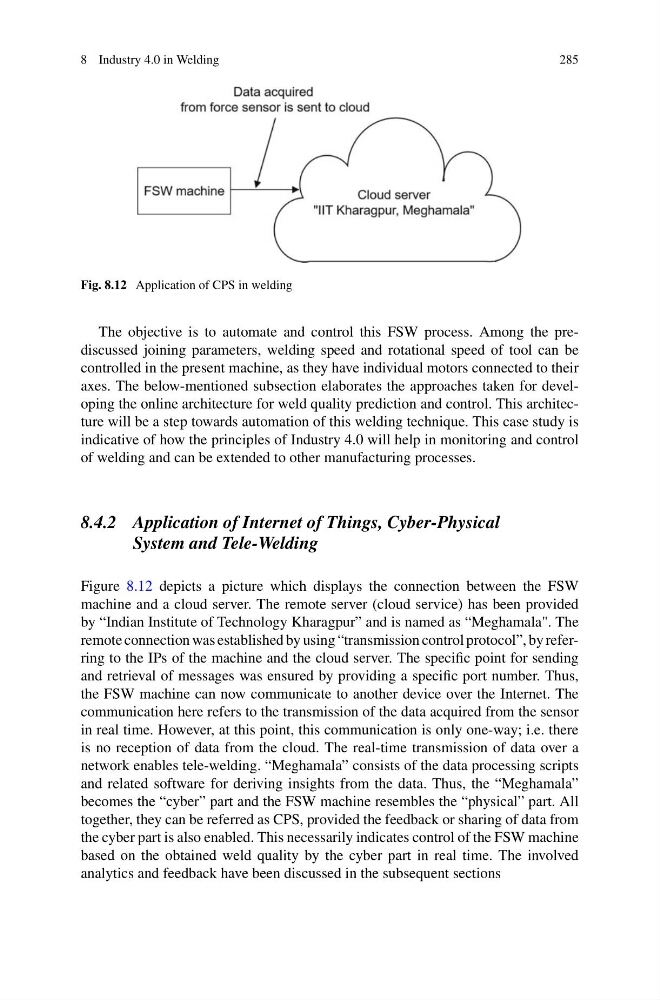
Fig. 8.12 Application of CPS in welding
The objective is to automate and control this FSW process. Among the prediscussed joining parameters, welding speed and rotational speed of tool can be
controlled in the present machine, as they have individual motors connected to their
axes. The below-mentioned subsection elaborates the approaches taken for developing the online architecture for weld quality prediction and control. This architecture will be a step towards automation of this welding technique. This case study is
indicative of how the principles of Industry 4.0 will help in monitoring and control
of welding and can be extended to other manufacturing processes.
8.4.2 Application of Internet of Things, Cyber-Physical
System and Tele-Welding
Figure 8.12 depicts a picture which displays the connection between the FSW
machine and a cloud server. The remote server (cloud service) has been provided
by “Indian Institute of Technology Kharagpur” and is named as “Meghamala". The
remote connection was established by using “transmission control protocol”, by referring to the IPs of the machine and the cloud server. The specific point for sending
and retrieval of messages was ensured by providing a specific port number. Thus,
the FSW machine can now communicate to another device over the Internet. The
communication here refers to the transmission of the data acquired from the sensor
in real time. However, at this point, this communication is only one-way; i.e. there
is no reception of data from the cloud. The real-time transmission of data over a
network enables tele-welding. “Meghamala” consists of the data processing scripts
and related software for deriving insights from the data. Thus, the “Meghamala”
becomes the “cyber” part and the FSW machine resembles the “physical” part. All
together, they can be referred as CPS, provided the feedback or sharing of data from
the cyber part is also enabled. This necessarily indicates control of the FSW machine
based on the obtained weld quality by the cyber part in real time. The involved
analytics and feedback have been discussed in the subsequent sections
285
Fig. 8.12 Application of CPS in welding
The objective is to automate and control this FSW process. Among the prediscussed joining parameters, welding speed and rotational speed of tool can be
controlled in the present machine, as they have individual motors connected to their
axes. The below-mentioned subsection elaborates the approaches taken for developing the online architecture for weld quality prediction and control. This architecture will be a step towards automation of this welding technique. This case study is
indicative of how the principles of Industry 4.0 will help in monitoring and control
of welding and can be extended to other manufacturing processes.
8.4.2 Application of Internet of Things, Cyber-Physical
System and Tele-Welding
Figure 8.12 depicts a picture which displays the connection between the FSW
machine and a cloud server. The remote server (cloud service) has been provided
by “Indian Institute of Technology Kharagpur” and is named as “Meghamala". The
remote connection was established by using “transmission control protocol”, by referring to the IPs of the machine and the cloud server. The specific point for sending
and retrieval of messages was ensured by providing a specific port number. Thus,
the FSW machine can now communicate to another device over the Internet. The
communication here refers to the transmission of the data acquired from the sensor
in real time. However, at this point, this communication is only one-way; i.e. there
is no reception of data from the cloud. The real-time transmission of data over a
network enables tele-welding. “Meghamala” consists of the data processing scripts
and related software for deriving insights from the data. Thus, the “Meghamala”
becomes the “cyber” part and the FSW machine resembles the “physical” part. All
together, they can be referred as CPS, provided the feedback or sharing of data from
the cyber part is also enabled. This necessarily indicates control of the FSW machine
based on the obtained weld quality by the cyber part in real time. The involved
analytics and feedback have been discussed in the subsequent sections