

262
D. Mishra et al.
Industry 4.0. Thinking, framing and applying the principles of Industry 4.0 would
be next to impossible without electronics.
Before utilizing the digital tools and concepts, it is necessary to know the different
techniques being used for automation of welding processes. This understanding and
information will help in appreciating the advantages while implementing Industry
4.0. The next section discusses this in detail.
8.3 Monitoring and Control of Various Welding Techniques
Monitoring refers to the art of “state estimation”, i.e. determining few characteristics in a process to make useful decisions. So, it is imperative to understand how
monitoring can be conducted in a manufacturing process.
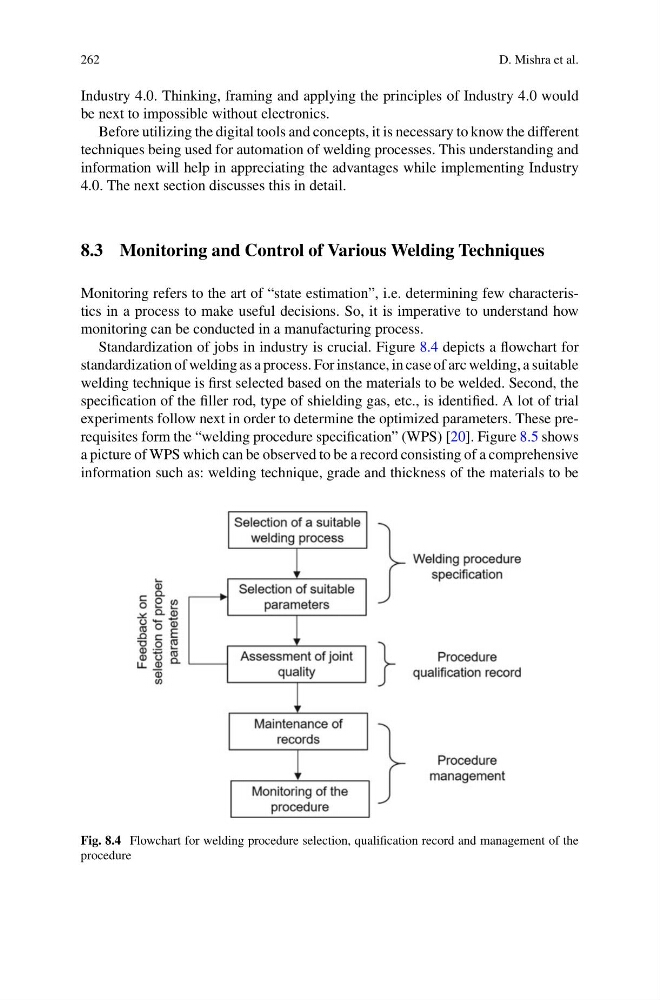
Standardization of jobs in industry is crucial. Figure 8.4 depicts a flowchart for
standardization of welding as a process. For instance, in case of arc welding, a suitable
welding technique is first selected based on the materials to be welded. Second, the
specification of the filler rod, type of shielding gas, etc., is identified. A lot of trial
experiments follow next in order to determine the optimized parameters. These prerequisites form the “welding procedure specification” (WPS) [20]. Figure 8.5 shows
a picture of WPS which can be observed to be a record consisting of a comprehensive
information such as: welding technique, grade and thickness of the materials to be
Fig. 8.4 Flowchart for welding procedure selection, qualification record and management of the
procedure
D. Mishra et al.
Industry 4.0. Thinking, framing and applying the principles of Industry 4.0 would
be next to impossible without electronics.
Before utilizing the digital tools and concepts, it is necessary to know the different
techniques being used for automation of welding processes. This understanding and
information will help in appreciating the advantages while implementing Industry
4.0. The next section discusses this in detail.
8.3 Monitoring and Control of Various Welding Techniques
Monitoring refers to the art of “state estimation”, i.e. determining few characteristics in a process to make useful decisions. So, it is imperative to understand how
monitoring can be conducted in a manufacturing process.
Standardization of jobs in industry is crucial. Figure 8.4 depicts a flowchart for
standardization of welding as a process. For instance, in case of arc welding, a suitable
welding technique is first selected based on the materials to be welded. Second, the
specification of the filler rod, type of shielding gas, etc., is identified. A lot of trial
experiments follow next in order to determine the optimized parameters. These prerequisites form the “welding procedure specification” (WPS) [20]. Figure 8.5 shows
a picture of WPS which can be observed to be a record consisting of a comprehensive
information such as: welding technique, grade and thickness of the materials to be
Fig. 8.4 Flowchart for welding procedure selection, qualification record and management of the
procedure