

7 Tubular Structures: Welding Difficulty and Potential …
249
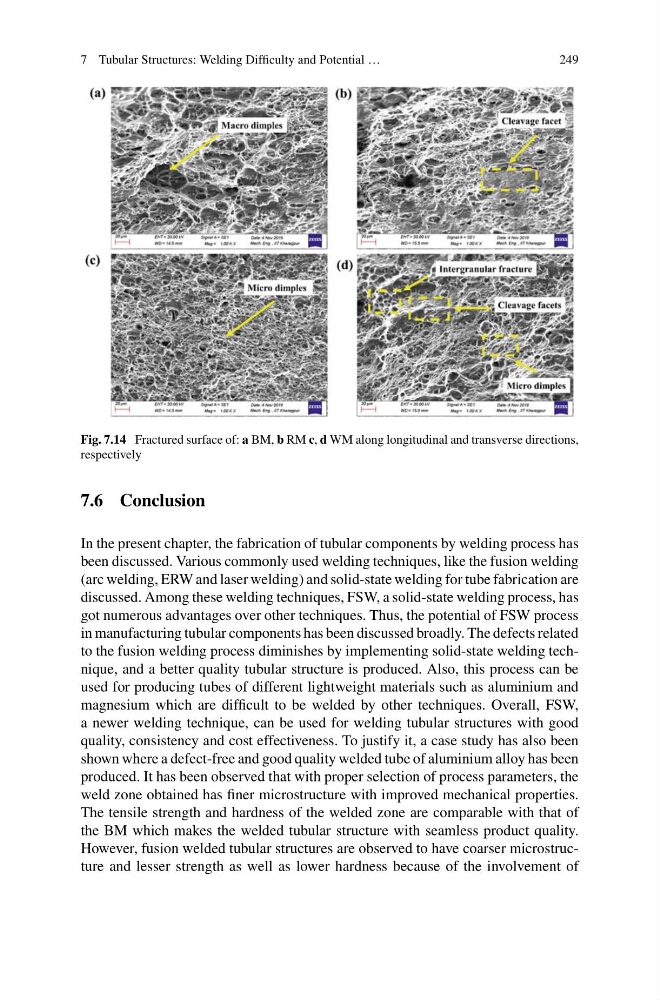
Fig. 7.14 Fractured surface of: a BM, b RM c, d WM along longitudinal and transverse directions,
respectively
7.6 Conclusion
In the present chapter, the fabrication of tubular components by welding process has
been discussed. Various commonly used welding techniques, like the fusion welding
(arc welding, ERW and laser welding) and solid-state welding for tube fabrication are
discussed. Among these welding techniques, FSW, a solid-state welding process, has
got numerous advantages over other techniques. Thus, the potential of FSW process
in manufacturing tubular components has been discussed broadly. The defects related
to the fusion welding process diminishes by implementing solid-state welding technique, and a better quality tubular structure is produced. Also, this process can be
used for producing tubes of different lightweight materials such as aluminium and
magnesium which are difficult to be welded by other techniques. Overall, FSW,
a newer welding technique, can be used for welding tubular structures with good
quality, consistency and cost effectiveness. To justify it, a case study has also been
shown where a defect-free and good quality welded tube of aluminium alloy has been
produced. It has been observed that with proper selection of process parameters, the
weld zone obtained has finer microstructure with improved mechanical properties.
The tensile strength and hardness of the welded zone are comparable with that of
the BM which makes the welded tubular structure with seamless product quality.
However, fusion welded tubular structures are observed to have coarser microstructure and lesser strength as well as lower hardness because of the involvement of
249
Fig. 7.14 Fractured surface of: a BM, b RM c, d WM along longitudinal and transverse directions,
respectively
7.6 Conclusion
In the present chapter, the fabrication of tubular components by welding process has
been discussed. Various commonly used welding techniques, like the fusion welding
(arc welding, ERW and laser welding) and solid-state welding for tube fabrication are
discussed. Among these welding techniques, FSW, a solid-state welding process, has
got numerous advantages over other techniques. Thus, the potential of FSW process
in manufacturing tubular components has been discussed broadly. The defects related
to the fusion welding process diminishes by implementing solid-state welding technique, and a better quality tubular structure is produced. Also, this process can be
used for producing tubes of different lightweight materials such as aluminium and
magnesium which are difficult to be welded by other techniques. Overall, FSW,
a newer welding technique, can be used for welding tubular structures with good
quality, consistency and cost effectiveness. To justify it, a case study has also been
shown where a defect-free and good quality welded tube of aluminium alloy has been
produced. It has been observed that with proper selection of process parameters, the
weld zone obtained has finer microstructure with improved mechanical properties.
The tensile strength and hardness of the welded zone are comparable with that of
the BM which makes the welded tubular structure with seamless product quality.
However, fusion welded tubular structures are observed to have coarser microstructure and lesser strength as well as lower hardness because of the involvement of