

5 Welding of Dissimilar Metals—Challenges and a Way Forward …
181
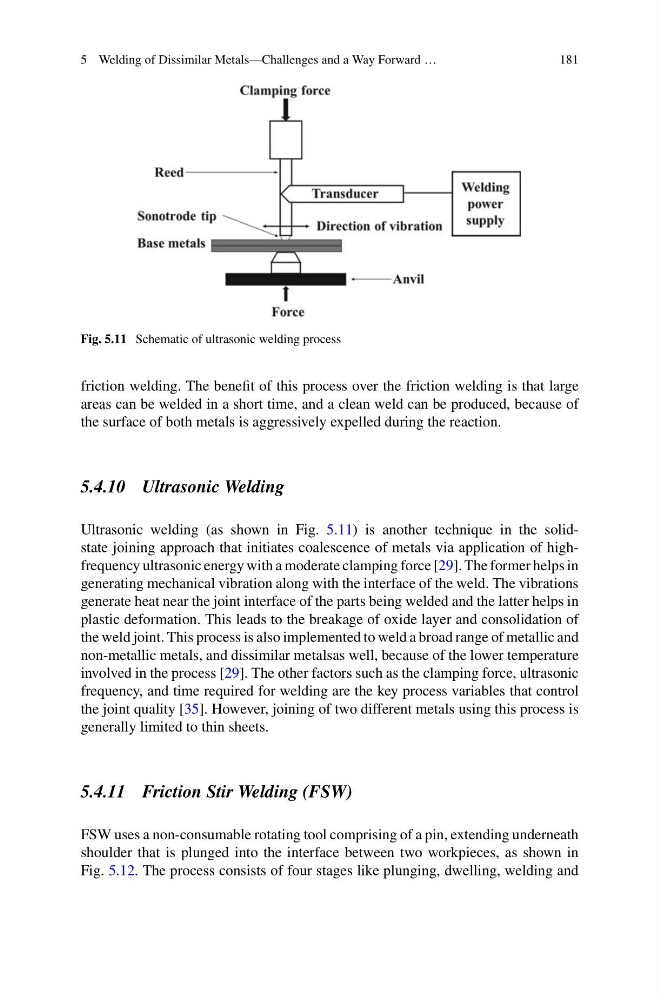
Fig. 5.11 Schematic of ultrasonic welding process
friction welding. The benefit of this process over the friction welding is that large
areas can be welded in a short time, and a clean weld can be produced, because of
the surface of both metals is aggressively expelled during the reaction.
5.4.10 Ultrasonic Welding
Ultrasonic welding (as shown in Fig. 5.11) is another technique in the solidstate joining approach that initiates coalescence of metals via application of highfrequency ultrasonic energy with a moderate clamping force [29]. The former helps in
generating mechanical vibration along with the interface of the weld. The vibrations
generate heat near the joint interface of the parts being welded and the latter helps in
plastic deformation. This leads to the breakage of oxide layer and consolidation of
the weld joint. This process is also implemented to weld a broad range of metallic and
non-metallic metals, and dissimilar metalsas well, because of the lower temperature
involved in the process [29]. The other factors such as the clamping force, ultrasonic
frequency, and time required for welding are the key process variables that control
the joint quality [35]. However, joining of two different metals using this process is
generally limited to thin sheets.
5.4.11 Friction Stir Welding (FSW)
FSW uses a non-consumable rotating tool comprising of a pin, extending underneath
shoulder that is plunged into the interface between two workpieces, as shown in
Fig. 5.12. The process consists of four stages like plunging, dwelling, welding and
181
Fig. 5.11 Schematic of ultrasonic welding process
friction welding. The benefit of this process over the friction welding is that large
areas can be welded in a short time, and a clean weld can be produced, because of
the surface of both metals is aggressively expelled during the reaction.
5.4.10 Ultrasonic Welding
Ultrasonic welding (as shown in Fig. 5.11) is another technique in the solidstate joining approach that initiates coalescence of metals via application of highfrequency ultrasonic energy with a moderate clamping force [29]. The former helps in
generating mechanical vibration along with the interface of the weld. The vibrations
generate heat near the joint interface of the parts being welded and the latter helps in
plastic deformation. This leads to the breakage of oxide layer and consolidation of
the weld joint. This process is also implemented to weld a broad range of metallic and
non-metallic metals, and dissimilar metalsas well, because of the lower temperature
involved in the process [29]. The other factors such as the clamping force, ultrasonic
frequency, and time required for welding are the key process variables that control
the joint quality [35]. However, joining of two different metals using this process is
generally limited to thin sheets.
5.4.11 Friction Stir Welding (FSW)
FSW uses a non-consumable rotating tool comprising of a pin, extending underneath
shoulder that is plunged into the interface between two workpieces, as shown in
Fig. 5.12. The process consists of four stages like plunging, dwelling, welding and