

180
S. Sahu et al.
dissimilar materials. These benefits include the absence of porosity, hot cracking,
and segregation. The other advantages of this process are the formation of refined
microstructure and low distortion of workpiece. But the method has limitations with
respect to joint configuration. It requires at least one of the workpieces to be of
circular in cross-section [30]. These parameters majorly govern the formation of
IMCs which is directly influenced by heat generation. The variations in the formation of the IMCs affect different mechanical properties specifically being the tensile
strength and the hardness. The excessive friction at high rotational speed generates
a greater amount of heat which ultimately substantiates the formation of the IMCs
thereby deteriorating different mechanical properties [31, 32].
5.4.9 Explosive Welding
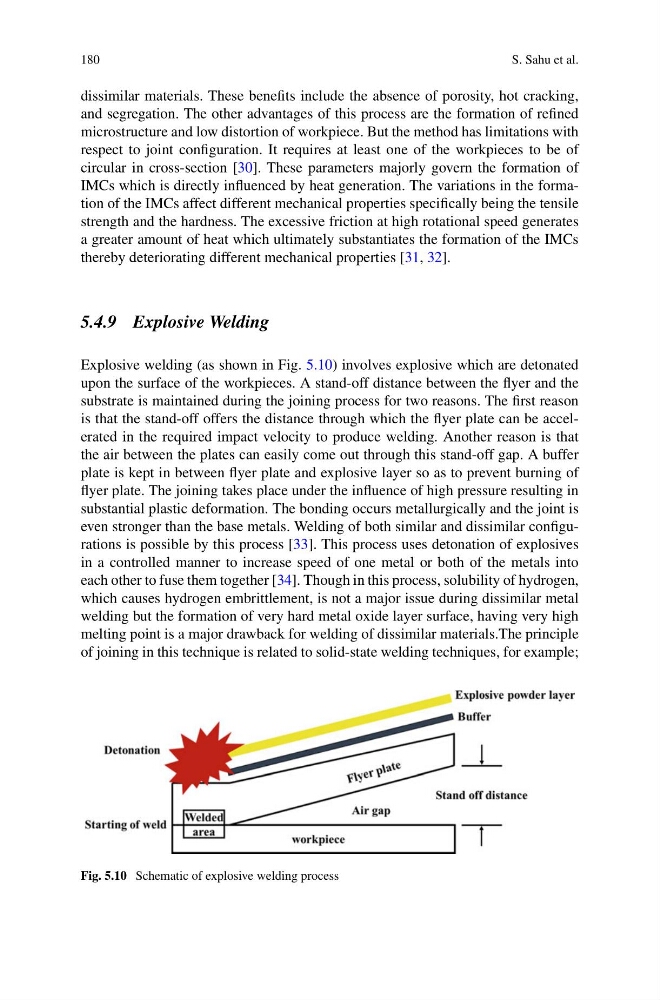
Explosive welding (as shown in Fig. 5.10) involves explosive which are detonated
upon the surface of the workpieces. A stand-off distance between the flyer and the
substrate is maintained during the joining process for two reasons. The first reason
is that the stand-off offers the distance through which the flyer plate can be accelerated in the required impact velocity to produce welding. Another reason is that
the air between the plates can easily come out through this stand-off gap. A buffer
plate is kept in between flyer plate and explosive layer so as to prevent burning of
flyer plate. The joining takes place under the influence of high pressure resulting in
substantial plastic deformation. The bonding occurs metallurgically and the joint is
even stronger than the base metals. Welding of both similar and dissimilar configurations is possible by this process [33]. This process uses detonation of explosives
in a controlled manner to increase speed of one metal or both of the metals into
each other to fuse them together [34]. Though in this process, solubility of hydrogen,
which causes hydrogen embrittlement, is not a major issue during dissimilar metal
welding but the formation of very hard metal oxide layer surface, having very high
melting point is a major drawback for welding of dissimilar materials.The principle
of joining in this technique is related to solid-state welding techniques, for example;
Fig. 5.10 Schematic of explosive welding process
S. Sahu et al.
dissimilar materials. These benefits include the absence of porosity, hot cracking,
and segregation. The other advantages of this process are the formation of refined
microstructure and low distortion of workpiece. But the method has limitations with
respect to joint configuration. It requires at least one of the workpieces to be of
circular in cross-section [30]. These parameters majorly govern the formation of
IMCs which is directly influenced by heat generation. The variations in the formation of the IMCs affect different mechanical properties specifically being the tensile
strength and the hardness. The excessive friction at high rotational speed generates
a greater amount of heat which ultimately substantiates the formation of the IMCs
thereby deteriorating different mechanical properties [31, 32].
5.4.9 Explosive Welding
Explosive welding (as shown in Fig. 5.10) involves explosive which are detonated
upon the surface of the workpieces. A stand-off distance between the flyer and the
substrate is maintained during the joining process for two reasons. The first reason
is that the stand-off offers the distance through which the flyer plate can be accelerated in the required impact velocity to produce welding. Another reason is that
the air between the plates can easily come out through this stand-off gap. A buffer
plate is kept in between flyer plate and explosive layer so as to prevent burning of
flyer plate. The joining takes place under the influence of high pressure resulting in
substantial plastic deformation. The bonding occurs metallurgically and the joint is
even stronger than the base metals. Welding of both similar and dissimilar configurations is possible by this process [33]. This process uses detonation of explosives
in a controlled manner to increase speed of one metal or both of the metals into
each other to fuse them together [34]. Though in this process, solubility of hydrogen,
which causes hydrogen embrittlement, is not a major issue during dissimilar metal
welding but the formation of very hard metal oxide layer surface, having very high
melting point is a major drawback for welding of dissimilar materials.The principle
of joining in this technique is related to solid-state welding techniques, for example;
Fig. 5.10 Schematic of explosive welding process