

5 Welding of Dissimilar Metals—Challenges and a Way Forward …
179
resulting in uncontrollable fusion of the two metals, formation of welding defects
such as porosity because of rapid solidification, and high cost of the equipment [28].
The welding of dissimilar metals by using the aforementioned fusion welding
methods may be challenging because of: large variance in the physical properties of
the dissimilar metals with respect to the heat available, and cooling rate of the welds.
The formation of more number of brittle IMCs and thicker IMC layer as a result
of the greater heat input in case of the fusion welding methods, further reduces the
end quality of the weld. Thus, to overcome the difficulties associated in the abovediscussed fusion welding techniques, an alternate to this is a solid-state welding
method.
5.4.8 Friction Welding
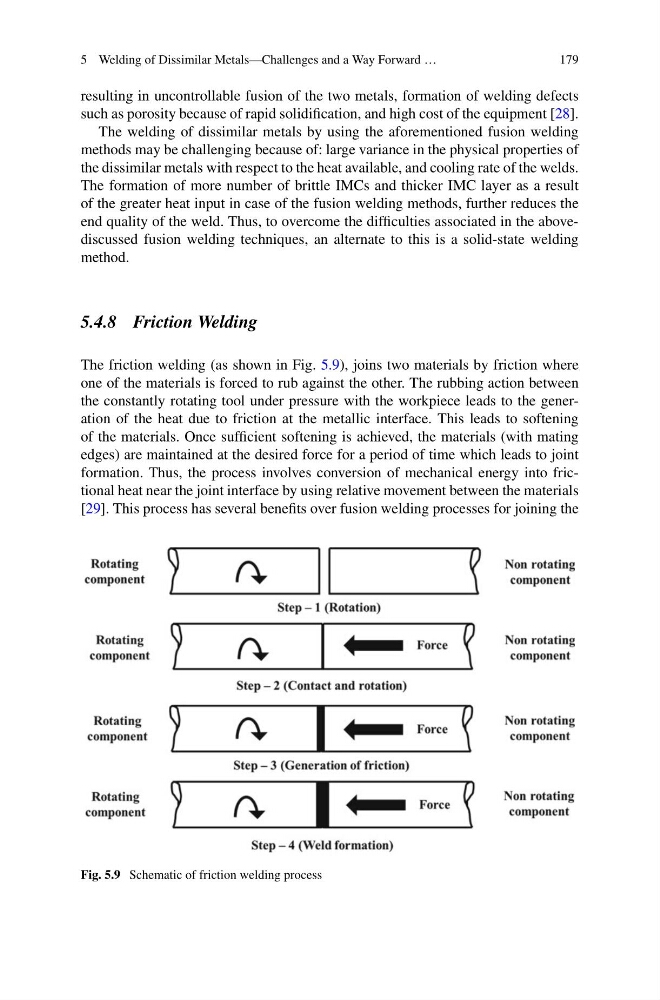
The friction welding (as shown in Fig. 5.9), joins two materials by friction where
one of the materials is forced to rub against the other. The rubbing action between
the constantly rotating tool under pressure with the workpiece leads to the generation of the heat due to friction at the metallic interface. This leads to softening
of the materials. Once sufficient softening is achieved, the materials (with mating
edges) are maintained at the desired force for a period of time which leads to joint
formation. Thus, the process involves conversion of mechanical energy into frictional heat near the joint interface by using relative movement between the materials
[29]. This process has several benefits over fusion welding processes for joining the
Fig. 5.9 Schematic of friction welding process
179
resulting in uncontrollable fusion of the two metals, formation of welding defects
such as porosity because of rapid solidification, and high cost of the equipment [28].
The welding of dissimilar metals by using the aforementioned fusion welding
methods may be challenging because of: large variance in the physical properties of
the dissimilar metals with respect to the heat available, and cooling rate of the welds.
The formation of more number of brittle IMCs and thicker IMC layer as a result
of the greater heat input in case of the fusion welding methods, further reduces the
end quality of the weld. Thus, to overcome the difficulties associated in the abovediscussed fusion welding techniques, an alternate to this is a solid-state welding
method.
5.4.8 Friction Welding
The friction welding (as shown in Fig. 5.9), joins two materials by friction where
one of the materials is forced to rub against the other. The rubbing action between
the constantly rotating tool under pressure with the workpiece leads to the generation of the heat due to friction at the metallic interface. This leads to softening
of the materials. Once sufficient softening is achieved, the materials (with mating
edges) are maintained at the desired force for a period of time which leads to joint
formation. Thus, the process involves conversion of mechanical energy into frictional heat near the joint interface by using relative movement between the materials
[29]. This process has several benefits over fusion welding processes for joining the
Fig. 5.9 Schematic of friction welding process