

178
S. Sahu et al.
the contrary, metals possessing higher degree of thermal conductivity generally have
low absorptivity. Porosity is a commonly associated drawback in laser welds, mainly
those involving partial penetration. The higher rate of solidification in the weld bead
and the complexity in the formation of the keyhole become the important traits that
exacerbate the problem compared to the conventional fusion welding methods.
5.4.7 Electron Beam Welding (EBW)
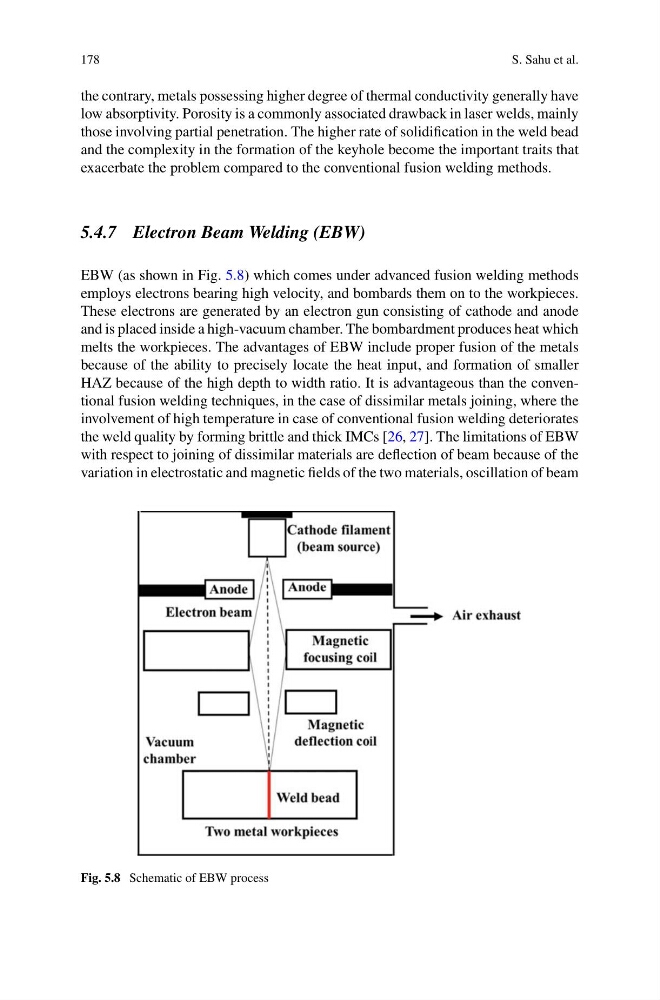
EBW (as shown in Fig. 5.8) which comes under advanced fusion welding methods
employs electrons bearing high velocity, and bombards them on to the workpieces.
These electrons are generated by an electron gun consisting of cathode and anode
and is placed inside a high-vacuum chamber. The bombardment produces heat which
melts the workpieces. The advantages of EBW include proper fusion of the metals
because of the ability to precisely locate the heat input, and formation of smaller
HAZ because of the high depth to width ratio. It is advantageous than the conventional fusion welding techniques, in the case of dissimilar metals joining, where the
involvement of high temperature in case of conventional fusion welding deteriorates
the weld quality by forming brittle and thick IMCs [26, 27]. The limitations of EBW
with respect to joining of dissimilar materials are deflection of beam because of the
variation in electrostatic and magnetic fields of the two materials, oscillation of beam
Fig. 5.8 Schematic of EBW process
S. Sahu et al.
the contrary, metals possessing higher degree of thermal conductivity generally have
low absorptivity. Porosity is a commonly associated drawback in laser welds, mainly
those involving partial penetration. The higher rate of solidification in the weld bead
and the complexity in the formation of the keyhole become the important traits that
exacerbate the problem compared to the conventional fusion welding methods.
5.4.7 Electron Beam Welding (EBW)
EBW (as shown in Fig. 5.8) which comes under advanced fusion welding methods
employs electrons bearing high velocity, and bombards them on to the workpieces.
These electrons are generated by an electron gun consisting of cathode and anode
and is placed inside a high-vacuum chamber. The bombardment produces heat which
melts the workpieces. The advantages of EBW include proper fusion of the metals
because of the ability to precisely locate the heat input, and formation of smaller
HAZ because of the high depth to width ratio. It is advantageous than the conventional fusion welding techniques, in the case of dissimilar metals joining, where the
involvement of high temperature in case of conventional fusion welding deteriorates
the weld quality by forming brittle and thick IMCs [26, 27]. The limitations of EBW
with respect to joining of dissimilar materials are deflection of beam because of the
variation in electrostatic and magnetic fields of the two materials, oscillation of beam
Fig. 5.8 Schematic of EBW process