

5 Welding of Dissimilar Metals—Challenges and a Way Forward …
177
pole is unfavourable to the metal transfer, as the moving droplets have a tendency to
grow in size which thereby increases the risk of spattering [22–24].
5.4.6 Laser Beam Welding (LBW)
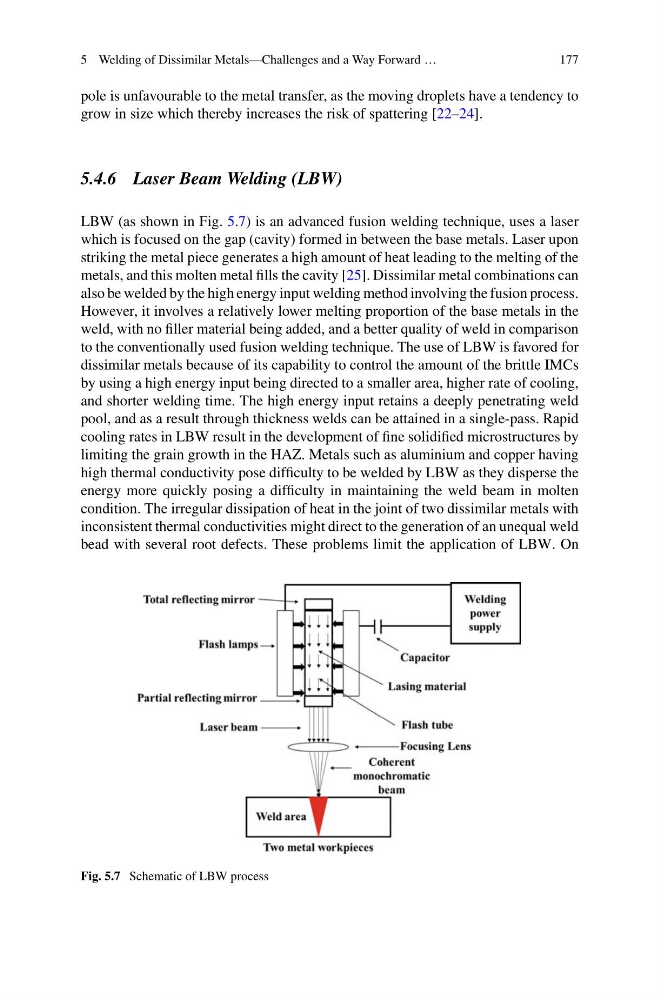
LBW (as shown in Fig. 5.7) is an advanced fusion welding technique, uses a laser
which is focused on the gap (cavity) formed in between the base metals. Laser upon
striking the metal piece generates a high amount of heat leading to the melting of the
metals, and this molten metal fills the cavity [25]. Dissimilar metal combinations can
also be welded by the high energy input welding method involving the fusion process.
However, it involves a relatively lower melting proportion of the base metals in the
weld, with no filler material being added, and a better quality of weld in comparison
to the conventionally used fusion welding technique. The use of LBW is favored for
dissimilar metals because of its capability to control the amount of the brittle IMCs
by using a high energy input being directed to a smaller area, higher rate of cooling,
and shorter welding time. The high energy input retains a deeply penetrating weld
pool, and as a result through thickness welds can be attained in a single-pass. Rapid
cooling rates in LBW result in the development of fine solidified microstructures by
limiting the grain growth in the HAZ. Metals such as aluminium and copper having
high thermal conductivity pose difficulty to be welded by LBW as they disperse the
energy more quickly posing a difficulty in maintaining the weld beam in molten
condition. The irregular dissipation of heat in the joint of two dissimilar metals with
inconsistent thermal conductivities might direct to the generation of an unequal weld
bead with several root defects. These problems limit the application of LBW. On
Fig. 5.7 Schematic of LBW process
177
pole is unfavourable to the metal transfer, as the moving droplets have a tendency to
grow in size which thereby increases the risk of spattering [22–24].
5.4.6 Laser Beam Welding (LBW)
LBW (as shown in Fig. 5.7) is an advanced fusion welding technique, uses a laser
which is focused on the gap (cavity) formed in between the base metals. Laser upon
striking the metal piece generates a high amount of heat leading to the melting of the
metals, and this molten metal fills the cavity [25]. Dissimilar metal combinations can
also be welded by the high energy input welding method involving the fusion process.
However, it involves a relatively lower melting proportion of the base metals in the
weld, with no filler material being added, and a better quality of weld in comparison
to the conventionally used fusion welding technique. The use of LBW is favored for
dissimilar metals because of its capability to control the amount of the brittle IMCs
by using a high energy input being directed to a smaller area, higher rate of cooling,
and shorter welding time. The high energy input retains a deeply penetrating weld
pool, and as a result through thickness welds can be attained in a single-pass. Rapid
cooling rates in LBW result in the development of fine solidified microstructures by
limiting the grain growth in the HAZ. Metals such as aluminium and copper having
high thermal conductivity pose difficulty to be welded by LBW as they disperse the
energy more quickly posing a difficulty in maintaining the weld beam in molten
condition. The irregular dissipation of heat in the joint of two dissimilar metals with
inconsistent thermal conductivities might direct to the generation of an unequal weld
bead with several root defects. These problems limit the application of LBW. On
Fig. 5.7 Schematic of LBW process