

176
S. Sahu et al.
penetration is not achieved. Moreover, joining of alloys of aluminium by using this
method becomes expensive owing to the presence of oxide layer over the surface of
aluminium. This oxide layer has high melting temperature. In order to remove the
oxide layer, wire brushing, or chemical cleaning are performed which adds cost to
the welding [21].
5.4.5 Flux-Cored Arc Welding (FCAW)
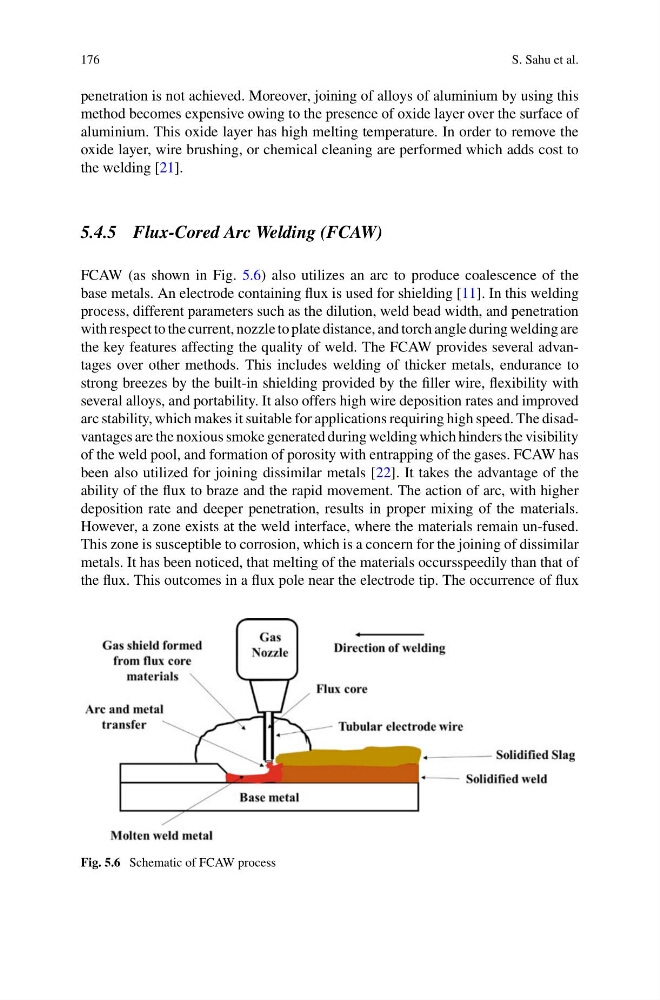
FCAW (as shown in Fig. 5.6) also utilizes an arc to produce coalescence of the
base metals. An electrode containing flux is used for shielding [11]. In this welding
process, different parameters such as the dilution, weld bead width, and penetration
with respect to the current, nozzle to plate distance, and torch angle during welding are
the key features affecting the quality of weld. The FCAW provides several advantages over other methods. This includes welding of thicker metals, endurance to
strong breezes by the built-in shielding provided by the filler wire, flexibility with
several alloys, and portability. It also offers high wire deposition rates and improved
arc stability, which makes it suitable for applications requiring high speed. The disadvantages are the noxious smoke generated during welding which hinders the visibility
of the weld pool, and formation of porosity with entrapping of the gases. FCAW has
been also utilized for joining dissimilar metals [22]. It takes the advantage of the
ability of the flux to braze and the rapid movement. The action of arc, with higher
deposition rate and deeper penetration, results in proper mixing of the materials.
However, a zone exists at the weld interface, where the materials remain un-fused.
This zone is susceptible to corrosion, which is a concern for the joining of dissimilar
metals. It has been noticed, that melting of the materials occursspeedily than that of
the flux. This outcomes in a flux pole near the electrode tip. The occurrence of flux
Fig. 5.6 Schematic of FCAW process
S. Sahu et al.
penetration is not achieved. Moreover, joining of alloys of aluminium by using this
method becomes expensive owing to the presence of oxide layer over the surface of
aluminium. This oxide layer has high melting temperature. In order to remove the
oxide layer, wire brushing, or chemical cleaning are performed which adds cost to
the welding [21].
5.4.5 Flux-Cored Arc Welding (FCAW)
FCAW (as shown in Fig. 5.6) also utilizes an arc to produce coalescence of the
base metals. An electrode containing flux is used for shielding [11]. In this welding
process, different parameters such as the dilution, weld bead width, and penetration
with respect to the current, nozzle to plate distance, and torch angle during welding are
the key features affecting the quality of weld. The FCAW provides several advantages over other methods. This includes welding of thicker metals, endurance to
strong breezes by the built-in shielding provided by the filler wire, flexibility with
several alloys, and portability. It also offers high wire deposition rates and improved
arc stability, which makes it suitable for applications requiring high speed. The disadvantages are the noxious smoke generated during welding which hinders the visibility
of the weld pool, and formation of porosity with entrapping of the gases. FCAW has
been also utilized for joining dissimilar metals [22]. It takes the advantage of the
ability of the flux to braze and the rapid movement. The action of arc, with higher
deposition rate and deeper penetration, results in proper mixing of the materials.
However, a zone exists at the weld interface, where the materials remain un-fused.
This zone is susceptible to corrosion, which is a concern for the joining of dissimilar
metals. It has been noticed, that melting of the materials occursspeedily than that of
the flux. This outcomes in a flux pole near the electrode tip. The occurrence of flux
Fig. 5.6 Schematic of FCAW process