

5 Welding of Dissimilar Metals—Challenges and a Way Forward …
175
because of the dissimilarities in the thermal expansion coefficients of the metals,
precipitation of either of the materials at elevated temperature during heat treatment,
and corrosion of either of materials because of environmental concerns. The other
challenges in this process include porosity, weld spatter, shallow penetration, poor
fusion, and cracking. Excessive heat input into the process causes spattering and
may deflect the arc from the weld pool. This results in welding defects for example
porosity and induces the residual stresses in the weld leading to cracking during
solidification. On the other hand, lower heat input causes improper fusion of the
metals.
5.4.4 Submerged Arc Welding (SAW)
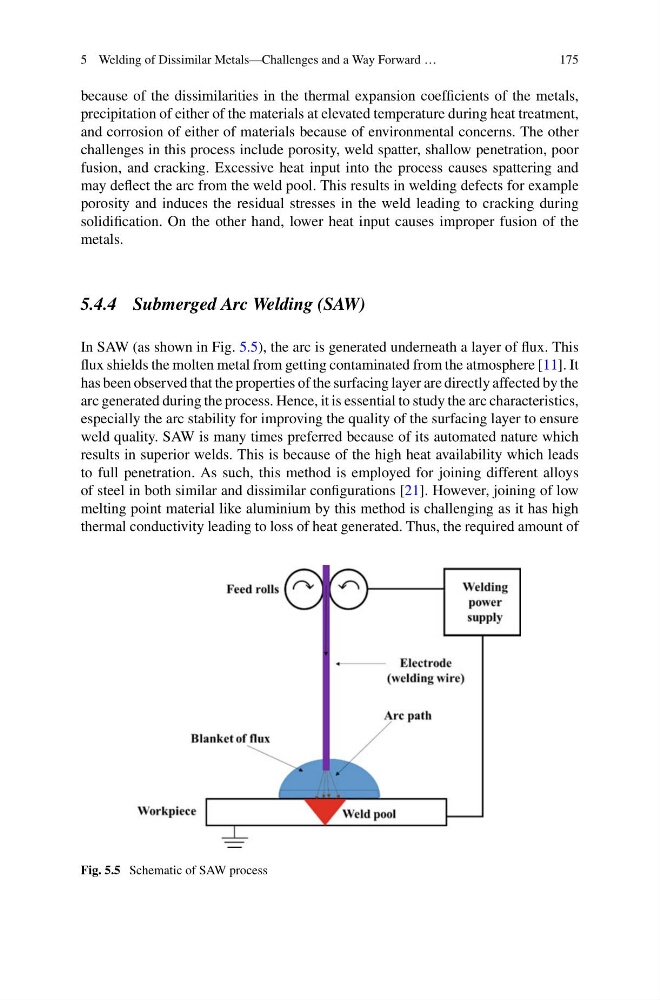
In SAW (as shown in Fig. 5.5), the arc is generated underneath a layer of flux. This
flux shields the molten metal from getting contaminated from the atmosphere [11]. It
has been observed that the properties of the surfacing layer are directly affected by the
arc generated during the process. Hence, it is essential to study the arc characteristics,
especially the arc stability for improving the quality of the surfacing layer to ensure
weld quality. SAW is many times preferred because of its automated nature which
results in superior welds. This is because of the high heat availability which leads
to full penetration. As such, this method is employed for joining different alloys
of steel in both similar and dissimilar configurations [21]. However, joining of low
melting point material like aluminium by this method is challenging as it has high
thermal conductivity leading to loss of heat generated. Thus, the required amount of
Fig. 5.5 Schematic of SAW process
175
because of the dissimilarities in the thermal expansion coefficients of the metals,
precipitation of either of the materials at elevated temperature during heat treatment,
and corrosion of either of materials because of environmental concerns. The other
challenges in this process include porosity, weld spatter, shallow penetration, poor
fusion, and cracking. Excessive heat input into the process causes spattering and
may deflect the arc from the weld pool. This results in welding defects for example
porosity and induces the residual stresses in the weld leading to cracking during
solidification. On the other hand, lower heat input causes improper fusion of the
metals.
5.4.4 Submerged Arc Welding (SAW)
In SAW (as shown in Fig. 5.5), the arc is generated underneath a layer of flux. This
flux shields the molten metal from getting contaminated from the atmosphere [11]. It
has been observed that the properties of the surfacing layer are directly affected by the
arc generated during the process. Hence, it is essential to study the arc characteristics,
especially the arc stability for improving the quality of the surfacing layer to ensure
weld quality. SAW is many times preferred because of its automated nature which
results in superior welds. This is because of the high heat availability which leads
to full penetration. As such, this method is employed for joining different alloys
of steel in both similar and dissimilar configurations [21]. However, joining of low
melting point material like aluminium by this method is challenging as it has high
thermal conductivity leading to loss of heat generated. Thus, the required amount of
Fig. 5.5 Schematic of SAW process