

182
S. Sahu et al.
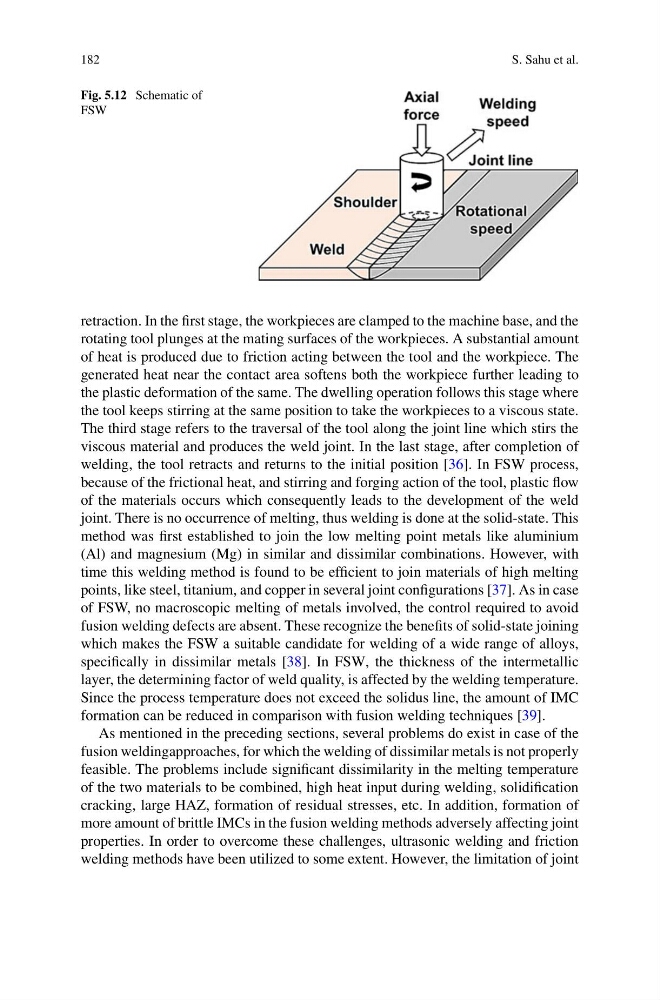
Fig. 5.12 Schematic of
FSW
retraction. In the first stage, the workpieces are clamped to the machine base, and the
rotating tool plunges at the mating surfaces of the workpieces. A substantial amount
of heat is produced due to friction acting between the tool and the workpiece. The
generated heat near the contact area softens both the workpiece further leading to
the plastic deformation of the same. The dwelling operation follows this stage where
the tool keeps stirring at the same position to take the workpieces to a viscous state.
The third stage refers to the traversal of the tool along the joint line which stirs the
viscous material and produces the weld joint. In the last stage, after completion of
welding, the tool retracts and returns to the initial position [36]. In FSW process,
because of the frictional heat, and stirring and forging action of the tool, plastic flow
of the materials occurs which consequently leads to the development of the weld
joint. There is no occurrence of melting, thus welding is done at the solid-state. This
method was first established to join the low melting point metals like aluminium
(Al) and magnesium (Mg) in similar and dissimilar combinations. However, with
time this welding method is found to be efficient to join materials of high melting
points, like steel, titanium, and copper in several joint configurations [37]. As in case
of FSW, no macroscopic melting of metals involved, the control required to avoid
fusion welding defects are absent. These recognize the benefits of solid-state joining
which makes the FSW a suitable candidate for welding of a wide range of alloys,
specifically in dissimilar metals [38]. In FSW, the thickness of the intermetallic
layer, the determining factor of weld quality, is affected by the welding temperature.
Since the process temperature does not exceed the solidus line, the amount of IMC
formation can be reduced in comparison with fusion welding techniques [39].
As mentioned in the preceding sections, several problems do exist in case of the
fusion weldingapproaches, for which the welding of dissimilar metals is not properly
feasible. The problems include significant dissimilarity in the melting temperature
of the two materials to be combined, high heat input during welding, solidification
cracking, large HAZ, formation of residual stresses, etc. In addition, formation of
more amount of brittle IMCs in the fusion welding methods adversely affecting joint
properties. In order to overcome these challenges, ultrasonic welding and friction
welding methods have been utilized to some extent. However, the limitation of joint
S. Sahu et al.
Fig. 5.12 Schematic of
FSW
retraction. In the first stage, the workpieces are clamped to the machine base, and the
rotating tool plunges at the mating surfaces of the workpieces. A substantial amount
of heat is produced due to friction acting between the tool and the workpiece. The
generated heat near the contact area softens both the workpiece further leading to
the plastic deformation of the same. The dwelling operation follows this stage where
the tool keeps stirring at the same position to take the workpieces to a viscous state.
The third stage refers to the traversal of the tool along the joint line which stirs the
viscous material and produces the weld joint. In the last stage, after completion of
welding, the tool retracts and returns to the initial position [36]. In FSW process,
because of the frictional heat, and stirring and forging action of the tool, plastic flow
of the materials occurs which consequently leads to the development of the weld
joint. There is no occurrence of melting, thus welding is done at the solid-state. This
method was first established to join the low melting point metals like aluminium
(Al) and magnesium (Mg) in similar and dissimilar combinations. However, with
time this welding method is found to be efficient to join materials of high melting
points, like steel, titanium, and copper in several joint configurations [37]. As in case
of FSW, no macroscopic melting of metals involved, the control required to avoid
fusion welding defects are absent. These recognize the benefits of solid-state joining
which makes the FSW a suitable candidate for welding of a wide range of alloys,
specifically in dissimilar metals [38]. In FSW, the thickness of the intermetallic
layer, the determining factor of weld quality, is affected by the welding temperature.
Since the process temperature does not exceed the solidus line, the amount of IMC
formation can be reduced in comparison with fusion welding techniques [39].
As mentioned in the preceding sections, several problems do exist in case of the
fusion weldingapproaches, for which the welding of dissimilar metals is not properly
feasible. The problems include significant dissimilarity in the melting temperature
of the two materials to be combined, high heat input during welding, solidification
cracking, large HAZ, formation of residual stresses, etc. In addition, formation of
more amount of brittle IMCs in the fusion welding methods adversely affecting joint
properties. In order to overcome these challenges, ultrasonic welding and friction
welding methods have been utilized to some extent. However, the limitation of joint