

104
N. Bhardwaj et al.
3.3.2 Thermal Modeling
The thermal history of a welding process determines the thermal stresses and
microstructure, which leads to determination of the strength, hardness, fatigue
behavior and elongation of the joined product. As such, modeling of heat source
is an important aspect, and the basics of modeling conduction in moving heat source
is briefly described in this section. A detailed section on thermal modeling of FSW
process is provided later.
The convective diffusion equation is
∂ρu
∂t
+
∂ρhV
∂ x
= ∇ · (k∇T ) + ˙
q,
(3.36)
where ρ represents density, k is the thermal conductivity, u is the internal energy, h is
the enthalpy, ˙
q is volumetric heat source, V is the speed of heat source, and T is the
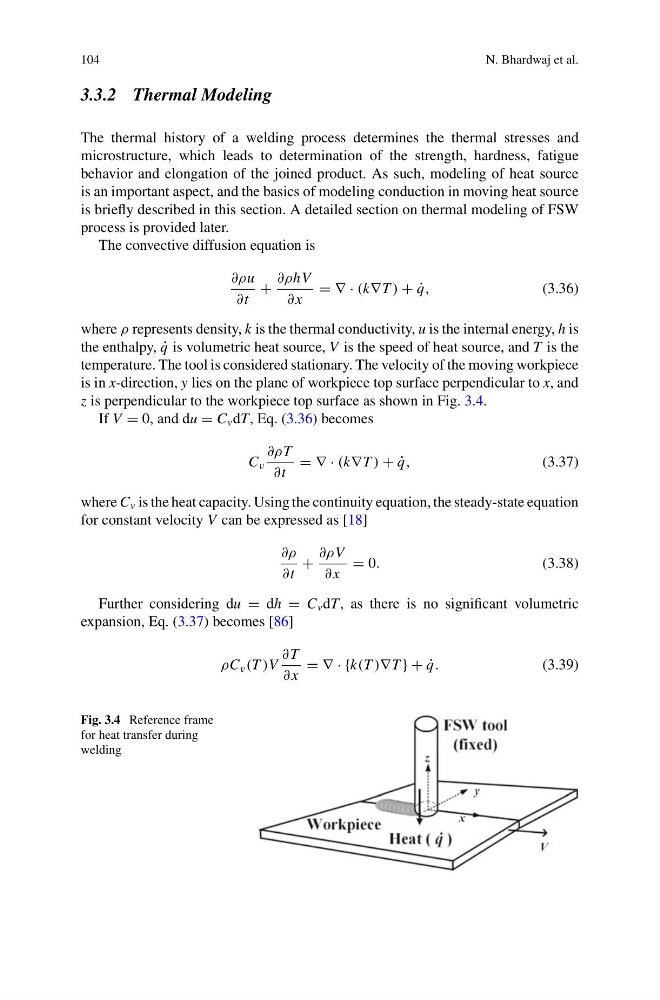
temperature. The tool is considered stationary. The velocity of the moving workpiece
is in x-direction, y lies on the plane of workpiece top surface perpendicular to x, and
z is perpendicular to the workpiece top surface as shown in Fig. 3.4.
If V = 0, and du = C v dT, Eq. (3.36) becomes
C v
∂ρT
∂t
= ∇ · (k∇T ) + ˙
q,
(3.37)
where C v is the heat capacity. Using the continuity equation, the steady-state equation
for constant velocity V can be expressed as [18]
∂ρ
∂t
+
∂ρV
∂ x
= 0.
(3.38)
Further considering du = dh = C v dT, as there is no significant volumetric
expansion, Eq. (3.37) becomes [86]
ρC v (T )V
∂ T
∂ x
= ∇ · {k(T )∇T } + ˙
q.
(3.39)
Fig. 3.4 Reference frame
for heat transfer during
welding
N. Bhardwaj et al.
3.3.2 Thermal Modeling
The thermal history of a welding process determines the thermal stresses and
microstructure, which leads to determination of the strength, hardness, fatigue
behavior and elongation of the joined product. As such, modeling of heat source
is an important aspect, and the basics of modeling conduction in moving heat source
is briefly described in this section. A detailed section on thermal modeling of FSW
process is provided later.
The convective diffusion equation is
∂ρu
∂t
+
∂ρhV
∂ x
= ∇ · (k∇T ) + ˙
q,
(3.36)
where ρ represents density, k is the thermal conductivity, u is the internal energy, h is
the enthalpy, ˙
q is volumetric heat source, V is the speed of heat source, and T is the
temperature. The tool is considered stationary. The velocity of the moving workpiece
is in x-direction, y lies on the plane of workpiece top surface perpendicular to x, and
z is perpendicular to the workpiece top surface as shown in Fig. 3.4.
If V = 0, and du = C v dT, Eq. (3.36) becomes
C v
∂ρT
∂t
= ∇ · (k∇T ) + ˙
q,
(3.37)
where C v is the heat capacity. Using the continuity equation, the steady-state equation
for constant velocity V can be expressed as [18]
∂ρ
∂t
+
∂ρV
∂ x
= 0.
(3.38)
Further considering du = dh = C v dT, as there is no significant volumetric
expansion, Eq. (3.37) becomes [86]
ρC v (T )V
∂ T
∂ x
= ∇ · {k(T )∇T } + ˙
q.
(3.39)
Fig. 3.4 Reference frame
for heat transfer during
welding