

3 Modeling of Friction Stir Welding Processes
103
between material and reference rate of stresses as
∂σ
∂t
x
=
∂σ
∂t
χ
+ (c • ∇)σ .
(3.35)
This approach helps to reduce element distortion in parts undergoing large deformations [52]. Some amount of mesh distortion still occurs in the tool which can be
solved by using adaptive remeshing tools [36]. ALE has been used to model temperature distribution, material flow and residual stresses in friction stir welded joints
[16, 84].
Another approach that takes advantage of the combination of strengths of Eulerian
and Lagrangian approaches is the coupled Eulerian–Lagrangian (CEL) formulation.
In CEL approach, the body undergoing large deformation is meshed exclusively
with Eulerian element, and the stiffer body is meshed exclusively using Lagrangian
elements. In case of FSW, the tool is meshed using Lagrangian elements while the
workpiece is meshed using Eulerian elements. The kinematic constraint for Eulerian
formulation is implemented by using the velocity of the Lagrangian boundary. On
the other hand, surface forces on the Lagrangian domain are calculated using stresses
within the Eulerian cell [8, 9, 15]. In addition to the advantages of ALE, CEL approach
can simulate void formation and defects in FSW [2]. However, this approach is not
widely used since it requires very powerful computational facility [56]. For more
details on the CEL approach, the article by Skrzat [77] may be referred. A comparison
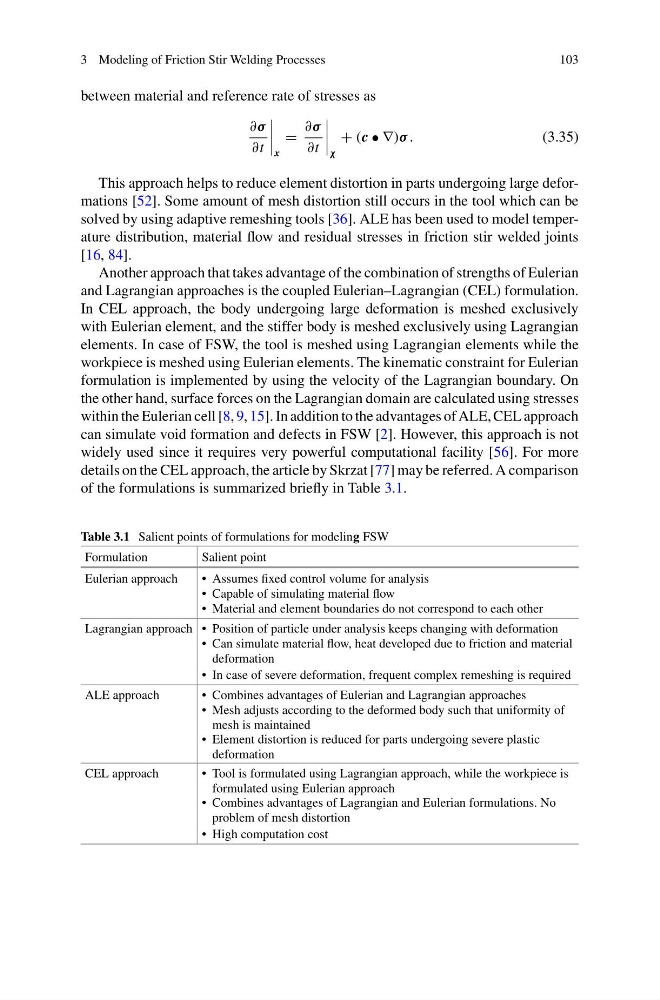
of the formulations is summarized briefly in Table 3.1.
Table 3.1 Salient points of formulations for modeling FSW
Formulation
Salient point
Eulerian approach
• Assumes fixed control volume for analysis
• Capable of simulating material flow
• Material and element boundaries do not correspond to each other
Lagrangian approach • Position of particle under analysis keeps changing with deformation
• Can simulate material flow, heat developed due to friction and material
deformation
• In case of severe deformation, frequent complex remeshing is required
ALE approach
• Combines advantages of Eulerian and Lagrangian approaches
• Mesh adjusts according to the deformed body such that uniformity of
mesh is maintained
• Element distortion is reduced for parts undergoing severe plastic
deformation
CEL approach
• Tool is formulated using Lagrangian approach, while the workpiece is
formulated using Eulerian approach
• Combines advantages of Lagrangian and Eulerian formulations. No
problem of mesh distortion
• High computation cost
103
between material and reference rate of stresses as
∂σ
∂t
x
=
∂σ
∂t
χ
+ (c • ∇)σ .
(3.35)
This approach helps to reduce element distortion in parts undergoing large deformations [52]. Some amount of mesh distortion still occurs in the tool which can be
solved by using adaptive remeshing tools [36]. ALE has been used to model temperature distribution, material flow and residual stresses in friction stir welded joints
[16, 84].
Another approach that takes advantage of the combination of strengths of Eulerian
and Lagrangian approaches is the coupled Eulerian–Lagrangian (CEL) formulation.
In CEL approach, the body undergoing large deformation is meshed exclusively
with Eulerian element, and the stiffer body is meshed exclusively using Lagrangian
elements. In case of FSW, the tool is meshed using Lagrangian elements while the
workpiece is meshed using Eulerian elements. The kinematic constraint for Eulerian
formulation is implemented by using the velocity of the Lagrangian boundary. On
the other hand, surface forces on the Lagrangian domain are calculated using stresses
within the Eulerian cell [8, 9, 15]. In addition to the advantages of ALE, CEL approach
can simulate void formation and defects in FSW [2]. However, this approach is not
widely used since it requires very powerful computational facility [56]. For more
details on the CEL approach, the article by Skrzat [77] may be referred. A comparison
of the formulations is summarized briefly in Table 3.1.
Table 3.1 Salient points of formulations for modeling FSW
Formulation
Salient point
Eulerian approach
• Assumes fixed control volume for analysis
• Capable of simulating material flow
• Material and element boundaries do not correspond to each other
Lagrangian approach • Position of particle under analysis keeps changing with deformation
• Can simulate material flow, heat developed due to friction and material
deformation
• In case of severe deformation, frequent complex remeshing is required
ALE approach
• Combines advantages of Eulerian and Lagrangian approaches
• Mesh adjusts according to the deformed body such that uniformity of
mesh is maintained
• Element distortion is reduced for parts undergoing severe plastic
deformation
CEL approach
• Tool is formulated using Lagrangian approach, while the workpiece is
formulated using Eulerian approach
• Combines advantages of Lagrangian and Eulerian formulations. No
problem of mesh distortion
• High computation cost