

102
N. Bhardwaj et al.
while deformation of the body takes place. In ALE, instead of material configuration, motion is described by the reference configuration in Lagrangian formulation and spatial configuration in Eulerian formulation. It consists of two phases—
Lagrangian phase and Eulerian phase, connected by some convective terms. The
mesh and material movements are identical in Lagrangian phase, while in the Eulerian phase, the mesh undergoes an arbitrary motion independent of material motion
while keeping the mesh undistorted. The approach involves analyzing each time step
by Lagrangian phase until convergence, followed by application of Eulerian phase
to keep mesh configuration undistorted. All the dependent variables (stress, strain,
etc.) are convected through the Eulerian phase since there is relative displacement
between material and mesh.
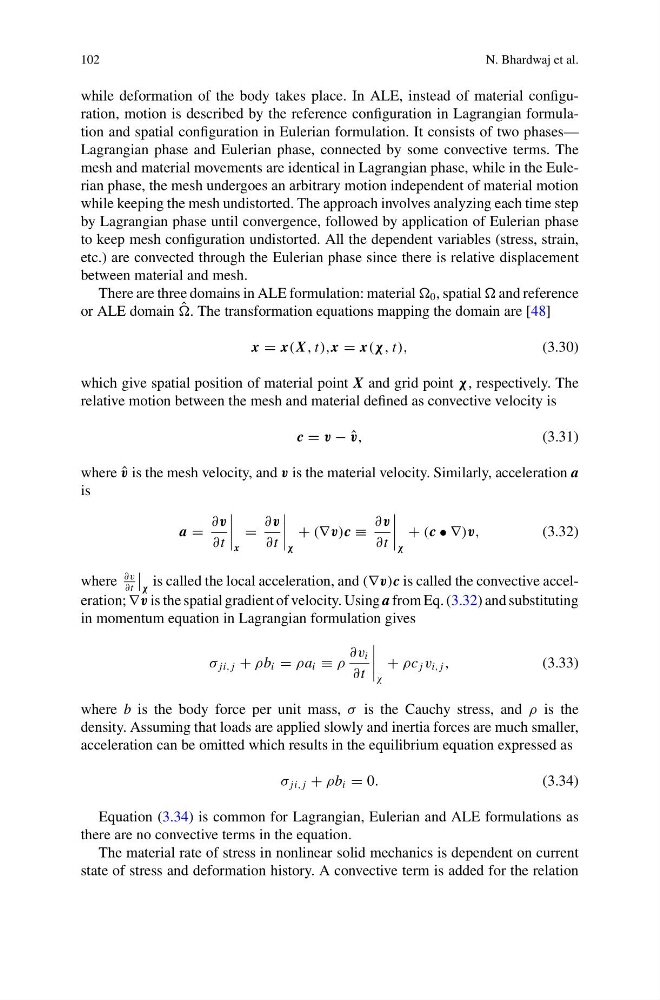
There are three domains in ALE formulation: material 0 , spatial and reference
or ALE domain ˆ
. The transformation equations mapping the domain are [48]
x = x(X, t),x = x(χ, t),
(3.30)
which give spatial position of material point X and grid point χ, respectively. The
relative motion between the mesh and material defined as convective velocity is
c = v − ˆ
v,
(3.31)
where ˆ
v is the mesh velocity, and v is the material velocity. Similarly, acceleration a
is
a =
∂v
∂t
x
=
∂v
∂t
χ
+ (∇v)c ≡
∂v
∂t
χ
+ (c • ∇)v,
(3.32)
where
∂v
∂t
χ is called the local acceleration, and (∇v)c is called the convective acceleration; ∇v is the spatial gradient of velocity. Using a from Eq. (3.32) and substituting
in momentum equation in Lagrangian formulation gives
σ ji, j + ρb i = ρa i ≡ ρ
∂v i
∂t
χ
+ ρc j v i, j ,
(3.33)
where b is the body force per unit mass, σ is the Cauchy stress, and ρ is the
density. Assuming that loads are applied slowly and inertia forces are much smaller,
acceleration can be omitted which results in the equilibrium equation expressed as
σ ji, j + ρb i = 0.
(3.34)
Equation (3.34) is common for Lagrangian, Eulerian and ALE formulations as
there are no convective terms in the equation.
The material rate of stress in nonlinear solid mechanics is dependent on current
state of stress and deformation history. A convective term is added for the relation
N. Bhardwaj et al.
while deformation of the body takes place. In ALE, instead of material configuration, motion is described by the reference configuration in Lagrangian formulation and spatial configuration in Eulerian formulation. It consists of two phases—
Lagrangian phase and Eulerian phase, connected by some convective terms. The
mesh and material movements are identical in Lagrangian phase, while in the Eulerian phase, the mesh undergoes an arbitrary motion independent of material motion
while keeping the mesh undistorted. The approach involves analyzing each time step
by Lagrangian phase until convergence, followed by application of Eulerian phase
to keep mesh configuration undistorted. All the dependent variables (stress, strain,
etc.) are convected through the Eulerian phase since there is relative displacement
between material and mesh.
There are three domains in ALE formulation: material 0 , spatial and reference
or ALE domain ˆ
. The transformation equations mapping the domain are [48]
x = x(X, t),x = x(χ, t),
(3.30)
which give spatial position of material point X and grid point χ, respectively. The
relative motion between the mesh and material defined as convective velocity is
c = v − ˆ
v,
(3.31)
where ˆ
v is the mesh velocity, and v is the material velocity. Similarly, acceleration a
is
a =
∂v
∂t
x
=
∂v
∂t
χ
+ (∇v)c ≡
∂v
∂t
χ
+ (c • ∇)v,
(3.32)
where
∂v
∂t
χ is called the local acceleration, and (∇v)c is called the convective acceleration; ∇v is the spatial gradient of velocity. Using a from Eq. (3.32) and substituting
in momentum equation in Lagrangian formulation gives
σ ji, j + ρb i = ρa i ≡ ρ
∂v i
∂t
χ
+ ρc j v i, j ,
(3.33)
where b is the body force per unit mass, σ is the Cauchy stress, and ρ is the
density. Assuming that loads are applied slowly and inertia forces are much smaller,
acceleration can be omitted which results in the equilibrium equation expressed as
σ ji, j + ρb i = 0.
(3.34)
Equation (3.34) is common for Lagrangian, Eulerian and ALE formulations as
there are no convective terms in the equation.
The material rate of stress in nonlinear solid mechanics is dependent on current
state of stress and deformation history. A convective term is added for the relation