

3 Modeling of Friction Stir Welding Processes
101
t C
E
i jkl =
2v
1 − 2v
Gδ kl δ i j + 2Gδ ik δ jl
(3.27)
3. Updating scheme:
It is important to use the stress tensors in objective form to nullify the effect of
rigid body rotation. The tensors are made objective by making them invariant with
change in reference frame. In case of finite deformation in an updated Lagrangian
formulation, the procedure to convert the stress tensor into objective is given as
t+t
σ = ( t R)
t σ
( t R)
T
+ t σ,
(3.28)
where t R represents a finite incremental form of rotation tensor.
4. Equilibrium equations:
∂
t+t
σ i j
∂ t+t x j
= 0,
(3.29)
where
t+t
σ i j and
t+t x j are stress tensor components and position vectors,
respectively, at updated time.
Both Eulerian and Lagrangian approaches have their own advantages and disadvantages. There have been efforts to combine the advantages of the two formulations
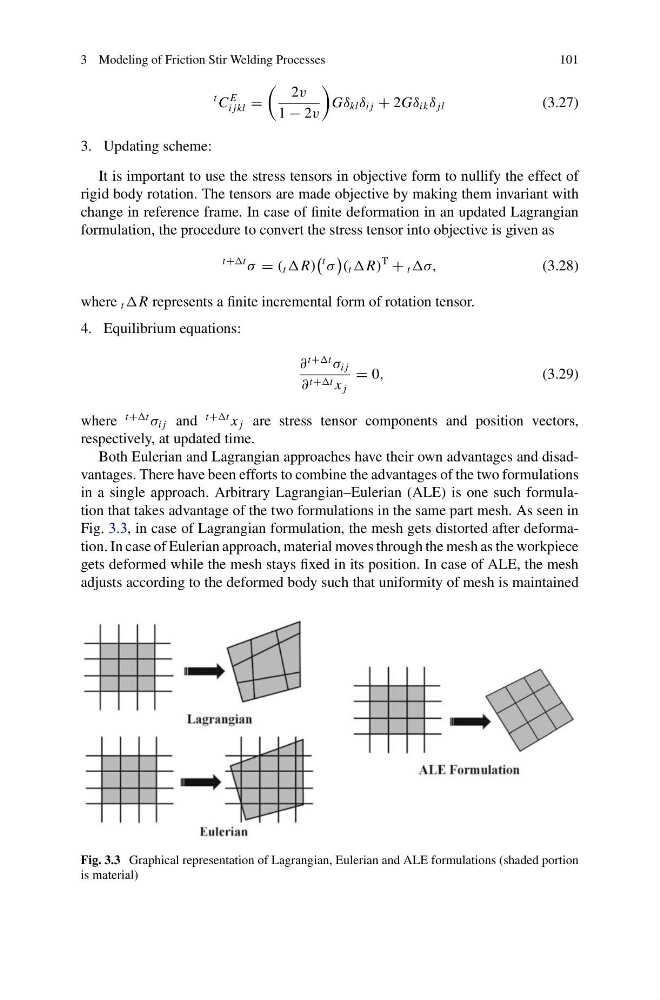
in a single approach. Arbitrary Lagrangian–Eulerian (ALE) is one such formulation that takes advantage of the two formulations in the same part mesh. As seen in
Fig. 3.3, in case of Lagrangian formulation, the mesh gets distorted after deformation. In case of Eulerian approach, material moves through the mesh as the workpiece
gets deformed while the mesh stays fixed in its position. In case of ALE, the mesh
adjusts according to the deformed body such that uniformity of mesh is maintained
Fig. 3.3 Graphical representation of Lagrangian, Eulerian and ALE formulations (shaded portion
is material)
101
t C
E
i jkl =
2v
1 − 2v
Gδ kl δ i j + 2Gδ ik δ jl
(3.27)
3. Updating scheme:
It is important to use the stress tensors in objective form to nullify the effect of
rigid body rotation. The tensors are made objective by making them invariant with
change in reference frame. In case of finite deformation in an updated Lagrangian
formulation, the procedure to convert the stress tensor into objective is given as
t+t
σ = ( t R)
t σ
( t R)
T
+ t σ,
(3.28)
where t R represents a finite incremental form of rotation tensor.
4. Equilibrium equations:
∂
t+t
σ i j
∂ t+t x j
= 0,
(3.29)
where
t+t
σ i j and
t+t x j are stress tensor components and position vectors,
respectively, at updated time.
Both Eulerian and Lagrangian approaches have their own advantages and disadvantages. There have been efforts to combine the advantages of the two formulations
in a single approach. Arbitrary Lagrangian–Eulerian (ALE) is one such formulation that takes advantage of the two formulations in the same part mesh. As seen in
Fig. 3.3, in case of Lagrangian formulation, the mesh gets distorted after deformation. In case of Eulerian approach, material moves through the mesh as the workpiece
gets deformed while the mesh stays fixed in its position. In case of ALE, the mesh
adjusts according to the deformed body such that uniformity of mesh is maintained
Fig. 3.3 Graphical representation of Lagrangian, Eulerian and ALE formulations (shaded portion
is material)