

100
N. Bhardwaj et al.
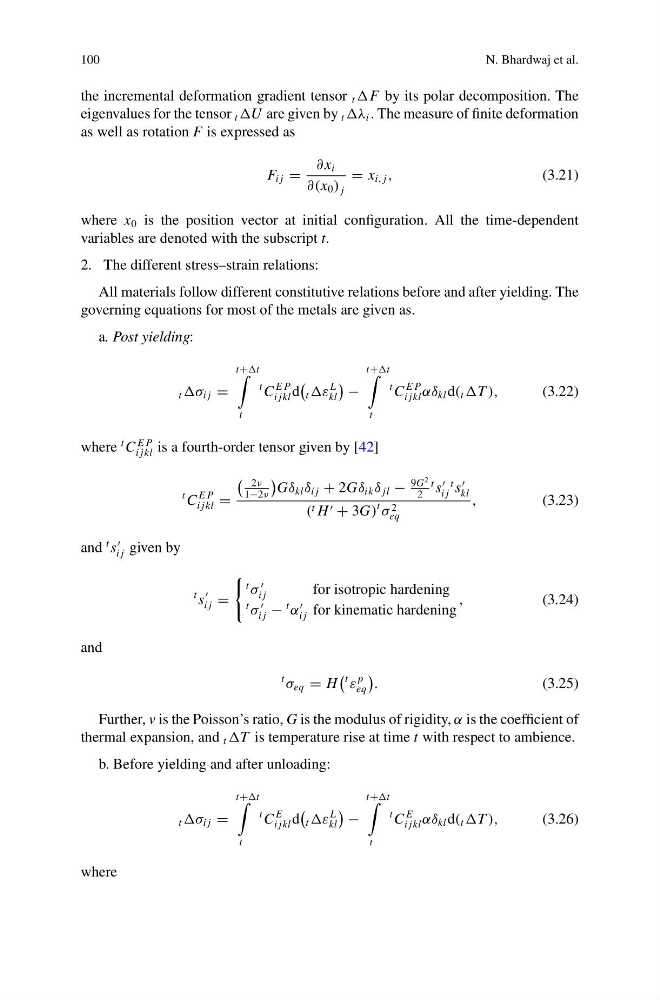
the incremental deformation gradient tensor t F by its polar decomposition. The
eigenvalues for the tensor t U are given by t λ i . The measure of finite deformation
as well as rotation F is expressed as
F i j =
∂ x i
∂(x 0 ) j
= x i, j ,
(3.21)
where x 0 is the position vector at initial configuration. All the time-dependent
variables are denoted with the subscript t.
2. The different stress–strain relations:
All materials follow different constitutive relations before and after yielding. The
governing equations for most of the metals are given as.
a. Post yielding:
t σ i j =
t+t
t
t C
E P
i jkl d
t ε
L
kl
−
t+t
t
t C
E P
i jkl αδ kl d( t T ),
(3.22)
where
t C
E P
i jkl is a fourth-order tensor given by [42]
t C
E P
i jkl =
2ν
1−2ν
Gδ kl δ i j + 2Gδ ik δ jl −
9G
2
2
t s
i j
t s
kl
( t H + 3G)
t
σ 2
eq
,
(3.23)
and
t s
i j given by
t s
i j =
t
σ
i j
for isotropic hardening
t
σ
i j −
t
α
i j for kinematic hardening
,
(3.24)
and
t
σ eq = H
t ε
p
eq
.
(3.25)
Further, v is the Poisson’s ratio, G is the modulus of rigidity, α is the coefficient of
thermal expansion, and t T is temperature rise at time t with respect to ambience.
b. Before yielding and after unloading:
t σ i j =
t+t
t
t C
E
i jkl d
t ε
L
kl
−
t+t
t
t C
E
i jkl αδ kl d( t T ),
(3.26)
where
N. Bhardwaj et al.
the incremental deformation gradient tensor t F by its polar decomposition. The
eigenvalues for the tensor t U are given by t λ i . The measure of finite deformation
as well as rotation F is expressed as
F i j =
∂ x i
∂(x 0 ) j
= x i, j ,
(3.21)
where x 0 is the position vector at initial configuration. All the time-dependent
variables are denoted with the subscript t.
2. The different stress–strain relations:
All materials follow different constitutive relations before and after yielding. The
governing equations for most of the metals are given as.
a. Post yielding:
t σ i j =
t+t
t
t C
E P
i jkl d
t ε
L
kl
−
t+t
t
t C
E P
i jkl αδ kl d( t T ),
(3.22)
where
t C
E P
i jkl is a fourth-order tensor given by [42]
t C
E P
i jkl =
2ν
1−2ν
Gδ kl δ i j + 2Gδ ik δ jl −
9G
2
2
t s
i j
t s
kl
( t H + 3G)
t
σ 2
eq
,
(3.23)
and
t s
i j given by
t s
i j =
t
σ
i j
for isotropic hardening
t
σ
i j −
t
α
i j for kinematic hardening
,
(3.24)
and
t
σ eq = H
t ε
p
eq
.
(3.25)
Further, v is the Poisson’s ratio, G is the modulus of rigidity, α is the coefficient of
thermal expansion, and t T is temperature rise at time t with respect to ambience.
b. Before yielding and after unloading:
t σ i j =
t+t
t
t C
E
i jkl d
t ε
L
kl
−
t+t
t
t C
E
i jkl αδ kl d( t T ),
(3.26)
where