

3 Modeling of Friction Stir Welding Processes
99
to each other. Processes like rolling, wire drawing and extrusion that involve flow
of material continuously through a control volume can be modeled using the Eulerian approach [26]. The mesh in Eulerian approach never changes,therefore, there is
no problem of excessive mesh distortion in processes with high plastic strains [89].
However, this approach is not much suitable for modeling free boundary surfaces.
The elemental and boundary nodes may not coincide and can be used only if the
surface boundaries that are deformed are known [61]. An impression of the tool
shape needs to be created on the workpiece in order to implement this formulation in FSW because plunging stage cannot be modeled using Eulerian formulation.
Eulerian formulation is not suitable for unsteady problems as well. Due to these
disadvantages and difficulty in tracking surfaces and boundary conditions, a purely
Eulerian approach for modeling FSW is rarely used.
In Lagrangian formulation, the analysis is performed on a set of particles, which
keep moving with the deformed material. The path of the particle is traced from
the original configuration to the material’s new deformed state. The primary variable in Lagrangian configuration can be incremental displacement as the deformation takes place incrementally with respect to time. This approach is generally
used for processes like forging, deep drawing or processes involving interaction
of solid boundaries [26, 41]. It is also easier to use boundary conditions in this
approach. In this approach, the material and element boundary coincide with each
other [52]. However, with large deformation, there is distortion and tangling of mesh
leading to difficulty in convergence. Although Lagrangian approach requires complex
remeshing, its ability to model heat from friction at the contacting surface of tool
and workpiece, material deformation in the workpiece and material flow makes it
a suitable and widely used approach for modeling FSW process [2, 44]. The reference for the current deformed state can be set as the reference frame at t = 0 or the
deformed configuration from previous state,the former is known as total Lagrangian
formulation, and the latter is known as the updated Lagrangian formulation [27]. In
the updated Lagrangian formulation, it is assumed that the deformations are finite.
It is also assumed that solution at time t (previous state) is known for evaluation of
unknown variables for the state at t + t. The following are the governing equations
[26]:
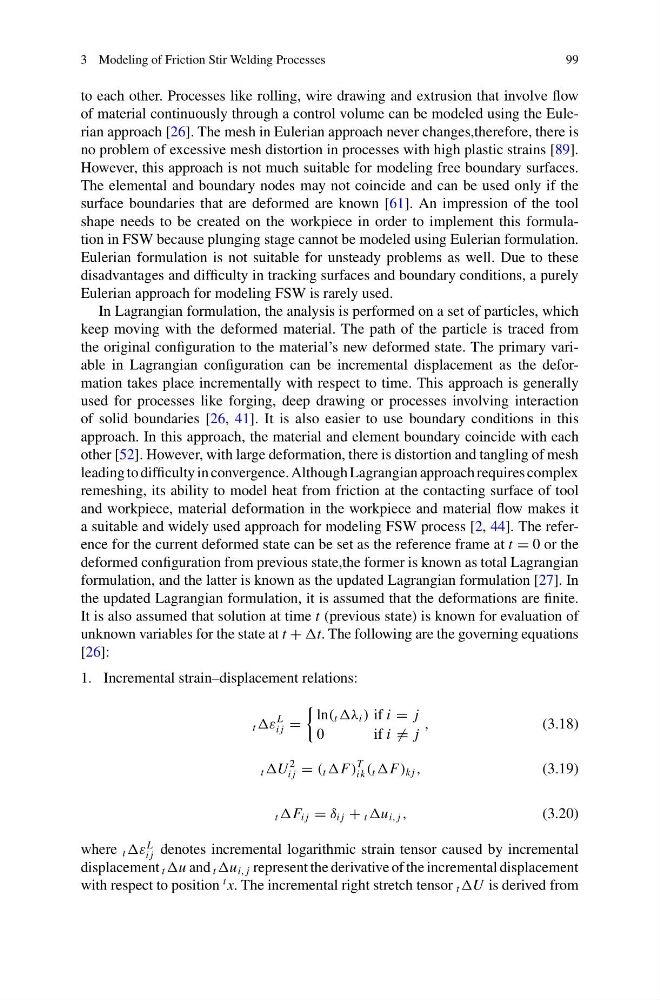
1. Incremental strain–displacement relations:
t ε
L
i j =
ln( t λ i ) if i = j
0
i fi = j
,
(3.18)
t U
2
i j = ( t F)
T
ik ( t F) k j ,
(3.19)
t F i j = δ i j + t u i, j ,
(3.20)
where t ε
L
i j denotes incremental logarithmic strain tensor caused by incremental
displacement t u and t u i, j represent the derivative of the incremental displacement
with respect to position
t x. The incremental right stretch tensor t U is derived from
99
to each other. Processes like rolling, wire drawing and extrusion that involve flow
of material continuously through a control volume can be modeled using the Eulerian approach [26]. The mesh in Eulerian approach never changes,therefore, there is
no problem of excessive mesh distortion in processes with high plastic strains [89].
However, this approach is not much suitable for modeling free boundary surfaces.
The elemental and boundary nodes may not coincide and can be used only if the
surface boundaries that are deformed are known [61]. An impression of the tool
shape needs to be created on the workpiece in order to implement this formulation in FSW because plunging stage cannot be modeled using Eulerian formulation.
Eulerian formulation is not suitable for unsteady problems as well. Due to these
disadvantages and difficulty in tracking surfaces and boundary conditions, a purely
Eulerian approach for modeling FSW is rarely used.
In Lagrangian formulation, the analysis is performed on a set of particles, which
keep moving with the deformed material. The path of the particle is traced from
the original configuration to the material’s new deformed state. The primary variable in Lagrangian configuration can be incremental displacement as the deformation takes place incrementally with respect to time. This approach is generally
used for processes like forging, deep drawing or processes involving interaction
of solid boundaries [26, 41]. It is also easier to use boundary conditions in this
approach. In this approach, the material and element boundary coincide with each
other [52]. However, with large deformation, there is distortion and tangling of mesh
leading to difficulty in convergence. Although Lagrangian approach requires complex
remeshing, its ability to model heat from friction at the contacting surface of tool
and workpiece, material deformation in the workpiece and material flow makes it
a suitable and widely used approach for modeling FSW process [2, 44]. The reference for the current deformed state can be set as the reference frame at t = 0 or the
deformed configuration from previous state,the former is known as total Lagrangian
formulation, and the latter is known as the updated Lagrangian formulation [27]. In
the updated Lagrangian formulation, it is assumed that the deformations are finite.
It is also assumed that solution at time t (previous state) is known for evaluation of
unknown variables for the state at t + t. The following are the governing equations
[26]:
1. Incremental strain–displacement relations:
t ε
L
i j =
ln( t λ i ) if i = j
0
i fi = j
,
(3.18)
t U
2
i j = ( t F)
T
ik ( t F) k j ,
(3.19)
t F i j = δ i j + t u i, j ,
(3.20)
where t ε
L
i j denotes incremental logarithmic strain tensor caused by incremental
displacement t u and t u i, j represent the derivative of the incremental displacement
with respect to position
t x. The incremental right stretch tensor t U is derived from