

could be beneficial from the point of view of the strong reduction of the target
erosion.
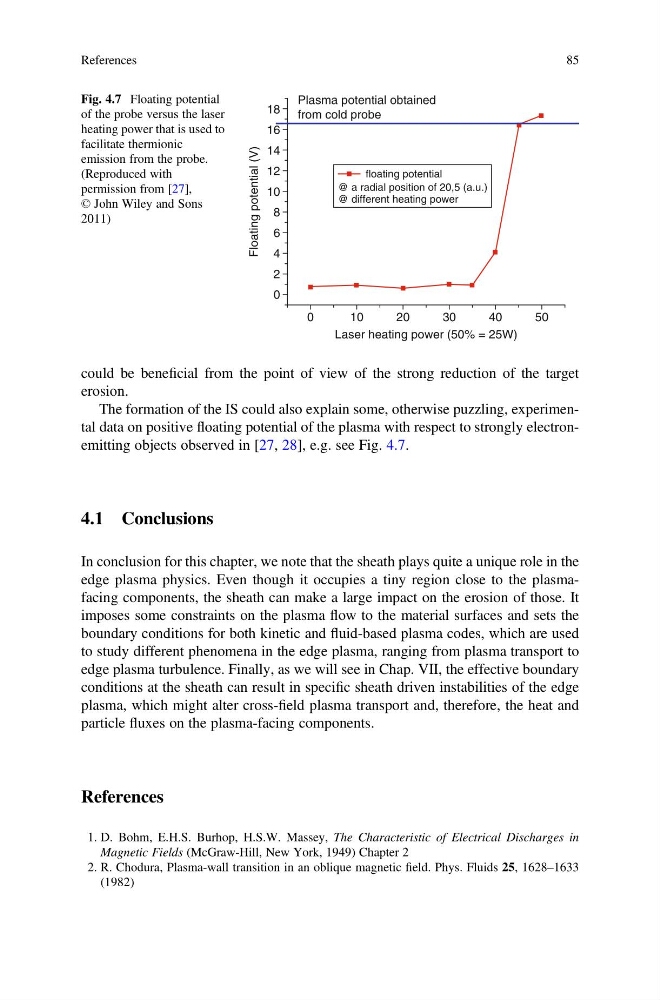
The formation of the IS could also explain some, otherwise puzzling, experimental data on positive floating potential of the plasma with respect to strongly electronemitting objects observed in [27, 28], e.g. see Fig. 4.7.
4.1 Conclusions
In conclusion for this chapter, we note that the sheath plays quite a unique role in the
edge plasma physics. Even though it occupies a tiny region close to the plasmafacing components, the sheath can make a large impact on the erosion of those. It
imposes some constraints on the plasma flow to the material surfaces and sets the
boundary conditions for both kinetic and fluid-based plasma codes, which are used
to study different phenomena in the edge plasma, ranging from plasma transport to
edge plasma turbulence. Finally, as we will see in Chap. VII, the effective boundary
conditions at the sheath can result in specific sheath driven instabilities of the edge
plasma, which might alter cross-field plasma transport and, therefore, the heat and
particle fluxes on the plasma-facing components.
References
1. D. Bohm, E.H.S. Burhop, H.S.W. Massey, The Characteristic of Electrical Discharges in
Magnetic Fields (McGraw-Hill, New York, 1949) Chapter 2
2. R. Chodura, Plasma-wall transition in an oblique magnetic field. Phys. Fluids 25, 1628–1633
(1982)
0
2
4
6
8
10
12
14
16
18
0
1 0
2 0
3 0
4 0
5 0
Laser heating power (50% = 25W)
Floating potential (V)
floating potential
Plasma potential obtained
from cold probe
@ a radial position of 20,5 (a.u.)
@ different heating power
Fig. 4.7 Floating potential
of the probe versus the laser
heating power that is used to
facilitate thermionic
emission from the probe.
(Reproduced with
permission from [27],
© John Wiley and Sons
2011)
References
85
erosion.
The formation of the IS could also explain some, otherwise puzzling, experimental data on positive floating potential of the plasma with respect to strongly electronemitting objects observed in [27, 28], e.g. see Fig. 4.7.
4.1 Conclusions
In conclusion for this chapter, we note that the sheath plays quite a unique role in the
edge plasma physics. Even though it occupies a tiny region close to the plasmafacing components, the sheath can make a large impact on the erosion of those. It
imposes some constraints on the plasma flow to the material surfaces and sets the
boundary conditions for both kinetic and fluid-based plasma codes, which are used
to study different phenomena in the edge plasma, ranging from plasma transport to
edge plasma turbulence. Finally, as we will see in Chap. VII, the effective boundary
conditions at the sheath can result in specific sheath driven instabilities of the edge
plasma, which might alter cross-field plasma transport and, therefore, the heat and
particle fluxes on the plasma-facing components.
References
1. D. Bohm, E.H.S. Burhop, H.S.W. Massey, The Characteristic of Electrical Discharges in
Magnetic Fields (McGraw-Hill, New York, 1949) Chapter 2
2. R. Chodura, Plasma-wall transition in an oblique magnetic field. Phys. Fluids 25, 1628–1633
(1982)
0
2
4
6
8
10
12
14
16
18
0
1 0
2 0
3 0
4 0
5 0
Laser heating power (50% = 25W)
Floating potential (V)
floating potential
Plasma potential obtained
from cold probe
@ a radial position of 20,5 (a.u.)
@ different heating power
Fig. 4.7 Floating potential
of the probe versus the laser
heating power that is used to
facilitate thermionic
emission from the probe.
(Reproduced with
permission from [27],
© John Wiley and Sons
2011)
References
85