

For the electron and ion heat fluxes to the material surface, one can find q
e
ð Þ
z ¼
γ e j
e
ð Þ
z T e and q
i
ð Þ
z ¼ γ i j
i
ð Þ
z T i , where j
e
ð Þ
z and j
i
ð Þ
z are correspondingly the electron and ion
particle fluxes to the target, whereas γ e and γ i are the so-called heat transmission
coefficients, which, in a general case of the tilted magnetic field, depend on the ion
distribution function F i (v k , ε ⊥ ), secondary electron emission, drifts, and potential
drop φ sh . However, the expressions for the fluid closures at the target (including
those for the electron and ion heat fluxes) become much more cumbersome if we
include grazing magnetic field, particle drifts and time dependence of the plasma
parameters related, for example, to the SOL plasma turbulence. Discussion of these
issues goes beyond the scope of this chapter. More details can be found in [12, 18,
19] and the references therein.
As indicated in Eq. (4.18), the secondary electron emission can significantly alter
the magnitude of φ sh . Moreover, closer consideration shows that for 1 > γ see ! γ
crit
ð Þ
see ,
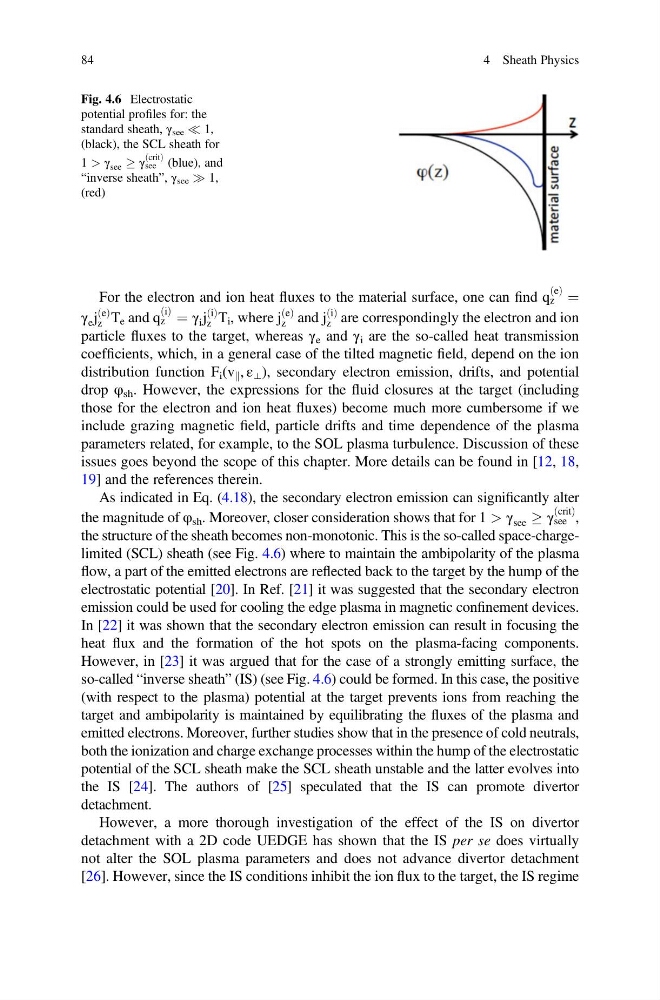
the structure of the sheath becomes non-monotonic. This is the so-called space-chargelimited (SCL) sheath (see Fig. 4.6) where to maintain the ambipolarity of the plasma
flow, a part of the emitted electrons are reflected back to the target by the hump of the
electrostatic potential [20]. In Ref. [21] it was suggested that the secondary electron
emission could be used for cooling the edge plasma in magnetic confinement devices.
In [22] it was shown that the secondary electron emission can result in focusing the
heat flux and the formation of the hot spots on the plasma-facing components.
However, in [23] it was argued that for the case of a strongly emitting surface, the
so-called “inverse sheath” (IS) (see Fig. 4.6) could be formed. In this case, the positive
(with respect to the plasma) potential at the target prevents ions from reaching the
target and ambipolarity is maintained by equilibrating the fluxes of the plasma and
emitted electrons. Moreover, further studies show that in the presence of cold neutrals,
both the ionization and charge exchange processes within the hump of the electrostatic
potential of the SCL sheath make the SCL sheath unstable and the latter evolves into
the IS [24]. The authors of [25] speculated that the IS can promote divertor
detachment.
However, a more thorough investigation of the effect of the IS on divertor
detachment with a 2D code UEDGE has shown that the IS per se does virtually
not alter the SOL plasma parameters and does not advance divertor detachment
[26]. However, since the IS conditions inhibit the ion flux to the target, the IS regime
Fig. 4.6 Electrostatic
potential profiles for: the
standard sheath, γ see ( 1,
(black), the SCL sheath for
1 > γ see ! γ
crit
ð Þ
see (blue), and
“inverse sheath”, γ see ) 1,
(red)
84
4 Sheath Physics
e
ð Þ
z ¼
γ e j
e
ð Þ
z T e and q
i
ð Þ
z ¼ γ i j
i
ð Þ
z T i , where j
e
ð Þ
z and j
i
ð Þ
z are correspondingly the electron and ion
particle fluxes to the target, whereas γ e and γ i are the so-called heat transmission
coefficients, which, in a general case of the tilted magnetic field, depend on the ion
distribution function F i (v k , ε ⊥ ), secondary electron emission, drifts, and potential
drop φ sh . However, the expressions for the fluid closures at the target (including
those for the electron and ion heat fluxes) become much more cumbersome if we
include grazing magnetic field, particle drifts and time dependence of the plasma
parameters related, for example, to the SOL plasma turbulence. Discussion of these
issues goes beyond the scope of this chapter. More details can be found in [12, 18,
19] and the references therein.
As indicated in Eq. (4.18), the secondary electron emission can significantly alter
the magnitude of φ sh . Moreover, closer consideration shows that for 1 > γ see ! γ
crit
ð Þ
see ,
the structure of the sheath becomes non-monotonic. This is the so-called space-chargelimited (SCL) sheath (see Fig. 4.6) where to maintain the ambipolarity of the plasma
flow, a part of the emitted electrons are reflected back to the target by the hump of the
electrostatic potential [20]. In Ref. [21] it was suggested that the secondary electron
emission could be used for cooling the edge plasma in magnetic confinement devices.
In [22] it was shown that the secondary electron emission can result in focusing the
heat flux and the formation of the hot spots on the plasma-facing components.
However, in [23] it was argued that for the case of a strongly emitting surface, the
so-called “inverse sheath” (IS) (see Fig. 4.6) could be formed. In this case, the positive
(with respect to the plasma) potential at the target prevents ions from reaching the
target and ambipolarity is maintained by equilibrating the fluxes of the plasma and
emitted electrons. Moreover, further studies show that in the presence of cold neutrals,
both the ionization and charge exchange processes within the hump of the electrostatic
potential of the SCL sheath make the SCL sheath unstable and the latter evolves into
the IS [24]. The authors of [25] speculated that the IS can promote divertor
detachment.
However, a more thorough investigation of the effect of the IS on divertor
detachment with a 2D code UEDGE has shown that the IS per se does virtually
not alter the SOL plasma parameters and does not advance divertor detachment
[26]. However, since the IS conditions inhibit the ion flux to the target, the IS regime
Fig. 4.6 Electrostatic
potential profiles for: the
standard sheath, γ see ( 1,
(black), the SCL sheath for
1 > γ see ! γ
crit
ð Þ
see (blue), and
“inverse sheath”, γ see ) 1,
(red)
84
4 Sheath Physics