

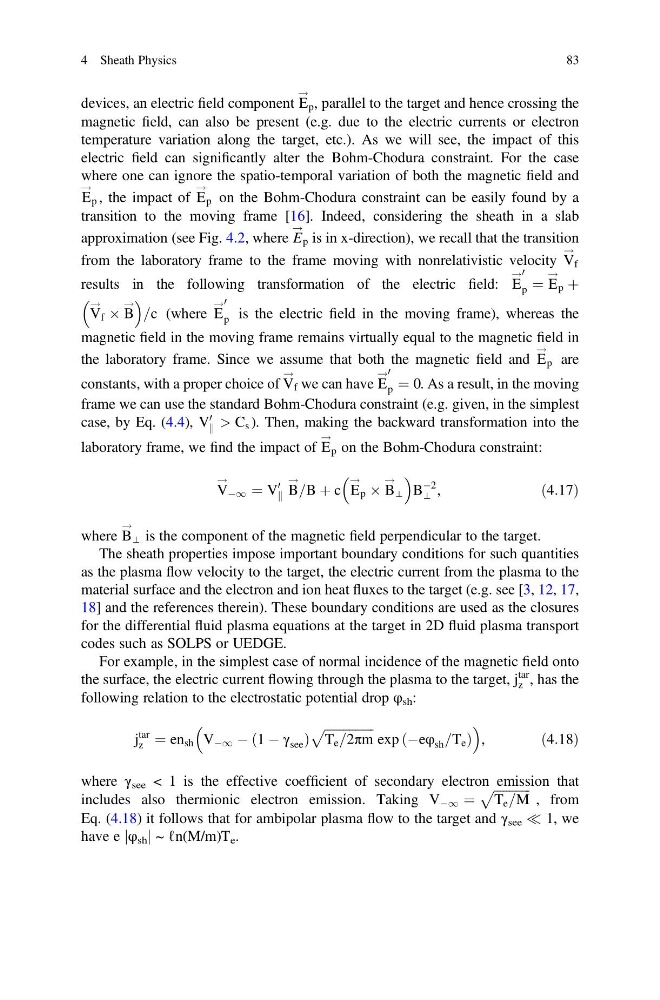
devices, an electric field component E
!
p , parallel to the target and hence crossing the
magnetic field, can also be present (e.g. due to the electric currents or electron
temperature variation along the target, etc.). As we will see, the impact of this
electric field can significantly alter the Bohm-Chodura constraint. For the case
where one can ignore the spatio-temporal variation of both the magnetic field and
E
!
p , the impact of E
!
p on the Bohm-Chodura constraint can be easily found by a
transition to the moving frame [16]. Indeed, considering the sheath in a slab
approximation (see Fig. 4.2, where E
!
p is in x-direction), we recall that the transition
from the laboratory frame to the frame moving with nonrelativistic velocity V
!
f
results in the following transformation of the electric field: E
! 0
p ¼ E
!
p þ
V
!
f  B
!
=c (where E
! 0
p is the electric field in the moving frame), whereas the
magnetic field in the moving frame remains virtually equal to the magnetic field in
the laboratory frame. Since we assume that both the magnetic field and E
!
p are
constants, with a proper choice of V
!
f we can have E
! 0
p ¼ 0. As a result, in the moving
frame we can use the standard Bohm-Chodura constraint (e.g. given, in the simplest
case, by Eq. (4.4), V
0
k > C s ). Then, making the backward transformation into the
laboratory frame, we find the impact of E
!
p on the Bohm-Chodura constraint:
V
!
À1 ¼ V
0
k B
! =B þ c
E
!
p  B
!
⊥
B
À2
⊥ ,
ð4:17Þ
where B
!
⊥ is the component of the magnetic field perpendicular to the target.
The sheath properties impose important boundary conditions for such quantities
as the plasma flow velocity to the target, the electric current from the plasma to the
material surface and the electron and ion heat fluxes to the target (e.g. see [3, 12, 17,
18] and the references therein). These boundary conditions are used as the closures
for the differential fluid plasma equations at the target in 2D fluid plasma transport
codes such as SOLPS or UEDGE.
For example, in the simplest case of normal incidence of the magnetic field onto
the surface, the electric current flowing through the plasma to the target, j
tar
z , has the
following relation to the electrostatic potential drop φ sh :
j
tar
z ¼ en sh V À1 À 1 À γ see
ð
Þ
ffiffiffiffiffiffiffiffiffiffiffiffiffiffiffiffi
T e =2πm
p
exp Àeφ sh =T e
ð
Þ
,
ð4:18Þ
where γ see < 1 is the effective coefficient of secondary electron emission that
includes also thermionic electron emission. Taking V À1 ¼
ffiffiffiffiffiffiffiffiffiffiffi ffi
T e =M
p
, from
Eq. (4.18) it follows that for ambipolar plasma flow to the target and γ see ( 1, we
have e jφ sh j ~ ℓn(M/m)T e .
4 Sheath Physics
83
!
p , parallel to the target and hence crossing the
magnetic field, can also be present (e.g. due to the electric currents or electron
temperature variation along the target, etc.). As we will see, the impact of this
electric field can significantly alter the Bohm-Chodura constraint. For the case
where one can ignore the spatio-temporal variation of both the magnetic field and
E
!
p , the impact of E
!
p on the Bohm-Chodura constraint can be easily found by a
transition to the moving frame [16]. Indeed, considering the sheath in a slab
approximation (see Fig. 4.2, where E
!
p is in x-direction), we recall that the transition
from the laboratory frame to the frame moving with nonrelativistic velocity V
!
f
results in the following transformation of the electric field: E
! 0
p ¼ E
!
p þ
V
!
f  B
!
=c (where E
! 0
p is the electric field in the moving frame), whereas the
magnetic field in the moving frame remains virtually equal to the magnetic field in
the laboratory frame. Since we assume that both the magnetic field and E
!
p are
constants, with a proper choice of V
!
f we can have E
! 0
p ¼ 0. As a result, in the moving
frame we can use the standard Bohm-Chodura constraint (e.g. given, in the simplest
case, by Eq. (4.4), V
0
k > C s ). Then, making the backward transformation into the
laboratory frame, we find the impact of E
!
p on the Bohm-Chodura constraint:
V
!
À1 ¼ V
0
k B
! =B þ c
E
!
p  B
!
⊥
B
À2
⊥ ,
ð4:17Þ
where B
!
⊥ is the component of the magnetic field perpendicular to the target.
The sheath properties impose important boundary conditions for such quantities
as the plasma flow velocity to the target, the electric current from the plasma to the
material surface and the electron and ion heat fluxes to the target (e.g. see [3, 12, 17,
18] and the references therein). These boundary conditions are used as the closures
for the differential fluid plasma equations at the target in 2D fluid plasma transport
codes such as SOLPS or UEDGE.
For example, in the simplest case of normal incidence of the magnetic field onto
the surface, the electric current flowing through the plasma to the target, j
tar
z , has the
following relation to the electrostatic potential drop φ sh :
j
tar
z ¼ en sh V À1 À 1 À γ see
ð
Þ
ffiffiffiffiffiffiffiffiffiffiffiffiffiffiffiffi
T e =2πm
p
exp Àeφ sh =T e
ð
Þ
,
ð4:18Þ
where γ see < 1 is the effective coefficient of secondary electron emission that
includes also thermionic electron emission. Taking V À1 ¼
ffiffiffiffiffiffiffiffiffiffiffi ffi
T e =M
p
, from
Eq. (4.18) it follows that for ambipolar plasma flow to the target and γ see ( 1, we
have e jφ sh j ~ ℓn(M/m)T e .
4 Sheath Physics
83