

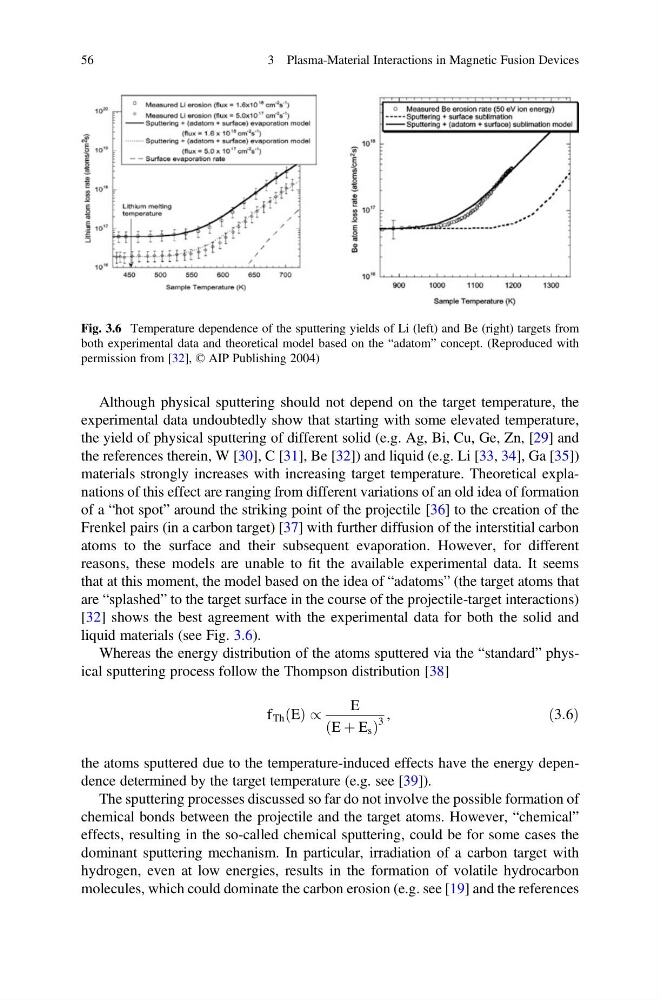
Although physical sputtering should not depend on the target temperature, the
experimental data undoubtedly show that starting with some elevated temperature,
the yield of physical sputtering of different solid (e.g. Ag, Bi, Cu, Ge, Zn, [29] and
the references therein, W [30], C [31], Be [32]) and liquid (e.g. Li [33, 34], Ga [35])
materials strongly increases with increasing target temperature. Theoretical explanations of this effect are ranging from different variations of an old idea of formation
of a “hot spot” around the striking point of the projectile [36] to the creation of the
Frenkel pairs (in a carbon target) [37] with further diffusion of the interstitial carbon
atoms to the surface and their subsequent evaporation. However, for different
reasons, these models are unable to fit the available experimental data. It seems
that at this moment, the model based on the idea of “adatoms” (the target atoms that
are “splashed” to the target surface in the course of the projectile-target interactions)
[32] shows the best agreement with the experimental data for both the solid and
liquid materials (see Fig. 3.6).
Whereas the energy distribution of the atoms sputtered via the “standard” physical sputtering process follow the Thompson distribution [38]
f Th E
ð Þ /
E
E þ E s
ð
Þ
3
,
ð3:6Þ
the atoms sputtered due to the temperature-induced effects have the energy dependence determined by the target temperature (e.g. see [39]).
The sputtering processes discussed so far do not involve the possible formation of
chemical bonds between the projectile and the target atoms. However, “chemical”
effects, resulting in the so-called chemical sputtering, could be for some cases the
dominant sputtering mechanism. In particular, irradiation of a carbon target with
hydrogen, even at low energies, results in the formation of volatile hydrocarbon
molecules, which could dominate the carbon erosion (e.g. see [19] and the references
Fig. 3.6 Temperature dependence of the sputtering yields of Li (left) and Be (right) targets from
both experimental data and theoretical model based on the “adatom” concept. (Reproduced with
permission from [32], © AIP Publishing 2004)
56
3 Plasma-Material Interactions in Magnetic Fusion Devices
experimental data undoubtedly show that starting with some elevated temperature,
the yield of physical sputtering of different solid (e.g. Ag, Bi, Cu, Ge, Zn, [29] and
the references therein, W [30], C [31], Be [32]) and liquid (e.g. Li [33, 34], Ga [35])
materials strongly increases with increasing target temperature. Theoretical explanations of this effect are ranging from different variations of an old idea of formation
of a “hot spot” around the striking point of the projectile [36] to the creation of the
Frenkel pairs (in a carbon target) [37] with further diffusion of the interstitial carbon
atoms to the surface and their subsequent evaporation. However, for different
reasons, these models are unable to fit the available experimental data. It seems
that at this moment, the model based on the idea of “adatoms” (the target atoms that
are “splashed” to the target surface in the course of the projectile-target interactions)
[32] shows the best agreement with the experimental data for both the solid and
liquid materials (see Fig. 3.6).
Whereas the energy distribution of the atoms sputtered via the “standard” physical sputtering process follow the Thompson distribution [38]
f Th E
ð Þ /
E
E þ E s
ð
Þ
3
,
ð3:6Þ
the atoms sputtered due to the temperature-induced effects have the energy dependence determined by the target temperature (e.g. see [39]).
The sputtering processes discussed so far do not involve the possible formation of
chemical bonds between the projectile and the target atoms. However, “chemical”
effects, resulting in the so-called chemical sputtering, could be for some cases the
dominant sputtering mechanism. In particular, irradiation of a carbon target with
hydrogen, even at low energies, results in the formation of volatile hydrocarbon
molecules, which could dominate the carbon erosion (e.g. see [19] and the references
Fig. 3.6 Temperature dependence of the sputtering yields of Li (left) and Be (right) targets from
both experimental data and theoretical model based on the “adatom” concept. (Reproduced with
permission from [32], © AIP Publishing 2004)
56
3 Plasma-Material Interactions in Magnetic Fusion Devices