

angle (ϑ p ) max < π/2 and then drops to a virtually zero value. Although the particular
angular dependence of Y ph (E p , ϑ p ) is significant, rather complex and sensitive to E p
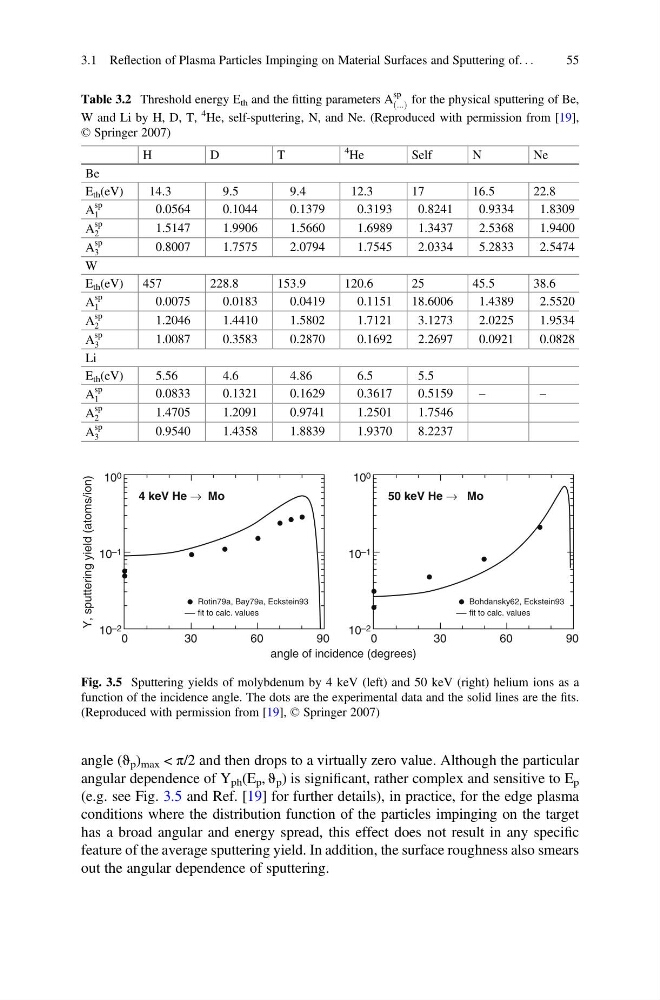
(e.g. see Fig. 3.5 and Ref. [19] for further details), in practice, for the edge plasma
conditions where the distribution function of the particles impinging on the target
has a broad angular and energy spread, this effect does not result in any specific
feature of the average sputtering yield. In addition, the surface roughness also smears
out the angular dependence of sputtering.
Table 3.2 Threshold energy E th and the fitting parameters A
sp
...
ð Þ for the physical sputtering of Be,
W and Li by H, D, T,
4
He, self-sputtering, N, and Ne. (Reproduced with permission from [19],
© Springer 2007)
H
D
T
4
He
Self
N
Ne
Be
E th (eV)
14.3
9.5
9.4
12.3
17
16.5
22.8
A
sp
1
0.0564
0.1044
0.1379
0.3193
0.8241
0.9334
1.8309
A
sp
2
1.5147
1.9906
1.5660
1.6989
1.3437
2.5368
1.9400
A
sp
3
0.8007
1.7575
2.0794
1.7545
2.0334
5.2833
2.5474
W
E th (eV)
457
228.8
153.9
120.6
25
45.5
38.6
A
sp
1
0.0075
0.0183
0.0419
0.1151
18.6006
1.4389
2.5520
A
sp
2
1.2046
1.4410
1.5802
1.7121
3.1273
2.0225
1.9534
A
sp
3
1.0087
0.3583
0.2870
0.1692
2.2697
0.0921
0.0828
Li
E th (eV)
5.56
4.6
4.86
6.5
5.5
A
sp
1
0.0833
0.1321
0.1629
0.3617
0.5159
–
–
A
sp
2
1.4705
1.2091
0.9741
1.2501
1.7546
A
sp
3
0.9540
1.4358
1.8839
1.9370
8.2237
0
3 0
6 0
9 0
angle of incidence (degrees)
fit to calc. values
Bohdansky62, Eckstein93
Y, sputtering yield (atoms/ion)
4 keV He → Mo
50 keV He → Mo
10 –2
10 –1
10 0
fit to calc. values
Rotin79a, Bay79a, Eckstein93
0
3 0
6 0
9 0
10 –2
10 –1
10 0
Fig. 3.5 Sputtering yields of molybdenum by 4 keV (left) and 50 keV (right) helium ions as a
function of the incidence angle. The dots are the experimental data and the solid lines are the fits.
(Reproduced with permission from [19], © Springer 2007)
3.1 Reflection of Plasma Particles Impinging on Material Surfaces and Sputtering of. . .
55
angular dependence of Y ph (E p , ϑ p ) is significant, rather complex and sensitive to E p
(e.g. see Fig. 3.5 and Ref. [19] for further details), in practice, for the edge plasma
conditions where the distribution function of the particles impinging on the target
has a broad angular and energy spread, this effect does not result in any specific
feature of the average sputtering yield. In addition, the surface roughness also smears
out the angular dependence of sputtering.
Table 3.2 Threshold energy E th and the fitting parameters A
sp
...
ð Þ for the physical sputtering of Be,
W and Li by H, D, T,
4
He, self-sputtering, N, and Ne. (Reproduced with permission from [19],
© Springer 2007)
H
D
T
4
He
Self
N
Ne
Be
E th (eV)
14.3
9.5
9.4
12.3
17
16.5
22.8
A
sp
1
0.0564
0.1044
0.1379
0.3193
0.8241
0.9334
1.8309
A
sp
2
1.5147
1.9906
1.5660
1.6989
1.3437
2.5368
1.9400
A
sp
3
0.8007
1.7575
2.0794
1.7545
2.0334
5.2833
2.5474
W
E th (eV)
457
228.8
153.9
120.6
25
45.5
38.6
A
sp
1
0.0075
0.0183
0.0419
0.1151
18.6006
1.4389
2.5520
A
sp
2
1.2046
1.4410
1.5802
1.7121
3.1273
2.0225
1.9534
A
sp
3
1.0087
0.3583
0.2870
0.1692
2.2697
0.0921
0.0828
Li
E th (eV)
5.56
4.6
4.86
6.5
5.5
A
sp
1
0.0833
0.1321
0.1629
0.3617
0.5159
–
–
A
sp
2
1.4705
1.2091
0.9741
1.2501
1.7546
A
sp
3
0.9540
1.4358
1.8839
1.9370
8.2237
0
3 0
6 0
9 0
angle of incidence (degrees)
fit to calc. values
Bohdansky62, Eckstein93
Y, sputtering yield (atoms/ion)
4 keV He → Mo
50 keV He → Mo
10 –2
10 –1
10 0
fit to calc. values
Rotin79a, Bay79a, Eckstein93
0
3 0
6 0
9 0
10 –2
10 –1
10 0
Fig. 3.5 Sputtering yields of molybdenum by 4 keV (left) and 50 keV (right) helium ions as a
function of the incidence angle. The dots are the experimental data and the solid lines are the fits.
(Reproduced with permission from [19], © Springer 2007)
3.1 Reflection of Plasma Particles Impinging on Material Surfaces and Sputtering of. . .
55