

However, a closer consideration shows that in order to penetrate into the tungsten
lattice and have a chance to be trapped there, the helium particle has to overcome a
potential barrier of ~6 eV [27]. Therefore, the helium reflection coefficient from
a pure tungsten target should be equal to unity for the helium kinetic energy below
this potential barrier. The situation with hydrogen impinging on the tungsten target is
more complex since hydrogen can be chemically adsorbed on the tungsten surface
(e.g. see [28] and the references therein).
Next, we consider the so-called physical sputtering of the targets. Physical
sputtering assumes no formation of chemical bonds between the projectile and the
target particles. The probability of the projectile to sputter a target particle (sputtering
yield) depends on both the projectile energy E p and the incidence angle. For the
normal incidence, the yield of physical sputtering Y ph (E p ) is given by the following
expression [19]
Y ph E p
À Á ¼ A
sp
1 f ε p
À Á
E p =E th À 1
À
Á A
sp
2
A
sp
3 þ E p =E th À 1
À
Á A
sp
2
,
ð3:4Þ
where E th is the sputtering threshold energy, A
sp
...
ð Þ are the fitting parameters and the
function f(ε p ) is given by the following formula
f ε p
À Á ¼
0:5ℓn 1 þ 1:2288ε p
À
Á
ε p þ 0:1728
ffiffiffiffi ffi
ε p
p þ 0:008 ε p
À Á 0:1504 :
ð3:5Þ
We notice that the surface binding energy, E s , of Be, W, and Li has values of 3.38,
8.68 and 1.67 eV respectively, which are, as follows from Table 3.2, significantly
lower than E th , in particular, for the case of a large mass ratio of the target to
projectile atoms. This is not surprising, since according to the binary collision
approximation, the maximum relative energy transfer between the two particles
is 4M p M t /(M p +M t )
2 , which is small for M p ( M t (e.g. for the collisions of
hydrogenic species with tungsten atoms).
Both the reflection coefficients and the sputtering yields depend also on the
projectile incidence angle, ϑ p . Whereas the particle reflection coefficient increases
with increasing ϑ p , the yield of physical sputtering, having a minimum at the normal
incidence, initially increases also with increasing ϑ p , reaches a maximum at some
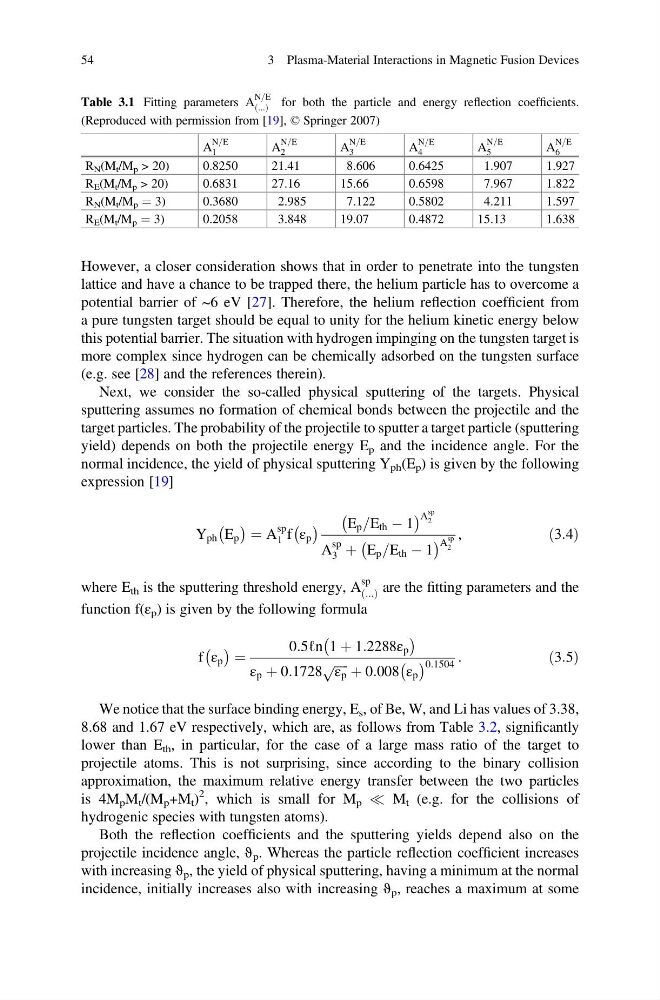
Table 3.1 Fitting parameters A
N=E
...
ð Þ for both the particle and energy reflection coefficients.
(Reproduced with permission from [19], © Springer 2007)
A
N=E
1
A
N=E
2
A
N=E
3
A
N=E
4
A
N=E
5
A
N=E
6
R N (M t /M p > 20)
0.8250
21.41
8.606
0.6425
1.907
1.927
R E (M t /M p > 20)
0.6831
27.16
15.66
0.6598
7.967
1.822
R N (M t /M p ¼ 3)
0.3680
2.985
7.122
0.5802
4.211
1.597
R E (M t /M p ¼ 3)
0.2058
3.848
19.07
0.4872
15.13
1.638
54
3 Plasma-Material Interactions in Magnetic Fusion Devices
lattice and have a chance to be trapped there, the helium particle has to overcome a
potential barrier of ~6 eV [27]. Therefore, the helium reflection coefficient from
a pure tungsten target should be equal to unity for the helium kinetic energy below
this potential barrier. The situation with hydrogen impinging on the tungsten target is
more complex since hydrogen can be chemically adsorbed on the tungsten surface
(e.g. see [28] and the references therein).
Next, we consider the so-called physical sputtering of the targets. Physical
sputtering assumes no formation of chemical bonds between the projectile and the
target particles. The probability of the projectile to sputter a target particle (sputtering
yield) depends on both the projectile energy E p and the incidence angle. For the
normal incidence, the yield of physical sputtering Y ph (E p ) is given by the following
expression [19]
Y ph E p
À Á ¼ A
sp
1 f ε p
À Á
E p =E th À 1
À
Á A
sp
2
A
sp
3 þ E p =E th À 1
À
Á A
sp
2
,
ð3:4Þ
where E th is the sputtering threshold energy, A
sp
...
ð Þ are the fitting parameters and the
function f(ε p ) is given by the following formula
f ε p
À Á ¼
0:5ℓn 1 þ 1:2288ε p
À
Á
ε p þ 0:1728
ffiffiffiffi ffi
ε p
p þ 0:008 ε p
À Á 0:1504 :
ð3:5Þ
We notice that the surface binding energy, E s , of Be, W, and Li has values of 3.38,
8.68 and 1.67 eV respectively, which are, as follows from Table 3.2, significantly
lower than E th , in particular, for the case of a large mass ratio of the target to
projectile atoms. This is not surprising, since according to the binary collision
approximation, the maximum relative energy transfer between the two particles
is 4M p M t /(M p +M t )
2 , which is small for M p ( M t (e.g. for the collisions of
hydrogenic species with tungsten atoms).
Both the reflection coefficients and the sputtering yields depend also on the
projectile incidence angle, ϑ p . Whereas the particle reflection coefficient increases
with increasing ϑ p , the yield of physical sputtering, having a minimum at the normal
incidence, initially increases also with increasing ϑ p , reaches a maximum at some
Table 3.1 Fitting parameters A
N=E
...
ð Þ for both the particle and energy reflection coefficients.
(Reproduced with permission from [19], © Springer 2007)
A
N=E
1
A
N=E
2
A
N=E
3
A
N=E
4
A
N=E
5
A
N=E
6
R N (M t /M p > 20)
0.8250
21.41
8.606
0.6425
1.907
1.927
R E (M t /M p > 20)
0.6831
27.16
15.66
0.6598
7.967
1.822
R N (M t /M p ¼ 3)
0.3680
2.985
7.122
0.5802
4.211
1.597
R E (M t /M p ¼ 3)
0.2058
3.848
19.07
0.4872
15.13
1.638
54
3 Plasma-Material Interactions in Magnetic Fusion Devices