

3.1 Reflection of Plasma Particles Impinging on Material
Surfaces and Sputtering of Plasma-Facing Materials
Both reflection and absorption of plasma particles (in particular, hydrogen and
helium) impinging on material surfaces result in the edge plasma energy and particle
sinks and, therefore, are crucially important for the plasma recycling process. In
addition, the accompanying processes of sputtering of the plasma-facing materials
are essential for plasma contamination with impurity and erosion of the PFCs.
We start with the particle and energy reflection coefficients. Whereas the particle
reflection coefficient, R N , is just the probability of particle impinging on the target
surface to be reflected back, the energy reflection coefficient, R E , needs some
clarification. The reflected particles usually have a broad energy distribution function
having an average value hE R i. For example, for the case where a light projectile
strikes a target of heavy elements (e.g. tungsten), some reflected particles have the
energy close to the initial projectile energy, E p . Therefore, for accurate treatment of
the energy of the reflected particles with MC neutral codes used in the edge plasma
studies, one should consider the whole energy spectrum of the reflected particles.
However, for some crude estimates one can use the average energy hE R i, which can
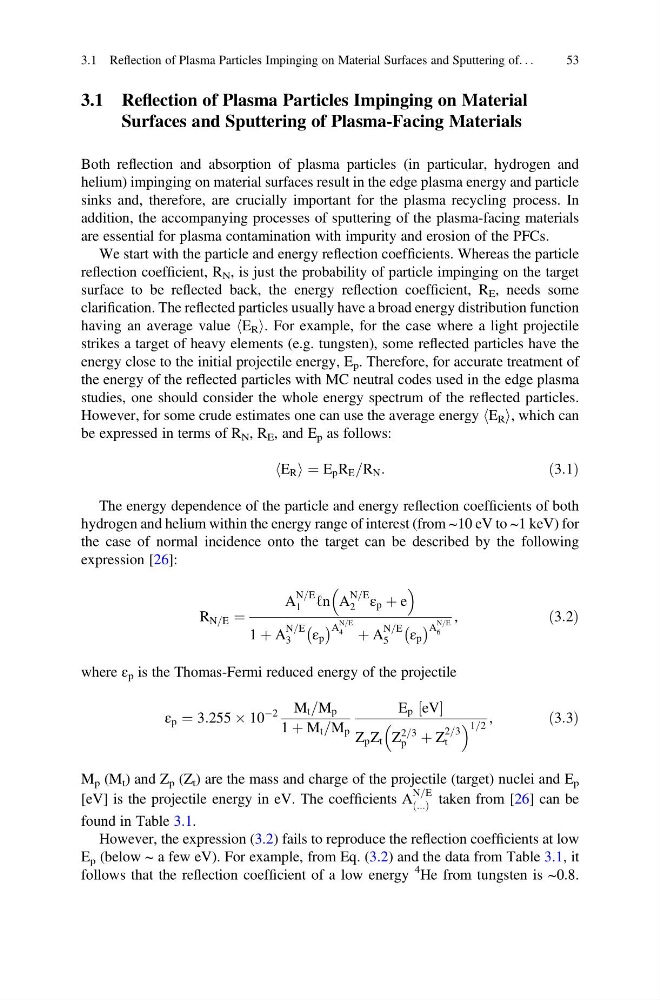
be expressed in terms of R N , R E , and E p as follows:
E R
h i ¼ E p R E =R N :
ð3:1Þ
The energy dependence of the particle and energy reflection coefficients of both
hydrogen and helium within the energy range of interest (from ~10 eV to ~1 keV) for
the case of normal incidence onto the target can be described by the following
expression [26]:
R N=E ¼
A
N=E
1 ℓn A
N=E
2 ε p þ e
1 þ A
N=E
3
ε p
À Á A
N=E
4
þ A
N=E
5
ε p
À Á A
N=E
6
,
ð3:2Þ
where ε p is the Thomas-Fermi reduced energy of the projectile
ε p ¼ 3:255 Â 10
À2
M t =M p
1 þ M t =M p
E p ½eV
Z p Z t
Z
2=3
p þ Z
2=3
t
1=2 ,
ð3:3Þ
M p (M t ) and Z p (Z t ) are the mass and charge of the projectile (target) nuclei and E p
[eV] is the projectile energy in eV. The coefficients A
N=E
...
ð Þ taken from [26] can be
found in Table 3.1.
However, the expression (3.2) fails to reproduce the reflection coefficients at low
E p (below ~ a few eV). For example, from Eq. (3.2) and the data from Table 3.1, it
follows that the reflection coefficient of a low energy
4
He from tungsten is ~0.8.
3.1 Reflection of Plasma Particles Impinging on Material Surfaces and Sputtering of. . .
53
Surfaces and Sputtering of Plasma-Facing Materials
Both reflection and absorption of plasma particles (in particular, hydrogen and
helium) impinging on material surfaces result in the edge plasma energy and particle
sinks and, therefore, are crucially important for the plasma recycling process. In
addition, the accompanying processes of sputtering of the plasma-facing materials
are essential for plasma contamination with impurity and erosion of the PFCs.
We start with the particle and energy reflection coefficients. Whereas the particle
reflection coefficient, R N , is just the probability of particle impinging on the target
surface to be reflected back, the energy reflection coefficient, R E , needs some
clarification. The reflected particles usually have a broad energy distribution function
having an average value hE R i. For example, for the case where a light projectile
strikes a target of heavy elements (e.g. tungsten), some reflected particles have the
energy close to the initial projectile energy, E p . Therefore, for accurate treatment of
the energy of the reflected particles with MC neutral codes used in the edge plasma
studies, one should consider the whole energy spectrum of the reflected particles.
However, for some crude estimates one can use the average energy hE R i, which can
be expressed in terms of R N , R E , and E p as follows:
E R
h i ¼ E p R E =R N :
ð3:1Þ
The energy dependence of the particle and energy reflection coefficients of both
hydrogen and helium within the energy range of interest (from ~10 eV to ~1 keV) for
the case of normal incidence onto the target can be described by the following
expression [26]:
R N=E ¼
A
N=E
1 ℓn A
N=E
2 ε p þ e
1 þ A
N=E
3
ε p
À Á A
N=E
4
þ A
N=E
5
ε p
À Á A
N=E
6
,
ð3:2Þ
where ε p is the Thomas-Fermi reduced energy of the projectile
ε p ¼ 3:255 Â 10
À2
M t =M p
1 þ M t =M p
E p ½eV
Z p Z t
Z
2=3
p þ Z
2=3
t
1=2 ,
ð3:3Þ
M p (M t ) and Z p (Z t ) are the mass and charge of the projectile (target) nuclei and E p
[eV] is the projectile energy in eV. The coefficients A
N=E
...
ð Þ taken from [26] can be
found in Table 3.1.
However, the expression (3.2) fails to reproduce the reflection coefficients at low
E p (below ~ a few eV). For example, from Eq. (3.2) and the data from Table 3.1, it
follows that the reflection coefficient of a low energy
4
He from tungsten is ~0.8.
3.1 Reflection of Plasma Particles Impinging on Material Surfaces and Sputtering of. . .
53