

therein). However, we notice that the formation of the chemical bonds between the
projectile and the target atoms does not necessarily result in chemical sputtering. For
example, in Ref. [40] it was found that beryllium irradiation with hydrogen results in
the formation of beryllium hydride, but, unlike hydrocarbons, it is not volatile and,
therefore, does not contribute to the chemical erosion mechanism.
We also note that both the reflection coefficients and the sputtering yields are
sensitive to the constituency of the very first atomic layers of the target, which can be
altered by mixing/implantation of different target materials (e.g. Be and W) or by the
saturation of these layers with hydrogen or helium.
3.2 Basic Features of Hydrogen/Helium Transport
in Plasma-Facing Materials
Once the hydrogen and/or helium atoms penetrate into the PFC material lattice, they
become subject to complex multi-body interactions with the lattice atoms. For
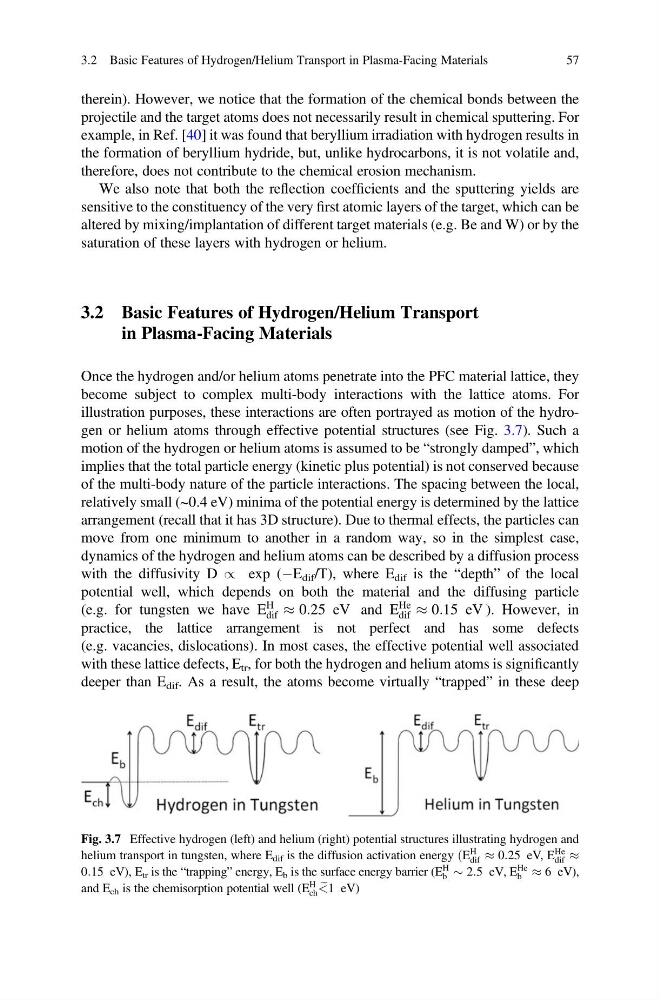
illustration purposes, these interactions are often portrayed as motion of the hydrogen or helium atoms through effective potential structures (see Fig. 3.7). Such a
motion of the hydrogen or helium atoms is assumed to be “strongly damped”, which
implies that the total particle energy (kinetic plus potential) is not conserved because
of the multi-body nature of the particle interactions. The spacing between the local,
relatively small (~0.4 eV) minima of the potential energy is determined by the lattice
arrangement (recall that it has 3D structure). Due to thermal effects, the particles can
move from one minimum to another in a random way, so in the simplest case,
dynamics of the hydrogen and helium atoms can be described by a diffusion process
with the diffusivity D / exp (ÀE dif /T), where E dif is the “depth” of the local
potential well, which depends on both the material and the diffusing particle
(e.g. for tungsten we have E
H
dif % 0:25 eV and E
He
dif % 0:15 eV ). However, in
practice, the lattice arrangement is not perfect and has some defects
(e.g. vacancies, dislocations). In most cases, the effective potential well associated
with these lattice defects, E tr , for both the hydrogen and helium atoms is significantly
deeper than E dif . As a result, the atoms become virtually “trapped” in these deep
Fig. 3.7 Effective hydrogen (left) and helium (right) potential structures illustrating hydrogen and
helium transport in tungsten, where E dif is the diffusion activation energy ðE
H
dif % 0:25 eV, E
He
dif %
0:15 eV), E tr is the “trapping” energy, E b is the surface energy barrier (E
H
b $ 2:5 eV, E
He
b % 6 eV),
and E ch is the chemisorption potential well (E
H
ch
e
<1 eV)
3.2 Basic Features of Hydrogen/Helium Transport in Plasma-Facing Materials
57
projectile and the target atoms does not necessarily result in chemical sputtering. For
example, in Ref. [40] it was found that beryllium irradiation with hydrogen results in
the formation of beryllium hydride, but, unlike hydrocarbons, it is not volatile and,
therefore, does not contribute to the chemical erosion mechanism.
We also note that both the reflection coefficients and the sputtering yields are
sensitive to the constituency of the very first atomic layers of the target, which can be
altered by mixing/implantation of different target materials (e.g. Be and W) or by the
saturation of these layers with hydrogen or helium.
3.2 Basic Features of Hydrogen/Helium Transport
in Plasma-Facing Materials
Once the hydrogen and/or helium atoms penetrate into the PFC material lattice, they
become subject to complex multi-body interactions with the lattice atoms. For
illustration purposes, these interactions are often portrayed as motion of the hydrogen or helium atoms through effective potential structures (see Fig. 3.7). Such a
motion of the hydrogen or helium atoms is assumed to be “strongly damped”, which
implies that the total particle energy (kinetic plus potential) is not conserved because
of the multi-body nature of the particle interactions. The spacing between the local,
relatively small (~0.4 eV) minima of the potential energy is determined by the lattice
arrangement (recall that it has 3D structure). Due to thermal effects, the particles can
move from one minimum to another in a random way, so in the simplest case,
dynamics of the hydrogen and helium atoms can be described by a diffusion process
with the diffusivity D / exp (ÀE dif /T), where E dif is the “depth” of the local
potential well, which depends on both the material and the diffusing particle
(e.g. for tungsten we have E
H
dif % 0:25 eV and E
He
dif % 0:15 eV ). However, in
practice, the lattice arrangement is not perfect and has some defects
(e.g. vacancies, dislocations). In most cases, the effective potential well associated
with these lattice defects, E tr , for both the hydrogen and helium atoms is significantly
deeper than E dif . As a result, the atoms become virtually “trapped” in these deep
Fig. 3.7 Effective hydrogen (left) and helium (right) potential structures illustrating hydrogen and
helium transport in tungsten, where E dif is the diffusion activation energy ðE
H
dif % 0:25 eV, E
He
dif %
0:15 eV), E tr is the “trapping” energy, E b is the surface energy barrier (E
H
b $ 2:5 eV, E
He
b % 6 eV),
and E ch is the chemisorption potential well (E
H
ch
e
<1 eV)
3.2 Basic Features of Hydrogen/Helium Transport in Plasma-Facing Materials
57