

Recalling the CRM (e.g. for atomic hydrogen described by Eqs. (2.12) and
(2.13)), we find that the major simplification of the description of the population
of excited states comes from the fact that the characteristic time for establishing the
quasi-stationary population of excited states is shorter than the characteristic transport time. In this case, the population of excited states can be expressed in terms of
the local density of atomic hydrogen, Eq. (2.13), assuming that the nonlocal effects
of radiation transport are not important. The same approximation is built into
the description of excited states for every ionization state of impurity, but not for
the distribution of the impurity ions over ionization states. The reason for this is that
the characteristic equilibration time scale of the distribution of impurity over ionization states, τ
Z
imp , can be comparable with or even longer than the characteristic
impurity transport time scale, τ
transp
imp . If we assume that τ
transp
imp does not depend on the
impurity charge state, we can write the following approximate balance equation for
the impurity density in the Z-th ionization state n Z (Z > 1) for stationary plasma
parameters [78]:
1
n e
dξ Z
dt
¼ À K
Z
ion þ K
Z
rec
À
Á
ξ Z þ K
ZÀ1
ion ξ ZÀ1 þ K
Zþ1
rec ξ Zþ1 À ξ Z n e τ
transp
imp
À1 ¼ 0,
ð2:31Þ
where K
Z
ion and K
Z
rec are the corresponding ionization and recombination rate
constants, whereas ξ Z ¼ n Z /n imp and n imp ¼ ∑ Z n Z are the partition of impurity
density over the ionization states and the total impurity density. Naturally, K
Z
ion ¼ 0
for the highest charge state and K
Z
rec ¼ 0 for the neutrals. In order to sustain the total
impurity density, the transport term in Eq. (2.31) for neutrals (Z ¼ 0) is replaced with
the corresponding source term. Note that writing ionization balance for the impurity
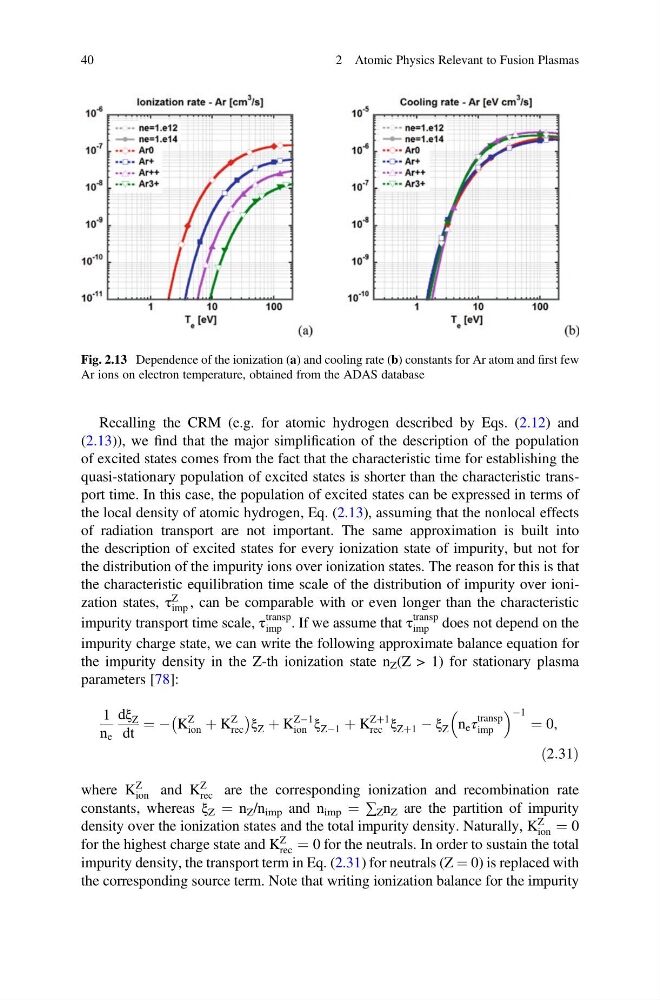
Fig. 2.13 Dependence of the ionization (a) and cooling rate (b) constants for Ar atom and first few
Ar ions on electron temperature, obtained from the ADAS database
40
2 Atomic Physics Relevant to Fusion Plasmas
(2.13)), we find that the major simplification of the description of the population
of excited states comes from the fact that the characteristic time for establishing the
quasi-stationary population of excited states is shorter than the characteristic transport time. In this case, the population of excited states can be expressed in terms of
the local density of atomic hydrogen, Eq. (2.13), assuming that the nonlocal effects
of radiation transport are not important. The same approximation is built into
the description of excited states for every ionization state of impurity, but not for
the distribution of the impurity ions over ionization states. The reason for this is that
the characteristic equilibration time scale of the distribution of impurity over ionization states, τ
Z
imp , can be comparable with or even longer than the characteristic
impurity transport time scale, τ
transp
imp . If we assume that τ
transp
imp does not depend on the
impurity charge state, we can write the following approximate balance equation for
the impurity density in the Z-th ionization state n Z (Z > 1) for stationary plasma
parameters [78]:
1
n e
dξ Z
dt
¼ À K
Z
ion þ K
Z
rec
À
Á
ξ Z þ K
ZÀ1
ion ξ ZÀ1 þ K
Zþ1
rec ξ Zþ1 À ξ Z n e τ
transp
imp
À1 ¼ 0,
ð2:31Þ
where K
Z
ion and K
Z
rec are the corresponding ionization and recombination rate
constants, whereas ξ Z ¼ n Z /n imp and n imp ¼ ∑ Z n Z are the partition of impurity
density over the ionization states and the total impurity density. Naturally, K
Z
ion ¼ 0
for the highest charge state and K
Z
rec ¼ 0 for the neutrals. In order to sustain the total
impurity density, the transport term in Eq. (2.31) for neutrals (Z ¼ 0) is replaced with
the corresponding source term. Note that writing ionization balance for the impurity
Fig. 2.13 Dependence of the ionization (a) and cooling rate (b) constants for Ar atom and first few
Ar ions on electron temperature, obtained from the ADAS database
40
2 Atomic Physics Relevant to Fusion Plasmas