

ions this way, we imply that the transport processes simply remove the charged
particles, replacing them by neutrals. Although in practice impurity transport is
much more complex, such an approach gives a simple and useful estimate for the
impurity radiation loss. By solving the algebraic Eq. (2.31) and neglecting threebody recombination of the impurity ions (which is only important at low temperatures where the impurity radiation loss is insignificant), we find that ξ z only depends
on n e , T e , and n e τ
transp
imp . As a result, we can write the following expression for the
volumetric plasma energy loss due to impurity radiation, W
rad
imp :
W
rad
imp ¼ n e n imp
X
Z
e
K
Z
cool ξ Z n e , T e , n e τ
transp
imp
n e n imp e
L imp n e , T e , n e τ
transp
imp
:
ð2:32Þ
Taking τ
transp
imp ! 1 and neglecting dependence of e
L imp on electron density, we
come to the so-called “coronal approximation” for the impurity radiation loss,
e
L imp L imp T e
ð Þ, which is often used in analytic and semi-analytic models. The
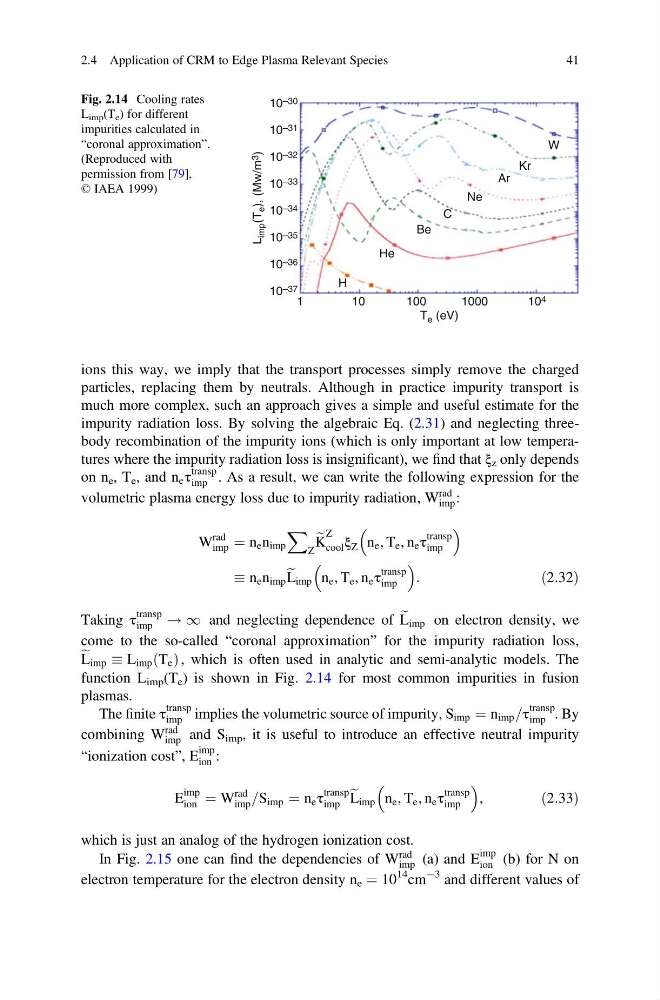
function L imp (T e ) is shown in Fig. 2.14 for most common impurities in fusion
plasmas.
The finite τ
transp
imp implies the volumetric source of impurity, S imp ¼ n imp =τ
transp
imp . By
combining W
rad
imp and S imp , it is useful to introduce an effective neutral impurity
“ionization cost”, E
imp
ion :
E
imp
ion ¼ W
rad
imp =S imp ¼ n e τ
transp
imp
e
L imp n e , T e , n e τ
transp
imp
,
ð2:33Þ
which is just an analog of the hydrogen ionization cost.
In Fig. 2.15 one can find the dependencies of W
rad
imp (a) and E
imp
ion (b) for N on
electron temperature for the electron density n e ¼ 10
14 cm
À3 and different values of
1
1 0
H
He
Be
C
Ne
Ar
Kr
W
L
imp (T
e ), (Mw/m 3
)
10 –37
10 –36
10 –35
10 –34
10 –33
10 –32
10 –31
10 –30
100
1000
T e (eV)
10 4
Fig. 2.14 Cooling rates
L imp (T e ) for different
impurities calculated in
“coronal approximation”.
(Reproduced with
permission from [79],
© IAEA 1999)
2.4 Application of CRM to Edge Plasma Relevant Species
41
particles, replacing them by neutrals. Although in practice impurity transport is
much more complex, such an approach gives a simple and useful estimate for the
impurity radiation loss. By solving the algebraic Eq. (2.31) and neglecting threebody recombination of the impurity ions (which is only important at low temperatures where the impurity radiation loss is insignificant), we find that ξ z only depends
on n e , T e , and n e τ
transp
imp . As a result, we can write the following expression for the
volumetric plasma energy loss due to impurity radiation, W
rad
imp :
W
rad
imp ¼ n e n imp
X
Z
e
K
Z
cool ξ Z n e , T e , n e τ
transp
imp
n e n imp e
L imp n e , T e , n e τ
transp
imp
:
ð2:32Þ
Taking τ
transp
imp ! 1 and neglecting dependence of e
L imp on electron density, we
come to the so-called “coronal approximation” for the impurity radiation loss,
e
L imp L imp T e
ð Þ, which is often used in analytic and semi-analytic models. The
function L imp (T e ) is shown in Fig. 2.14 for most common impurities in fusion
plasmas.
The finite τ
transp
imp implies the volumetric source of impurity, S imp ¼ n imp =τ
transp
imp . By
combining W
rad
imp and S imp , it is useful to introduce an effective neutral impurity
“ionization cost”, E
imp
ion :
E
imp
ion ¼ W
rad
imp =S imp ¼ n e τ
transp
imp
e
L imp n e , T e , n e τ
transp
imp
,
ð2:33Þ
which is just an analog of the hydrogen ionization cost.
In Fig. 2.15 one can find the dependencies of W
rad
imp (a) and E
imp
ion (b) for N on
electron temperature for the electron density n e ¼ 10
14 cm
À3 and different values of
1
1 0
H
He
Be
C
Ne
Ar
Kr
W
L
imp (T
e ), (Mw/m 3
)
10 –37
10 –36
10 –35
10 –34
10 –33
10 –32
10 –31
10 –30
100
1000
T e (eV)
10 4
Fig. 2.14 Cooling rates
L imp (T e ) for different
impurities calculated in
“coronal approximation”.
(Reproduced with
permission from [79],
© IAEA 1999)
2.4 Application of CRM to Edge Plasma Relevant Species
41