

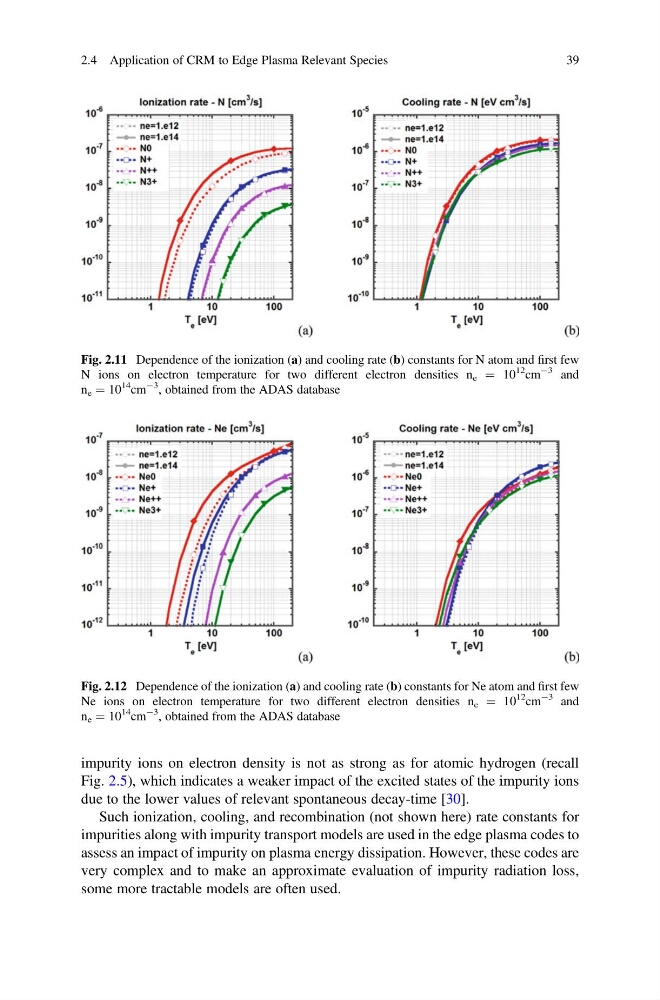
impurity ions on electron density is not as strong as for atomic hydrogen (recall
Fig. 2.5), which indicates a weaker impact of the excited states of the impurity ions
due to the lower values of relevant spontaneous decay-time [30].
Such ionization, cooling, and recombination (not shown here) rate constants for
impurities along with impurity transport models are used in the edge plasma codes to
assess an impact of impurity on plasma energy dissipation. However, these codes are
very complex and to make an approximate evaluation of impurity radiation loss,
some more tractable models are often used.
Fig. 2.11 Dependence of the ionization (a) and cooling rate (b) constants for N atom and first few
N ions on electron temperature for two different electron densities n e ¼ 10
12
cm
À3 and
n e ¼ 10
14
cm
À3
, obtained from the ADAS database
Fig. 2.12 Dependence of the ionization (a) and cooling rate (b) constants for Ne atom and first few
Ne ions on electron temperature for two different electron densities n e ¼ 10
12
cm
À3 and
n e ¼ 10
14
cm
À3
, obtained from the ADAS database
2.4 Application of CRM to Edge Plasma Relevant Species
39
Fig. 2.5), which indicates a weaker impact of the excited states of the impurity ions
due to the lower values of relevant spontaneous decay-time [30].
Such ionization, cooling, and recombination (not shown here) rate constants for
impurities along with impurity transport models are used in the edge plasma codes to
assess an impact of impurity on plasma energy dissipation. However, these codes are
very complex and to make an approximate evaluation of impurity radiation loss,
some more tractable models are often used.
Fig. 2.11 Dependence of the ionization (a) and cooling rate (b) constants for N atom and first few
N ions on electron temperature for two different electron densities n e ¼ 10
12
cm
À3 and
n e ¼ 10
14
cm
À3
, obtained from the ADAS database
Fig. 2.12 Dependence of the ionization (a) and cooling rate (b) constants for Ne atom and first few
Ne ions on electron temperature for two different electron densities n e ¼ 10
12
cm
À3 and
n e ¼ 10
14
cm
À3
, obtained from the ADAS database
2.4 Application of CRM to Edge Plasma Relevant Species
39