

2.4.2 Impurities
The energy loss due to impurity radiation plays an important role in many phenomena observed in the edge plasma, e.g. MARFE (which stands for the Multifaceted
Asymmetric Radiation From the Edge) and divertor plasma detachment (see
Chap. 9). Therefore, the data obtained with the CRM discussed above are widely
used in both simplified estimates and comprehensive numerical simulations. Due to
the relatively low density of impurity in the edge plasma in the “standard” regime of
operation, trapping of impurity line radiation is not important. However, in some
particular cases, where the generation of a dense cloud of impurities takes place
(e.g. disruptions, injection of large dust grains into edge plasma, etc.), trapping of
impurity line radiation becomes important (e.g. see [76]).
Today, the main source of fusion-relevant atomic data including impurity, which
is widely used in magnetic and astrophysical communities for both diagnostic
purposes and numerical simulations, is the ADAS database [30, 41], which provides
the rate constants for different atomic processes, radiation energy loss by different
charge states of many impurities, the contribution to the radiation loss of different
lines, etc.
In this sub-section, we present particular examples of impurity charge state
distribution and corresponding radiation energy loss and discuss some simplified
models for the impurity radiation loss used in the literature.
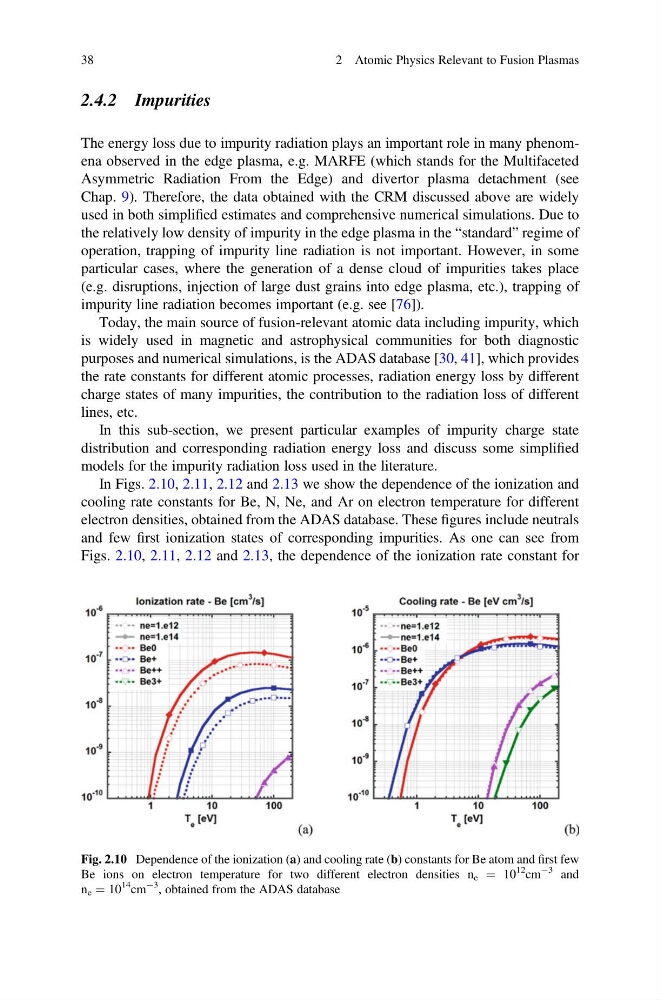
In Figs. 2.10, 2.11, 2.12 and 2.13 we show the dependence of the ionization and
cooling rate constants for Be, N, Ne, and Ar on electron temperature for different
electron densities, obtained from the ADAS database. These figures include neutrals
and few first ionization states of corresponding impurities. As one can see from
Figs. 2.10, 2.11, 2.12 and 2.13, the dependence of the ionization rate constant for
Fig. 2.10 Dependence of the ionization (a) and cooling rate (b) constants for Be atom and first few
Be ions on electron temperature for two different electron densities n e ¼ 10
12
cm
À3 and
n e ¼ 10
14
cm
À3
, obtained from the ADAS database
38
2 Atomic Physics Relevant to Fusion Plasmas
The energy loss due to impurity radiation plays an important role in many phenomena observed in the edge plasma, e.g. MARFE (which stands for the Multifaceted
Asymmetric Radiation From the Edge) and divertor plasma detachment (see
Chap. 9). Therefore, the data obtained with the CRM discussed above are widely
used in both simplified estimates and comprehensive numerical simulations. Due to
the relatively low density of impurity in the edge plasma in the “standard” regime of
operation, trapping of impurity line radiation is not important. However, in some
particular cases, where the generation of a dense cloud of impurities takes place
(e.g. disruptions, injection of large dust grains into edge plasma, etc.), trapping of
impurity line radiation becomes important (e.g. see [76]).
Today, the main source of fusion-relevant atomic data including impurity, which
is widely used in magnetic and astrophysical communities for both diagnostic
purposes and numerical simulations, is the ADAS database [30, 41], which provides
the rate constants for different atomic processes, radiation energy loss by different
charge states of many impurities, the contribution to the radiation loss of different
lines, etc.
In this sub-section, we present particular examples of impurity charge state
distribution and corresponding radiation energy loss and discuss some simplified
models for the impurity radiation loss used in the literature.
In Figs. 2.10, 2.11, 2.12 and 2.13 we show the dependence of the ionization and
cooling rate constants for Be, N, Ne, and Ar on electron temperature for different
electron densities, obtained from the ADAS database. These figures include neutrals
and few first ionization states of corresponding impurities. As one can see from
Figs. 2.10, 2.11, 2.12 and 2.13, the dependence of the ionization rate constant for
Fig. 2.10 Dependence of the ionization (a) and cooling rate (b) constants for Be atom and first few
Be ions on electron temperature for two different electron densities n e ¼ 10
12
cm
À3 and
n e ¼ 10
14
cm
À3
, obtained from the ADAS database
38
2 Atomic Physics Relevant to Fusion Plasmas