

K
e
ð Þ
k!n n e ¼
Z
σ
e
ð Þ
k!n v
ð Þvf e v
!
, r
! , t
dv
! ,
ð2:11Þ
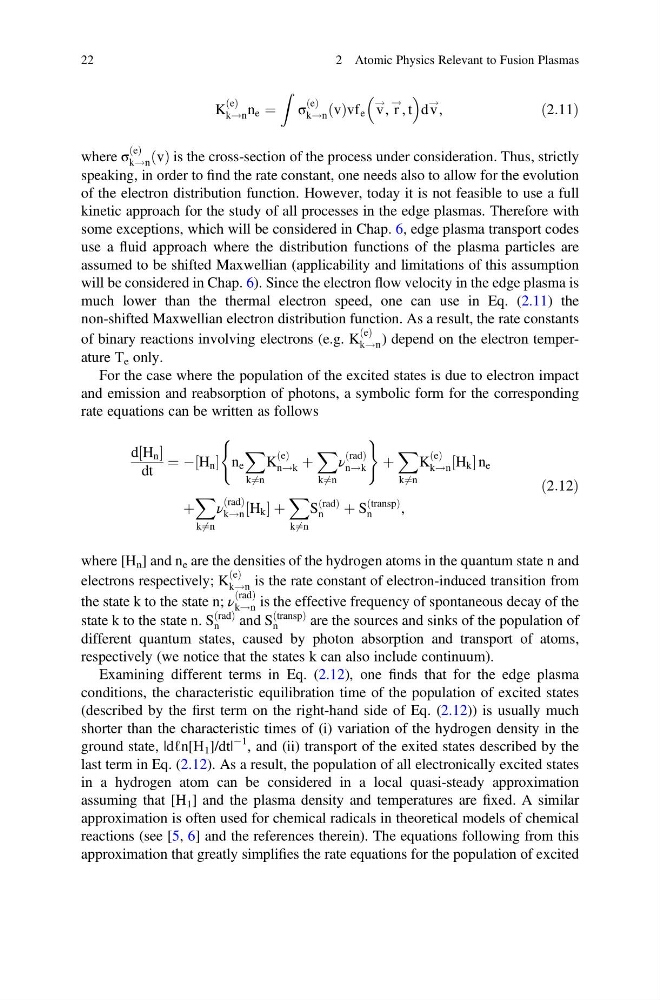
where σ
e
ð Þ
k!n v
ð Þ is the cross-section of the process under consideration. Thus, strictly
speaking, in order to find the rate constant, one needs also to allow for the evolution
of the electron distribution function. However, today it is not feasible to use a full
kinetic approach for the study of all processes in the edge plasmas. Therefore with
some exceptions, which will be considered in Chap. 6, edge plasma transport codes
use a fluid approach where the distribution functions of the plasma particles are
assumed to be shifted Maxwellian (applicability and limitations of this assumption
will be considered in Chap. 6). Since the electron flow velocity in the edge plasma is
much lower than the thermal electron speed, one can use in Eq. (2.11) the
non-shifted Maxwellian electron distribution function. As a result, the rate constants
of binary reactions involving electrons (e.g. K
e
ð Þ
k!n ) depend on the electron temperature T e only.
For the case where the population of the excited states is due to electron impact
and emission and reabsorption of photons, a symbolic form for the corresponding
rate equations can be written as follows
d H n
½
dt
¼ À H n
½ n e
X
k6 ¼n
K
e
ð Þ
n!k þ
X
k6 ¼n
ν
rad
ð Þ
n!k
(
)
þ
X
k6 ¼n
K
e
ð Þ
k!n H k
½ n e
þ
X
k6 ¼n
ν
rad
ð Þ
k!n H k
½ þ
X
k6 ¼n
S
rad
ð Þ
n
þ S
transp
ð
Þ
n
,
ð2:12Þ
where [H n ] and n e are the densities of the hydrogen atoms in the quantum state n and
electrons respectively; K
e
ð Þ
k!n is the rate constant of electron-induced transition from
the state k to the state n; ν
rad
ð Þ
k!n is the effective frequency of spontaneous decay of the
state k to the state n. S
rad
ð Þ
n
and S
transp
ð
Þ
n
are the sources and sinks of the population of
different quantum states, caused by photon absorption and transport of atoms,
respectively (we notice that the states k can also include continuum).
Examining different terms in Eq. (2.12), one finds that for the edge plasma
conditions, the characteristic equilibration time of the population of excited states
(described by the first term on the right-hand side of Eq. (2.12)) is usually much
shorter than the characteristic times of (i) variation of the hydrogen density in the
ground state, |dℓn[H 1 ]/dt|
À1 , and (ii) transport of the exited states described by the
last term in Eq. (2.12). As a result, the population of all electronically excited states
in a hydrogen atom can be considered in a local quasi-steady approximation
assuming that [H 1 ] and the plasma density and temperatures are fixed. A similar
approximation is often used for chemical radicals in theoretical models of chemical
reactions (see [5, 6] and the references therein). The equations following from this
approximation that greatly simplifies the rate equations for the population of excited
22
2 Atomic Physics Relevant to Fusion Plasmas
e
ð Þ
k!n n e ¼
Z
σ
e
ð Þ
k!n v
ð Þvf e v
!
, r
! , t
dv
! ,
ð2:11Þ
where σ
e
ð Þ
k!n v
ð Þ is the cross-section of the process under consideration. Thus, strictly
speaking, in order to find the rate constant, one needs also to allow for the evolution
of the electron distribution function. However, today it is not feasible to use a full
kinetic approach for the study of all processes in the edge plasmas. Therefore with
some exceptions, which will be considered in Chap. 6, edge plasma transport codes
use a fluid approach where the distribution functions of the plasma particles are
assumed to be shifted Maxwellian (applicability and limitations of this assumption
will be considered in Chap. 6). Since the electron flow velocity in the edge plasma is
much lower than the thermal electron speed, one can use in Eq. (2.11) the
non-shifted Maxwellian electron distribution function. As a result, the rate constants
of binary reactions involving electrons (e.g. K
e
ð Þ
k!n ) depend on the electron temperature T e only.
For the case where the population of the excited states is due to electron impact
and emission and reabsorption of photons, a symbolic form for the corresponding
rate equations can be written as follows
d H n
½
dt
¼ À H n
½ n e
X
k6 ¼n
K
e
ð Þ
n!k þ
X
k6 ¼n
ν
rad
ð Þ
n!k
(
)
þ
X
k6 ¼n
K
e
ð Þ
k!n H k
½ n e
þ
X
k6 ¼n
ν
rad
ð Þ
k!n H k
½ þ
X
k6 ¼n
S
rad
ð Þ
n
þ S
transp
ð
Þ
n
,
ð2:12Þ
where [H n ] and n e are the densities of the hydrogen atoms in the quantum state n and
electrons respectively; K
e
ð Þ
k!n is the rate constant of electron-induced transition from
the state k to the state n; ν
rad
ð Þ
k!n is the effective frequency of spontaneous decay of the
state k to the state n. S
rad
ð Þ
n
and S
transp
ð
Þ
n
are the sources and sinks of the population of
different quantum states, caused by photon absorption and transport of atoms,
respectively (we notice that the states k can also include continuum).
Examining different terms in Eq. (2.12), one finds that for the edge plasma
conditions, the characteristic equilibration time of the population of excited states
(described by the first term on the right-hand side of Eq. (2.12)) is usually much
shorter than the characteristic times of (i) variation of the hydrogen density in the
ground state, |dℓn[H 1 ]/dt|
À1 , and (ii) transport of the exited states described by the
last term in Eq. (2.12). As a result, the population of all electronically excited states
in a hydrogen atom can be considered in a local quasi-steady approximation
assuming that [H 1 ] and the plasma density and temperatures are fixed. A similar
approximation is often used for chemical radicals in theoretical models of chemical
reactions (see [5, 6] and the references therein). The equations following from this
approximation that greatly simplifies the rate equations for the population of excited
22
2 Atomic Physics Relevant to Fusion Plasmas