

and ion ionization [3] to electron excitation (e.g. the electron impact excitation of
hydrogen-like ions from n ¼ 1 to k ¼ 2 follows Eq. (2.9) for a wide range of Z [24]).
Equation (2.9) predicts an important feature of the excitation and ionization crosssections: their maximum values, which are ~(ΔE nk )
À2 , increase roughly ~n
4 with
increasing n. In addition, both the excitation and ionization energy thresholds
decrease with increasing n, which increases the number of electrons that can
contribute to these transitions. The latter circumstance is particularly important for
low-temperature plasma, such that T < I H . Finally, recalling Eq. (2.3), we see that the
rate of spontaneous decay of highly excited states falls down. All these effects
suggest an appreciable population of the excited states and emphasize the importance of these states in overall reaction rates (e.g. hydrogen ionization).
In other words, the so-called multistep processes including multiple excitation/
de-excitation of atoms, molecules, and ions with subsequent ionization, radiation,
recombination and other processes affecting the population of excited states can
significantly alter the rates of many atomic processes. They include not only
ionization, recombination, and radiation loss, but also many other processes. Moreover, as we will see later, the presence of excited particles can “switch on” some
important chemical reactions, which would not be possible otherwise.
To allow properly for the impact of the excited states on the rates of different
atomic processes, one should consider the rate equations for the populations of these
states. As an illustration, we consider here the rate equations for the excited states of
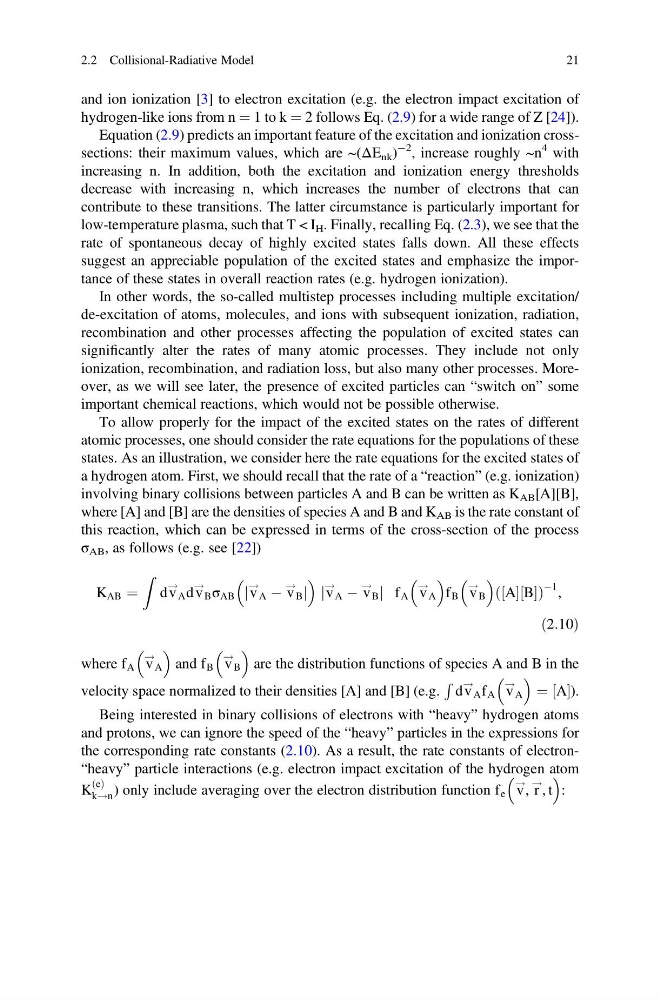
a hydrogen atom. First, we should recall that the rate of a “reaction” (e.g. ionization)
involving binary collisions between particles A and B can be written as K AB [A][B],
where [A] and [B] are the densities of species A and B and K AB is the rate constant of
this reaction, which can be expressed in terms of the cross-section of the process
σ AB , as follows (e.g. see [22])
K AB ¼
Z
dv
!
A dv
!
B σ AB jv
!
A À v
!
B j
jv
!
A À v
!
B j f A v
!
A
f B v
!
B
A
½ B
½
ð
Þ
À1 ,
ð2:10Þ
where f A v
!
A
and f B v
!
B
are the distribution functions of species A and B in the
velocity space normalized to their densities [A] and [B] (e.g.
R
dv
!
A f A v
!
A
¼ A
½ ).
Being interested in binary collisions of electrons with “heavy” hydrogen atoms
and protons, we can ignore the speed of the “heavy” particles in the expressions for
the corresponding rate constants (2.10). As a result, the rate constants of electron“heavy” particle interactions (e.g. electron impact excitation of the hydrogen atom
K
e
ð Þ
k!n ) only include averaging over the electron distribution function f e v
! , r
!
, t
:
2.2 Collisional-Radiative Model
21
hydrogen-like ions from n ¼ 1 to k ¼ 2 follows Eq. (2.9) for a wide range of Z [24]).
Equation (2.9) predicts an important feature of the excitation and ionization crosssections: their maximum values, which are ~(ΔE nk )
À2 , increase roughly ~n
4 with
increasing n. In addition, both the excitation and ionization energy thresholds
decrease with increasing n, which increases the number of electrons that can
contribute to these transitions. The latter circumstance is particularly important for
low-temperature plasma, such that T < I H . Finally, recalling Eq. (2.3), we see that the
rate of spontaneous decay of highly excited states falls down. All these effects
suggest an appreciable population of the excited states and emphasize the importance of these states in overall reaction rates (e.g. hydrogen ionization).
In other words, the so-called multistep processes including multiple excitation/
de-excitation of atoms, molecules, and ions with subsequent ionization, radiation,
recombination and other processes affecting the population of excited states can
significantly alter the rates of many atomic processes. They include not only
ionization, recombination, and radiation loss, but also many other processes. Moreover, as we will see later, the presence of excited particles can “switch on” some
important chemical reactions, which would not be possible otherwise.
To allow properly for the impact of the excited states on the rates of different
atomic processes, one should consider the rate equations for the populations of these
states. As an illustration, we consider here the rate equations for the excited states of
a hydrogen atom. First, we should recall that the rate of a “reaction” (e.g. ionization)
involving binary collisions between particles A and B can be written as K AB [A][B],
where [A] and [B] are the densities of species A and B and K AB is the rate constant of
this reaction, which can be expressed in terms of the cross-section of the process
σ AB , as follows (e.g. see [22])
K AB ¼
Z
dv
!
A dv
!
B σ AB jv
!
A À v
!
B j
jv
!
A À v
!
B j f A v
!
A
f B v
!
B
A
½ B
½
ð
Þ
À1 ,
ð2:10Þ
where f A v
!
A
and f B v
!
B
are the distribution functions of species A and B in the
velocity space normalized to their densities [A] and [B] (e.g.
R
dv
!
A f A v
!
A
¼ A
½ ).
Being interested in binary collisions of electrons with “heavy” hydrogen atoms
and protons, we can ignore the speed of the “heavy” particles in the expressions for
the corresponding rate constants (2.10). As a result, the rate constants of electron“heavy” particle interactions (e.g. electron impact excitation of the hydrogen atom
K
e
ð Þ
k!n ) only include averaging over the electron distribution function f e v
! , r
!
, t
:
2.2 Collisional-Radiative Model
21