

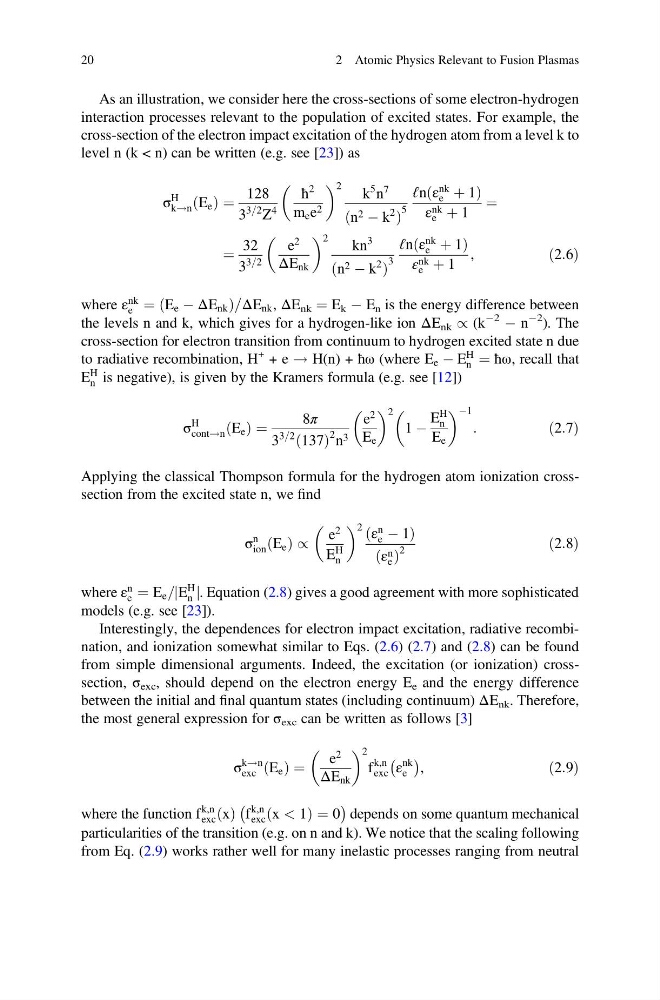
As an illustration, we consider here the cross-sections of some electron-hydrogen
interaction processes relevant to the population of excited states. For example, the
cross-section of the electron impact excitation of the hydrogen atom from a level k to
level n (k < n) can be written (e.g. see [23]) as
σ
H
k!n ðE e Þ ¼
128
3
3=2 Z
4
ħ
2
m e e 2
2 k
5 n
7
ðn 2 À k
2
Þ
5
ℓnðε
nk
e þ 1Þ
ε nk
e þ 1
¼
¼
32
3
3=2
e
2
ΔE nk
2
kn
3
ðn 2 À k
2
Þ
3
ℓnðε
nk
e þ 1Þ
ε nk
e þ 1
,
ð2:6Þ
where ε
nk
e ¼ E e À ΔE nk
ð
Þ =ΔE nk , ΔE nk ¼ E k À E n is the energy difference between
the levels n and k, which gives for a hydrogen-like ion ΔE nk / (k
À2
À n
À2 ). The
cross-section for electron transition from continuum to hydrogen excited state n due
to radiative recombination, H
+ + e ! H(n) + ħω (where E e À E
H
n ¼ ħω, recall that
E
H
n is negative), is given by the Kramers formula (e.g. see [12])
σ
H
cont!n E e
ð Þ ¼
8π
3
3=2 137
ð
Þ
2 n 3
e
2
E e
2
1 À
E
H
n
E e
À1
:
ð2:7Þ
Applying the classical Thompson formula for the hydrogen atom ionization crosssection from the excited state n, we find
σ
n
ion ðE e Þ /
e
2
E
H
n
2 ðε
n
e À 1Þ
ðε n
e Þ
2
ð2:8Þ
where ε
n
e ¼ E e =jE
H
n j. Equation (2.8) gives a good agreement with more sophisticated
models (e.g. see [23]).
Interestingly, the dependences for electron impact excitation, radiative recombination, and ionization somewhat similar to Eqs. (2.6) (2.7) and (2.8) can be found
from simple dimensional arguments. Indeed, the excitation (or ionization) crosssection, σ exc , should depend on the electron energy E e and the energy difference
between the initial and final quantum states (including continuum) ΔE nk . Therefore,
the most general expression for σ exc can be written as follows [3]
σ
k!n
exc E e
ð Þ ¼
e
2
ΔE nk
2
f
k,n
exc ε
nk
e
À Á
,
ð2:9Þ
where the function f
k,n
exc x
ð Þ f
k,n
exc x < 1
ð
Þ¼0
À
Á
depends on some quantum mechanical
particularities of the transition (e.g. on n and k). We notice that the scaling following
from Eq. (2.9) works rather well for many inelastic processes ranging from neutral
20
2 Atomic Physics Relevant to Fusion Plasmas
interaction processes relevant to the population of excited states. For example, the
cross-section of the electron impact excitation of the hydrogen atom from a level k to
level n (k < n) can be written (e.g. see [23]) as
σ
H
k!n ðE e Þ ¼
128
3
3=2 Z
4
ħ
2
m e e 2
2 k
5 n
7
ðn 2 À k
2
Þ
5
ℓnðε
nk
e þ 1Þ
ε nk
e þ 1
¼
¼
32
3
3=2
e
2
ΔE nk
2
kn
3
ðn 2 À k
2
Þ
3
ℓnðε
nk
e þ 1Þ
ε nk
e þ 1
,
ð2:6Þ
where ε
nk
e ¼ E e À ΔE nk
ð
Þ =ΔE nk , ΔE nk ¼ E k À E n is the energy difference between
the levels n and k, which gives for a hydrogen-like ion ΔE nk / (k
À2
À n
À2 ). The
cross-section for electron transition from continuum to hydrogen excited state n due
to radiative recombination, H
+ + e ! H(n) + ħω (where E e À E
H
n ¼ ħω, recall that
E
H
n is negative), is given by the Kramers formula (e.g. see [12])
σ
H
cont!n E e
ð Þ ¼
8π
3
3=2 137
ð
Þ
2 n 3
e
2
E e
2
1 À
E
H
n
E e
À1
:
ð2:7Þ
Applying the classical Thompson formula for the hydrogen atom ionization crosssection from the excited state n, we find
σ
n
ion ðE e Þ /
e
2
E
H
n
2 ðε
n
e À 1Þ
ðε n
e Þ
2
ð2:8Þ
where ε
n
e ¼ E e =jE
H
n j. Equation (2.8) gives a good agreement with more sophisticated
models (e.g. see [23]).
Interestingly, the dependences for electron impact excitation, radiative recombination, and ionization somewhat similar to Eqs. (2.6) (2.7) and (2.8) can be found
from simple dimensional arguments. Indeed, the excitation (or ionization) crosssection, σ exc , should depend on the electron energy E e and the energy difference
between the initial and final quantum states (including continuum) ΔE nk . Therefore,
the most general expression for σ exc can be written as follows [3]
σ
k!n
exc E e
ð Þ ¼
e
2
ΔE nk
2
f
k,n
exc ε
nk
e
À Á
,
ð2:9Þ
where the function f
k,n
exc x
ð Þ f
k,n
exc x < 1
ð
Þ¼0
À
Á
depends on some quantum mechanical
particularities of the transition (e.g. on n and k). We notice that the scaling following
from Eq. (2.9) works rather well for many inelastic processes ranging from neutral
20
2 Atomic Physics Relevant to Fusion Plasmas