

states are called the Collisional-Radiative Model. Originally, it was developed for
hydrogen, and then extended to helium, impurities, and molecular hydrogen (e.g. see
[12, 13, 25–31] and the references therein).
The CRM can be simplified further by using proximity of the states with n % n max
to continuum and describing their population by the local thermodynamic equilibrium (LTE) by implementing the Saha equilibrium, so that H n max
½
/ H
þ
½ n e , (see
[5, 12, 13, 25, 26, 29] and the references therein). Moreover, since in edge plasmas
H 1
½ )
P
n¼n max
n¼2
H n
½ , we can assume that [H 1 ] is equal to the density of atomic
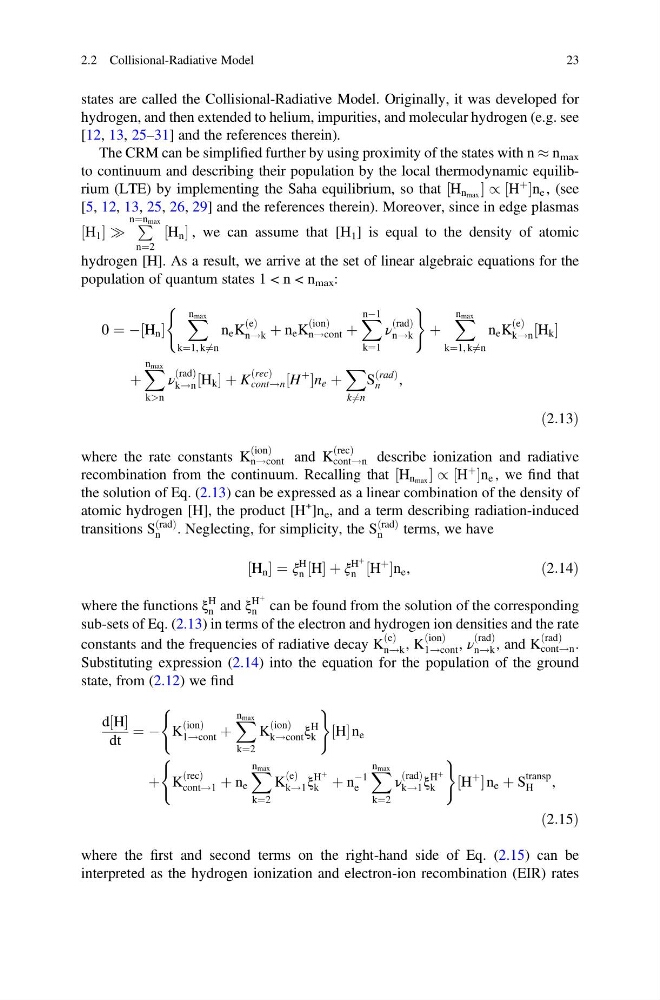
hydrogen [H]. As a result, we arrive at the set of linear algebraic equations for the
population of quantum states 1 < n < n max :
0 ¼ À H n
½
X n max
k¼1, k6 ¼n
n e K
e
ð Þ
n!k þ n e K
ion
ð Þ
n!cont þ
X nÀ1
k¼1
ν
rad
ð Þ
n!k
(
)
þ
X n max
k¼1, k6 ¼n
n e K
e
ð Þ
k!n H k
½
þ
X n max
k>n
ν
rad
ð Þ
k!n H k
½ þ K
rec
ð Þ
cont!n H
þ
½ n e þ
X
k6 ¼n
S
rad
ð Þ
n
,
ð2:13Þ
where the rate constants K
ion
ð Þ
n!cont and K
rec
ð Þ
cont!n describe ionization and radiative
recombination from the continuum. Recalling that H n max
½
/ H
þ
½ n e , we find that
the solution of Eq. (2.13) can be expressed as a linear combination of the density of
atomic hydrogen [H], the product [H
+
]n e , and a term describing radiation-induced
transitions S
rad
ð Þ
n
. Neglecting, for simplicity, the S
rad
ð Þ
n
terms, we have
H n
½ ¼ ξ
H
n H
½ þ ξ
H
þ
n H
þ
½ n e ,
ð2:14Þ
where the functions ξ
H
n and ξ
H
þ
n can be found from the solution of the corresponding
sub-sets of Eq. (2.13) in terms of the electron and hydrogen ion densities and the rate
constants and the frequencies of radiative decay K
e
ð Þ
n!k , K
ion
ð Þ
1!cont , ν
rad
ð Þ
n!k , and K
rad
ð Þ
cont!n .
Substituting expression (2.14) into the equation for the population of the ground
state, from (2.12) we find
d H
½
dt
¼ À K
ion
ð Þ
1!cont þ
X n max
k¼2
K
ion
ð Þ
k!cont ξ
H
k
(
)
H
½ n e
þ K
rec
ð Þ
cont!1 þ n e
X n max
k¼2
K
e
ð Þ
k!1 ξ
H
þ
k þ n
À1
e
X n max
k¼2
ν
rad
ð Þ
k!1 ξ
H
þ
k
(
)
H
þ
½ n e þ S
transp
H
,
ð2:15Þ
where the first and second terms on the right-hand side of Eq. (2.15) can be
interpreted as the hydrogen ionization and electron-ion recombination (EIR) rates
2.2 Collisional-Radiative Model
23
hydrogen, and then extended to helium, impurities, and molecular hydrogen (e.g. see
[12, 13, 25–31] and the references therein).
The CRM can be simplified further by using proximity of the states with n % n max
to continuum and describing their population by the local thermodynamic equilibrium (LTE) by implementing the Saha equilibrium, so that H n max
½
/ H
þ
½ n e , (see
[5, 12, 13, 25, 26, 29] and the references therein). Moreover, since in edge plasmas
H 1
½ )
P
n¼n max
n¼2
H n
½ , we can assume that [H 1 ] is equal to the density of atomic
hydrogen [H]. As a result, we arrive at the set of linear algebraic equations for the
population of quantum states 1 < n < n max :
0 ¼ À H n
½
X n max
k¼1, k6 ¼n
n e K
e
ð Þ
n!k þ n e K
ion
ð Þ
n!cont þ
X nÀ1
k¼1
ν
rad
ð Þ
n!k
(
)
þ
X n max
k¼1, k6 ¼n
n e K
e
ð Þ
k!n H k
½
þ
X n max
k>n
ν
rad
ð Þ
k!n H k
½ þ K
rec
ð Þ
cont!n H
þ
½ n e þ
X
k6 ¼n
S
rad
ð Þ
n
,
ð2:13Þ
where the rate constants K
ion
ð Þ
n!cont and K
rec
ð Þ
cont!n describe ionization and radiative
recombination from the continuum. Recalling that H n max
½
/ H
þ
½ n e , we find that
the solution of Eq. (2.13) can be expressed as a linear combination of the density of
atomic hydrogen [H], the product [H
+
]n e , and a term describing radiation-induced
transitions S
rad
ð Þ
n
. Neglecting, for simplicity, the S
rad
ð Þ
n
terms, we have
H n
½ ¼ ξ
H
n H
½ þ ξ
H
þ
n H
þ
½ n e ,
ð2:14Þ
where the functions ξ
H
n and ξ
H
þ
n can be found from the solution of the corresponding
sub-sets of Eq. (2.13) in terms of the electron and hydrogen ion densities and the rate
constants and the frequencies of radiative decay K
e
ð Þ
n!k , K
ion
ð Þ
1!cont , ν
rad
ð Þ
n!k , and K
rad
ð Þ
cont!n .
Substituting expression (2.14) into the equation for the population of the ground
state, from (2.12) we find
d H
½
dt
¼ À K
ion
ð Þ
1!cont þ
X n max
k¼2
K
ion
ð Þ
k!cont ξ
H
k
(
)
H
½ n e
þ K
rec
ð Þ
cont!1 þ n e
X n max
k¼2
K
e
ð Þ
k!1 ξ
H
þ
k þ n
À1
e
X n max
k¼2
ν
rad
ð Þ
k!1 ξ
H
þ
k
(
)
H
þ
½ n e þ S
transp
H
,
ð2:15Þ
where the first and second terms on the right-hand side of Eq. (2.15) can be
interpreted as the hydrogen ionization and electron-ion recombination (EIR) rates
2.2 Collisional-Radiative Model
23