

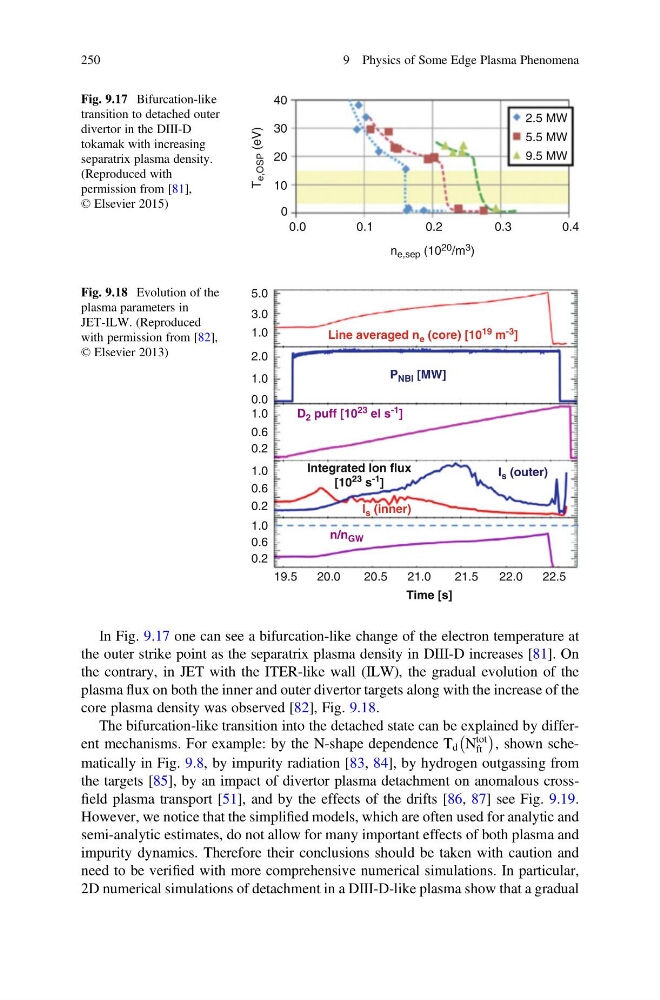
In Fig. 9.17 one can see a bifurcation-like change of the electron temperature at
the outer strike point as the separatrix plasma density in DIII-D increases [81]. On
the contrary, in JET with the ITER-like wall (ILW), the gradual evolution of the
plasma flux on both the inner and outer divertor targets along with the increase of the
core plasma density was observed [82], Fig. 9.18.
The bifurcation-like transition into the detached state can be explained by different mechanisms. For example: by the N-shape dependence T d N
tot
ft
À Á
, shown schematically in Fig. 9.8, by impurity radiation [83, 84], by hydrogen outgassing from
the targets [85], by an impact of divertor plasma detachment on anomalous crossfield plasma transport [51], and by the effects of the drifts [86, 87] see Fig. 9.19.
However, we notice that the simplified models, which are often used for analytic and
semi-analytic estimates, do not allow for many important effects of both plasma and
impurity dynamics. Therefore their conclusions should be taken with caution and
need to be verified with more comprehensive numerical simulations. In particular,
2D numerical simulations of detachment in a DIII-D-like plasma show that a gradual
40
30
20
10
0
0.0
0.1
0.2
n e,sep (10 20 /m 3 )
T
e,OSP (eV)
0.3
2.5 MW
5.5 MW
9.5 MW
0.4
Fig. 9.17 Bifurcation-like
transition to detached outer
divertor in the DIII-D
tokamak with increasing
separatrix plasma density.
(Reproduced with
permission from [81],
© Elsevier 2015)
5.0
3.0
1.0
2.0
1.0
1.0
0.6
0.2
1.0
0.6
0.2
1.0
0.6
0.2
19.5
20.0
20.5
21.0
Time [s]
Line averaged n e (core) [10
19 m
-3 ]
Integrated lon flux
[10
23 s
-1 ]
l s (inner)
n/n GW
l s (outer)
D 2 puff [10
23 el s
-1 ]
P NBI [MW]
21.5
22.0
22.5
0.0
Fig. 9.18 Evolution of the
plasma parameters in
JET-ILW. (Reproduced
with permission from [82],
© Elsevier 2013)
250
9 Physics of Some Edge Plasma Phenomena
the outer strike point as the separatrix plasma density in DIII-D increases [81]. On
the contrary, in JET with the ITER-like wall (ILW), the gradual evolution of the
plasma flux on both the inner and outer divertor targets along with the increase of the
core plasma density was observed [82], Fig. 9.18.
The bifurcation-like transition into the detached state can be explained by different mechanisms. For example: by the N-shape dependence T d N
tot
ft
À Á
, shown schematically in Fig. 9.8, by impurity radiation [83, 84], by hydrogen outgassing from
the targets [85], by an impact of divertor plasma detachment on anomalous crossfield plasma transport [51], and by the effects of the drifts [86, 87] see Fig. 9.19.
However, we notice that the simplified models, which are often used for analytic and
semi-analytic estimates, do not allow for many important effects of both plasma and
impurity dynamics. Therefore their conclusions should be taken with caution and
need to be verified with more comprehensive numerical simulations. In particular,
2D numerical simulations of detachment in a DIII-D-like plasma show that a gradual
40
30
20
10
0
0.0
0.1
0.2
n e,sep (10 20 /m 3 )
T
e,OSP (eV)
0.3
2.5 MW
5.5 MW
9.5 MW
0.4
Fig. 9.17 Bifurcation-like
transition to detached outer
divertor in the DIII-D
tokamak with increasing
separatrix plasma density.
(Reproduced with
permission from [81],
© Elsevier 2015)
5.0
3.0
1.0
2.0
1.0
1.0
0.6
0.2
1.0
0.6
0.2
1.0
0.6
0.2
19.5
20.0
20.5
21.0
Time [s]
Line averaged n e (core) [10
19 m
-3 ]
Integrated lon flux
[10
23 s
-1 ]
l s (inner)
n/n GW
l s (outer)
D 2 puff [10
23 el s
-1 ]
P NBI [MW]
21.5
22.0
22.5
0.0
Fig. 9.18 Evolution of the
plasma parameters in
JET-ILW. (Reproduced
with permission from [82],
© Elsevier 2013)
250
9 Physics of Some Edge Plasma Phenomena