

described by Eq. (9.14), whereas the expression (9.16) determines the rollover of the
specific plasma flux to the target.
Even though the expressions (9.14) and (9.16) describe both the total plasma flux
to the target and the local onset of detachment reasonably well, from the experimental and engineering points of view they are not very practical. Therefore, in [51, 76]
the expression (9.14) was recast in terms of the neutral hydrogen, P H , and impurity,
P imp , pressures in the divertor.
In addition, following [79] we introduce an effective “ionization cost” for the
impurity, E
imp
ion , which describes the energy radiated by an impurity ion during the
time from ionization to complete recombination in the volume or neutralization on a
material surface. So the impurity radiation loss in Eq. (9.14) can be written as
Q imp ¼ E
imp
ion Γ imp , where Γ imp is the impurity influx into the divertor plasma. Then,
taking into account that both the neutral impurity and hydrogen fluxes into the
divertor plasma are proportional to their pressures and that divertor plasma detachment starts when Q SOL is dissipated by the energy loss associated with the impurity
and hydrogen “ionization costs”, we find the following condition for the onset of
plasma detachment
Q crit C det P H þ E
imp
ion =E
H
ion
ffiffiffiffiffiffiffiffiffiffiffiffiffiffiffiffiffiffiffi
M H =M imp
q
P imp
n
o
e
> Q SOL ,
ð9:17Þ
where C det is the normalization constant which depends on both the magnetic
topology and the geometrical configuration of the divertor, M H and M imp are the
masses of, correspondingly, hydrogen and impurity particles.
From [79], we find the estimate E
imp
ion $ 3 keV for the low-Z impurities (although
this value can depend on the magnetic topology and the geometrical configuration of
the divertor). Then, taking E
H
ion $ 40 eV and M H /M imp ~ 0.1, from Eq. (9.17) we
find Q crit / P H + 25 Â P imp , which is in the same ballpark with the recent
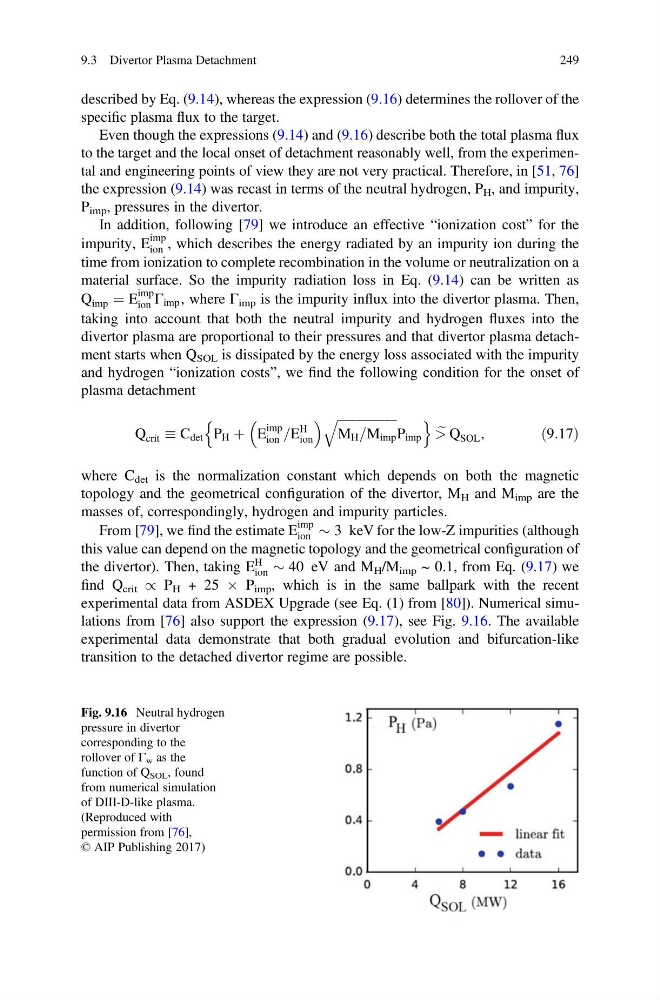
experimental data from ASDEX Upgrade (see Eq. (1) from [80]). Numerical simulations from [76] also support the expression (9.17), see Fig. 9.16. The available
experimental data demonstrate that both gradual evolution and bifurcation-like
transition to the detached divertor regime are possible.
Fig. 9.16 Neutral hydrogen
pressure in divertor
corresponding to the
rollover of Γ w as the
function of Q SOL , found
from numerical simulation
of DIII-D-like plasma.
(Reproduced with
permission from [76],
© AIP Publishing 2017)
9.3 Divertor Plasma Detachment
249
specific plasma flux to the target.
Even though the expressions (9.14) and (9.16) describe both the total plasma flux
to the target and the local onset of detachment reasonably well, from the experimental and engineering points of view they are not very practical. Therefore, in [51, 76]
the expression (9.14) was recast in terms of the neutral hydrogen, P H , and impurity,
P imp , pressures in the divertor.
In addition, following [79] we introduce an effective “ionization cost” for the
impurity, E
imp
ion , which describes the energy radiated by an impurity ion during the
time from ionization to complete recombination in the volume or neutralization on a
material surface. So the impurity radiation loss in Eq. (9.14) can be written as
Q imp ¼ E
imp
ion Γ imp , where Γ imp is the impurity influx into the divertor plasma. Then,
taking into account that both the neutral impurity and hydrogen fluxes into the
divertor plasma are proportional to their pressures and that divertor plasma detachment starts when Q SOL is dissipated by the energy loss associated with the impurity
and hydrogen “ionization costs”, we find the following condition for the onset of
plasma detachment
Q crit C det P H þ E
imp
ion =E
H
ion
ffiffiffiffiffiffiffiffiffiffiffiffiffiffiffiffiffiffiffi
M H =M imp
q
P imp
n
o
e
> Q SOL ,
ð9:17Þ
where C det is the normalization constant which depends on both the magnetic
topology and the geometrical configuration of the divertor, M H and M imp are the
masses of, correspondingly, hydrogen and impurity particles.
From [79], we find the estimate E
imp
ion $ 3 keV for the low-Z impurities (although
this value can depend on the magnetic topology and the geometrical configuration of
the divertor). Then, taking E
H
ion $ 40 eV and M H /M imp ~ 0.1, from Eq. (9.17) we
find Q crit / P H + 25 Â P imp , which is in the same ballpark with the recent
experimental data from ASDEX Upgrade (see Eq. (1) from [80]). Numerical simulations from [76] also support the expression (9.17), see Fig. 9.16. The available
experimental data demonstrate that both gradual evolution and bifurcation-like
transition to the detached divertor regime are possible.
Fig. 9.16 Neutral hydrogen
pressure in divertor
corresponding to the
rollover of Γ w as the
function of Q SOL , found
from numerical simulation
of DIII-D-like plasma.
(Reproduced with
permission from [76],
© AIP Publishing 2017)
9.3 Divertor Plasma Detachment
249