

In addition, we notice that the impurity radiation loss is roughly proportional to
the plasma density squared. Therefore the magnitude of q recycl ¼ q ft À q imp decreases
most strongly on the magnetic flux surfaces close to the separatrix, where the plasma
density and, therefore, P
tot
ft are usually higher. As a result, the onset of divertor
plasma detachment starts typically in the vicinity of the separatrix (recall Fig. 1.5b),
even though q ft is higher in this region.
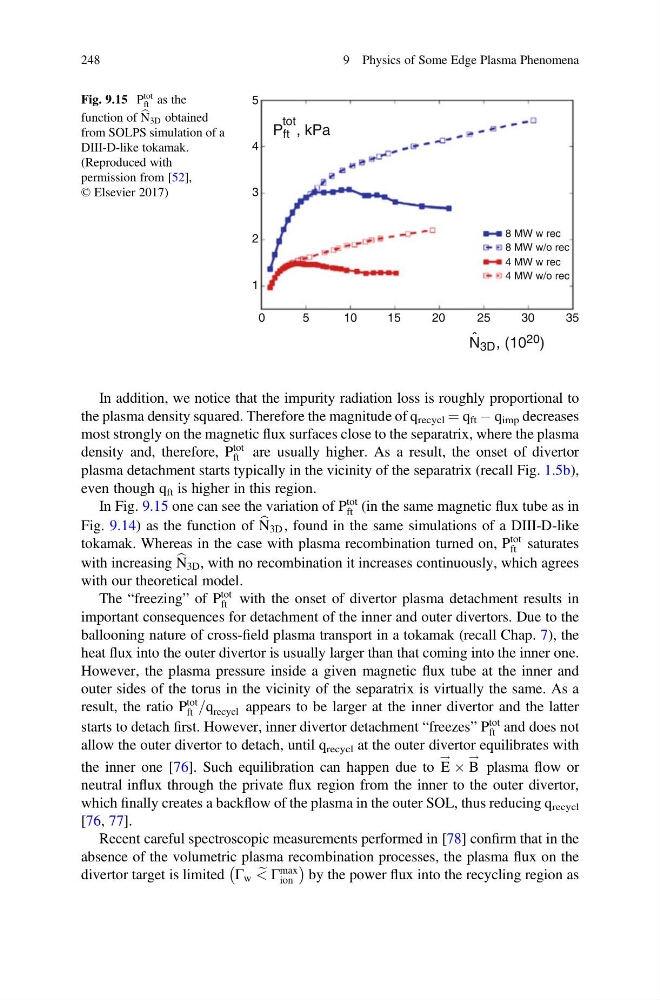
In Fig. 9.15 one can see the variation of P
tot
ft (in the same magnetic flux tube as in
Fig. 9.14) as the function of b
N 3D , found in the same simulations of a DIII-D-like
tokamak. Whereas in the case with plasma recombination turned on, P
tot
ft saturates
with increasing b
N 3D , with no recombination it increases continuously, which agrees
with our theoretical model.
The “freezing” of P
tot
ft with the onset of divertor plasma detachment results in
important consequences for detachment of the inner and outer divertors. Due to the
ballooning nature of cross-field plasma transport in a tokamak (recall Chap. 7), the
heat flux into the outer divertor is usually larger than that coming into the inner one.
However, the plasma pressure inside a given magnetic flux tube at the inner and
outer sides of the torus in the vicinity of the separatrix is virtually the same. As a
result, the ratio P
tot
ft =q recycl appears to be larger at the inner divertor and the latter
starts to detach first. However, inner divertor detachment “freezes” P
tot
ft and does not
allow the outer divertor to detach, until q recycl at the outer divertor equilibrates with
the inner one [76]. Such equilibration can happen due to E
! Â B
!
plasma flow or
neutral influx through the private flux region from the inner to the outer divertor,
which finally creates a backflow of the plasma in the outer SOL, thus reducing q recycl
[76, 77].
Recent careful spectroscopic measurements performed in [78] confirm that in the
absence of the volumetric plasma recombination processes, the plasma flux on the
divertor target is limited Γ w e
< Γ
max
ion
À
Á
by the power flux into the recycling region as
5
4
8 MW w rec
4 MW w rec
8 MW w/o rec
4 MW w/o rec
3
2
1
0
5
10
15
20
25
30
35
P ft , kPa
tot
ˆ
N 3D , (10 20 )
Fig. 9.15 P
tot
ft as the
function of b
N 3D obtained
from SOLPS simulation of a
DIII-D-like tokamak.
(Reproduced with
permission from [52],
© Elsevier 2017)
248
9 Physics of Some Edge Plasma Phenomena
the plasma density squared. Therefore the magnitude of q recycl ¼ q ft À q imp decreases
most strongly on the magnetic flux surfaces close to the separatrix, where the plasma
density and, therefore, P
tot
ft are usually higher. As a result, the onset of divertor
plasma detachment starts typically in the vicinity of the separatrix (recall Fig. 1.5b),
even though q ft is higher in this region.
In Fig. 9.15 one can see the variation of P
tot
ft (in the same magnetic flux tube as in
Fig. 9.14) as the function of b
N 3D , found in the same simulations of a DIII-D-like
tokamak. Whereas in the case with plasma recombination turned on, P
tot
ft saturates
with increasing b
N 3D , with no recombination it increases continuously, which agrees
with our theoretical model.
The “freezing” of P
tot
ft with the onset of divertor plasma detachment results in
important consequences for detachment of the inner and outer divertors. Due to the
ballooning nature of cross-field plasma transport in a tokamak (recall Chap. 7), the
heat flux into the outer divertor is usually larger than that coming into the inner one.
However, the plasma pressure inside a given magnetic flux tube at the inner and
outer sides of the torus in the vicinity of the separatrix is virtually the same. As a
result, the ratio P
tot
ft =q recycl appears to be larger at the inner divertor and the latter
starts to detach first. However, inner divertor detachment “freezes” P
tot
ft and does not
allow the outer divertor to detach, until q recycl at the outer divertor equilibrates with
the inner one [76]. Such equilibration can happen due to E
! Â B
!
plasma flow or
neutral influx through the private flux region from the inner to the outer divertor,
which finally creates a backflow of the plasma in the outer SOL, thus reducing q recycl
[76, 77].
Recent careful spectroscopic measurements performed in [78] confirm that in the
absence of the volumetric plasma recombination processes, the plasma flux on the
divertor target is limited Γ w e
< Γ
max
ion
À
Á
by the power flux into the recycling region as
5
4
8 MW w rec
4 MW w rec
8 MW w/o rec
4 MW w/o rec
3
2
1
0
5
10
15
20
25
30
35
P ft , kPa
tot
ˆ
N 3D , (10 20 )
Fig. 9.15 P
tot
ft as the
function of b
N 3D obtained
from SOLPS simulation of a
DIII-D-like tokamak.
(Reproduced with
permission from [52],
© Elsevier 2017)
248
9 Physics of Some Edge Plasma Phenomena