

targets, followed by a strong increase of plasma recombination and the reduction of
the specific plasma flux to the target j d . Thus we can consider the condition
P
tot
ft
q recycl
%
ffiffiffiffiffiffiffiffiffiffi
M
γE
H
ion
s
% 20
N
MW
,
ð9:16Þ
as the criterion for the local onset of divertor plasma detachment at some particular
flux tube [50] (we assume here deuterium plasma). We also notice that plasma
recombination does not allow virtually any further increase of P
tot
ft
beyond
P
tot
ft
À Á
max
[50, 52, 74]. The reason for this is the strong increase of the plasma
recombination rate, which effectively “dumps” any excessive plasma particles into
the cold neutral gas cushion in the vicinity of the target and “freezes” P
tot
ft at the level
determined by Eq. (9.16). Recalling that the upstream plasma temperature is a weak
function of q ft , T(L ft ) / (q ft L ft )
2/7 , we find that the restriction for P
tot
ft effectively
limits the accessible upstream plasma density and results in the so-called edge
plasma density limit (e.g. see [75]).
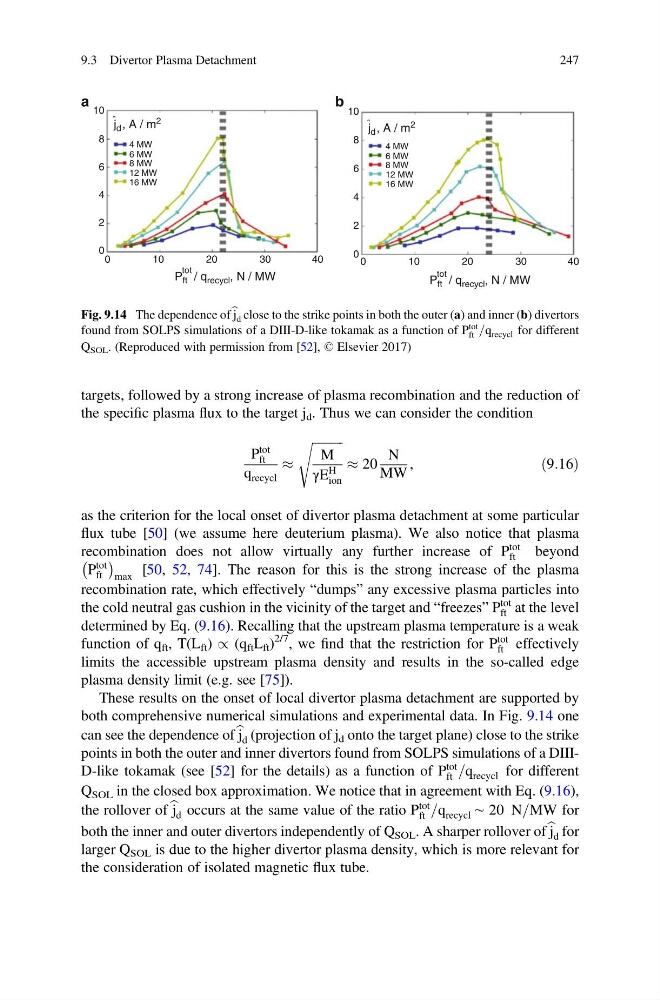
These results on the onset of local divertor plasma detachment are supported by
both comprehensive numerical simulations and experimental data. In Fig. 9.14 one
can see the dependence of b j d (projection of j d onto the target plane) close to the strike
points in both the outer and inner divertors found from SOLPS simulations of a DIIID-like tokamak (see [52] for the details) as a function of P
tot
ft =q recycl for different
Q SOL in the closed box approximation. We notice that in agreement with Eq. (9.16),
the rollover of b j d occurs at the same value of the ratio P
tot
ft =q recycl ∼ 20 N=MW for
both the inner and outer divertors independently of Q SOL . A sharper rollover of b j d for
larger Q SOL is due to the higher divertor plasma density, which is more relevant for
the consideration of isolated magnetic flux tube.
10
ˆ
8
4 MW
6 MW
8 MW
12 MW
16 MW
4 MW
6 MW
8 MW
12 MW
16 MW
j d , A / m
2
ˆ j d , A / m
2
6
4
2
0
0
1 0
2 0
3 0
4 0
10
b
a
8
6
4
2
0 0
1 0
2 0
3 0
4 0
P ft / q recycl , N / MW
tot
P ft / q recycl , N / MW
tot
Fig. 9.14 The dependence of b j d close to the strike points in both the outer (a) and inner (b) divertors
found from SOLPS simulations of a DIII-D-like tokamak as a function of P
tot
ft =q recycl for different
Q SOL . (Reproduced with permission from [52], © Elsevier 2017)
9.3 Divertor Plasma Detachment
247
the specific plasma flux to the target j d . Thus we can consider the condition
P
tot
ft
q recycl
%
ffiffiffiffiffiffiffiffiffiffi
M
γE
H
ion
s
% 20
N
MW
,
ð9:16Þ
as the criterion for the local onset of divertor plasma detachment at some particular
flux tube [50] (we assume here deuterium plasma). We also notice that plasma
recombination does not allow virtually any further increase of P
tot
ft
beyond
P
tot
ft
À Á
max
[50, 52, 74]. The reason for this is the strong increase of the plasma
recombination rate, which effectively “dumps” any excessive plasma particles into
the cold neutral gas cushion in the vicinity of the target and “freezes” P
tot
ft at the level
determined by Eq. (9.16). Recalling that the upstream plasma temperature is a weak
function of q ft , T(L ft ) / (q ft L ft )
2/7 , we find that the restriction for P
tot
ft effectively
limits the accessible upstream plasma density and results in the so-called edge
plasma density limit (e.g. see [75]).
These results on the onset of local divertor plasma detachment are supported by
both comprehensive numerical simulations and experimental data. In Fig. 9.14 one
can see the dependence of b j d (projection of j d onto the target plane) close to the strike
points in both the outer and inner divertors found from SOLPS simulations of a DIIID-like tokamak (see [52] for the details) as a function of P
tot
ft =q recycl for different
Q SOL in the closed box approximation. We notice that in agreement with Eq. (9.16),
the rollover of b j d occurs at the same value of the ratio P
tot
ft =q recycl ∼ 20 N=MW for
both the inner and outer divertors independently of Q SOL . A sharper rollover of b j d for
larger Q SOL is due to the higher divertor plasma density, which is more relevant for
the consideration of isolated magnetic flux tube.
10
ˆ
8
4 MW
6 MW
8 MW
12 MW
16 MW
4 MW
6 MW
8 MW
12 MW
16 MW
j d , A / m
2
ˆ j d , A / m
2
6
4
2
0
0
1 0
2 0
3 0
4 0
10
b
a
8
6
4
2
0 0
1 0
2 0
3 0
4 0
P ft / q recycl , N / MW
tot
P ft / q recycl , N / MW
tot
Fig. 9.14 The dependence of b j d close to the strike points in both the outer (a) and inner (b) divertors
found from SOLPS simulations of a DIII-D-like tokamak as a function of P
tot
ft =q recycl for different
Q SOL . (Reproduced with permission from [52], © Elsevier 2017)
9.3 Divertor Plasma Detachment
247