

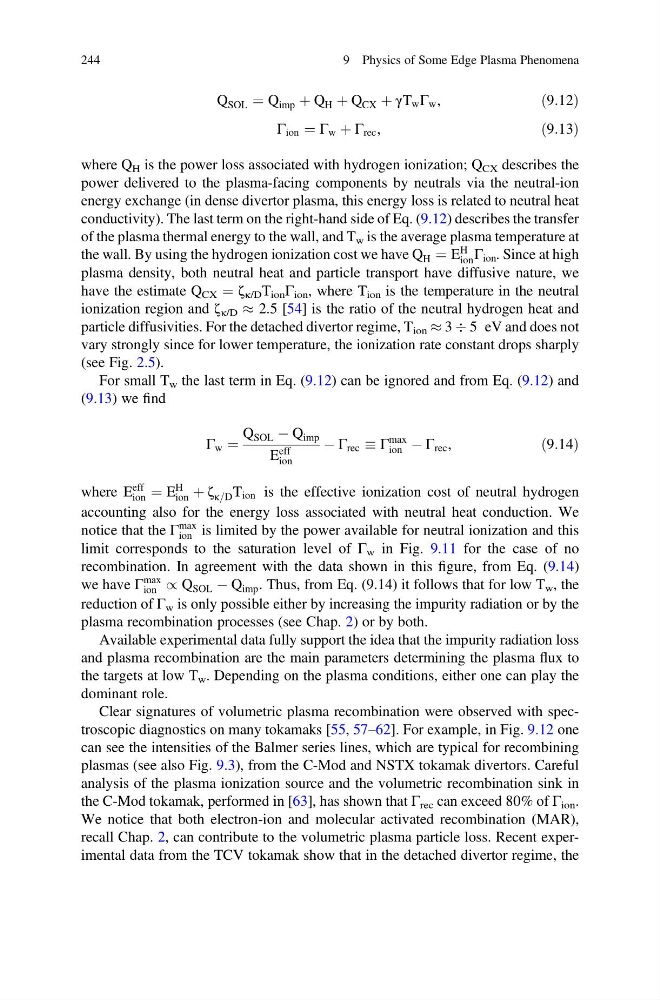
Q SOL ¼ Q imp þ Q H þ Q CX þ γT w Γ w ,
ð9:12Þ
Γ ion ¼ Γ w þ Γ rec ,
ð9:13Þ
where Q H is the power loss associated with hydrogen ionization; Q CX describes the
power delivered to the plasma-facing components by neutrals via the neutral-ion
energy exchange (in dense divertor plasma, this energy loss is related to neutral heat
conductivity). The last term on the right-hand side of Eq. (9.12) describes the transfer
of the plasma thermal energy to the wall, and T w is the average plasma temperature at
the wall. By using the hydrogen ionization cost we have Q H ¼ E
H
ion Γ ion . Since at high
plasma density, both neutral heat and particle transport have diffusive nature, we
have the estimate Q CX ¼ ζ κ/D T ion Γ ion , where T ion is the temperature in the neutral
ionization region and ζ κ/D % 2.5 [54] is the ratio of the neutral hydrogen heat and
particle diffusivities. For the detached divertor regime, T ion % 3 Ä 5 eV and does not
vary strongly since for lower temperature, the ionization rate constant drops sharply
(see Fig. 2.5).
For small T w the last term in Eq. (9.12) can be ignored and from Eq. (9.12) and
(9.13) we find
Γ w ¼
Q SOL À Q imp
E
eff
ion
À Γ rec Γ
max
ion À Γ rec ,
ð9:14Þ
where E
eff
ion ¼ E
H
ion þ ζ κ=D T ion is the effective ionization cost of neutral hydrogen
accounting also for the energy loss associated with neutral heat conduction. We
notice that the Γ
max
ion is limited by the power available for neutral ionization and this
limit corresponds to the saturation level of Γ w in Fig. 9.11 for the case of no
recombination. In agreement with the data shown in this figure, from Eq. (9.14)
we have Γ
max
ion / Q SOL À Q imp . Thus, from Eq. (9.14) it follows that for low T w , the
reduction of Γ w is only possible either by increasing the impurity radiation or by the
plasma recombination processes (see Chap. 2) or by both.
Available experimental data fully support the idea that the impurity radiation loss
and plasma recombination are the main parameters determining the plasma flux to
the targets at low T w . Depending on the plasma conditions, either one can play the
dominant role.
Clear signatures of volumetric plasma recombination were observed with spectroscopic diagnostics on many tokamaks [55, 57–62]. For example, in Fig. 9.12 one
can see the intensities of the Balmer series lines, which are typical for recombining
plasmas (see also Fig. 9.3), from the C-Mod and NSTX tokamak divertors. Careful
analysis of the plasma ionization source and the volumetric recombination sink in
the C-Mod tokamak, performed in [63], has shown that Γ rec can exceed 80% of Γ ion .
We notice that both electron-ion and molecular activated recombination (MAR),
recall Chap. 2, can contribute to the volumetric plasma particle loss. Recent experimental data from the TCV tokamak show that in the detached divertor regime, the
244
9 Physics of Some Edge Plasma Phenomena
ð9:12Þ
Γ ion ¼ Γ w þ Γ rec ,
ð9:13Þ
where Q H is the power loss associated with hydrogen ionization; Q CX describes the
power delivered to the plasma-facing components by neutrals via the neutral-ion
energy exchange (in dense divertor plasma, this energy loss is related to neutral heat
conductivity). The last term on the right-hand side of Eq. (9.12) describes the transfer
of the plasma thermal energy to the wall, and T w is the average plasma temperature at
the wall. By using the hydrogen ionization cost we have Q H ¼ E
H
ion Γ ion . Since at high
plasma density, both neutral heat and particle transport have diffusive nature, we
have the estimate Q CX ¼ ζ κ/D T ion Γ ion , where T ion is the temperature in the neutral
ionization region and ζ κ/D % 2.5 [54] is the ratio of the neutral hydrogen heat and
particle diffusivities. For the detached divertor regime, T ion % 3 Ä 5 eV and does not
vary strongly since for lower temperature, the ionization rate constant drops sharply
(see Fig. 2.5).
For small T w the last term in Eq. (9.12) can be ignored and from Eq. (9.12) and
(9.13) we find
Γ w ¼
Q SOL À Q imp
E
eff
ion
À Γ rec Γ
max
ion À Γ rec ,
ð9:14Þ
where E
eff
ion ¼ E
H
ion þ ζ κ=D T ion is the effective ionization cost of neutral hydrogen
accounting also for the energy loss associated with neutral heat conduction. We
notice that the Γ
max
ion is limited by the power available for neutral ionization and this
limit corresponds to the saturation level of Γ w in Fig. 9.11 for the case of no
recombination. In agreement with the data shown in this figure, from Eq. (9.14)
we have Γ
max
ion / Q SOL À Q imp . Thus, from Eq. (9.14) it follows that for low T w , the
reduction of Γ w is only possible either by increasing the impurity radiation or by the
plasma recombination processes (see Chap. 2) or by both.
Available experimental data fully support the idea that the impurity radiation loss
and plasma recombination are the main parameters determining the plasma flux to
the targets at low T w . Depending on the plasma conditions, either one can play the
dominant role.
Clear signatures of volumetric plasma recombination were observed with spectroscopic diagnostics on many tokamaks [55, 57–62]. For example, in Fig. 9.12 one
can see the intensities of the Balmer series lines, which are typical for recombining
plasmas (see also Fig. 9.3), from the C-Mod and NSTX tokamak divertors. Careful
analysis of the plasma ionization source and the volumetric recombination sink in
the C-Mod tokamak, performed in [63], has shown that Γ rec can exceed 80% of Γ ion .
We notice that both electron-ion and molecular activated recombination (MAR),
recall Chap. 2, can contribute to the volumetric plasma particle loss. Recent experimental data from the TCV tokamak show that in the detached divertor regime, the
244
9 Physics of Some Edge Plasma Phenomena