

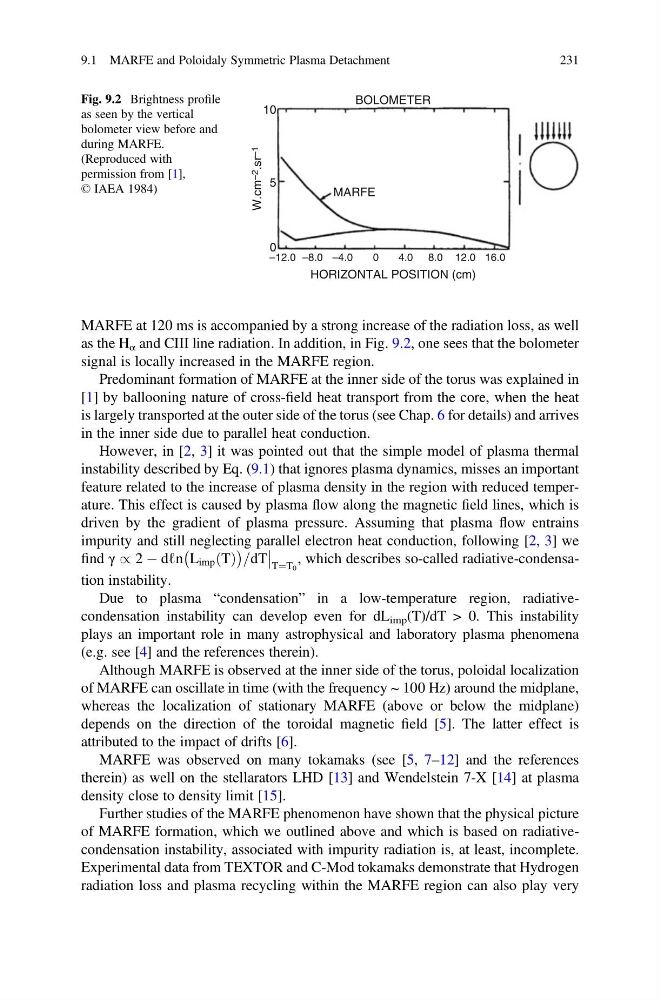
MARFE at 120 ms is accompanied by a strong increase of the radiation loss, as well
as the H α and CIII line radiation. In addition, in Fig. 9.2, one sees that the bolometer
signal is locally increased in the MARFE region.
Predominant formation of MARFE at the inner side of the torus was explained in
[1] by ballooning nature of cross-field heat transport from the core, when the heat
is largely transported at the outer side of the torus (see Chap. 6 for details) and arrives
in the inner side due to parallel heat conduction.
However, in [2, 3] it was pointed out that the simple model of plasma thermal
instability described by Eq. (9.1) that ignores plasma dynamics, misses an important
feature related to the increase of plasma density in the region with reduced temperature. This effect is caused by plasma flow along the magnetic field lines, which is
driven by the gradient of plasma pressure. Assuming that plasma flow entrains
impurity and still neglecting parallel electron heat conduction, following [2, 3] we
find γ / 2 À dℓn L imp T
ð Þ
À
Á =dT
T¼T 0
, which describes so-called radiative-condensation instability.
Due to plasma “condensation” in a low-temperature region, radiativecondensation instability can develop even for dL imp (T)/dT > 0. This instability
plays an important role in many astrophysical and laboratory plasma phenomena
(e.g. see [4] and the references therein).
Although MARFE is observed at the inner side of the torus, poloidal localization
of MARFE can oscillate in time (with the frequency ~ 100 Hz) around the midplane,
whereas the localization of stationary MARFE (above or below the midplane)
depends on the direction of the toroidal magnetic field [5]. The latter effect is
attributed to the impact of drifts [6].
MARFE was observed on many tokamaks (see [5, 7–12] and the references
therein) as well on the stellarators LHD [13] and Wendelstein 7-X [14] at plasma
density close to density limit [15].
Further studies of the MARFE phenomenon have shown that the physical picture
of MARFE formation, which we outlined above and which is based on radiativecondensation instability, associated with impurity radiation is, at least, incomplete.
Experimental data from TEXTOR and C-Mod tokamaks demonstrate that Hydrogen
radiation loss and plasma recycling within the MARFE region can also play very
–12.0
0
W.cm –2
.sr –1
5
10
–8.0 –4.0
0
4.0
HORIZONTAL POSITION (cm)
MARFE
BOLOMETER
8.0 12.0 16.0
Fig. 9.2 Brightness profile
as seen by the vertical
bolometer view before and
during MARFE.
(Reproduced with
permission from [1],
© IAEA 1984)
9.1 MARFE and Poloidaly Symmetric Plasma Detachment
231
as the H α and CIII line radiation. In addition, in Fig. 9.2, one sees that the bolometer
signal is locally increased in the MARFE region.
Predominant formation of MARFE at the inner side of the torus was explained in
[1] by ballooning nature of cross-field heat transport from the core, when the heat
is largely transported at the outer side of the torus (see Chap. 6 for details) and arrives
in the inner side due to parallel heat conduction.
However, in [2, 3] it was pointed out that the simple model of plasma thermal
instability described by Eq. (9.1) that ignores plasma dynamics, misses an important
feature related to the increase of plasma density in the region with reduced temperature. This effect is caused by plasma flow along the magnetic field lines, which is
driven by the gradient of plasma pressure. Assuming that plasma flow entrains
impurity and still neglecting parallel electron heat conduction, following [2, 3] we
find γ / 2 À dℓn L imp T
ð Þ
À
Á =dT
T¼T 0
, which describes so-called radiative-condensation instability.
Due to plasma “condensation” in a low-temperature region, radiativecondensation instability can develop even for dL imp (T)/dT > 0. This instability
plays an important role in many astrophysical and laboratory plasma phenomena
(e.g. see [4] and the references therein).
Although MARFE is observed at the inner side of the torus, poloidal localization
of MARFE can oscillate in time (with the frequency ~ 100 Hz) around the midplane,
whereas the localization of stationary MARFE (above or below the midplane)
depends on the direction of the toroidal magnetic field [5]. The latter effect is
attributed to the impact of drifts [6].
MARFE was observed on many tokamaks (see [5, 7–12] and the references
therein) as well on the stellarators LHD [13] and Wendelstein 7-X [14] at plasma
density close to density limit [15].
Further studies of the MARFE phenomenon have shown that the physical picture
of MARFE formation, which we outlined above and which is based on radiativecondensation instability, associated with impurity radiation is, at least, incomplete.
Experimental data from TEXTOR and C-Mod tokamaks demonstrate that Hydrogen
radiation loss and plasma recycling within the MARFE region can also play very
–12.0
0
W.cm –2
.sr –1
5
10
–8.0 –4.0
0
4.0
HORIZONTAL POSITION (cm)
MARFE
BOLOMETER
8.0 12.0 16.0
Fig. 9.2 Brightness profile
as seen by the vertical
bolometer view before and
during MARFE.
(Reproduced with
permission from [1],
© IAEA 1984)
9.1 MARFE and Poloidaly Symmetric Plasma Detachment
231