

be obtained from the power balance equation where we neglect plasma dynamics
and parallel heat conduction:
3n
dT
dt
¼ H À nn imp L imp T
ð Þ:
ð9:1Þ
Here, for simplicity, we assume equal electron and ion temperatures, n and n imp
are plasma and impurity densities, and H is the plasma heating term, which is
assumed to be constant. Then, assuming that temperature T ¼ T 0 corresponds to
the steady-state solution of Eq. (9.1) and taking T ¼ T 0 þ e
T, where e
T / exp γt
ð Þ
describes a small departure from the equilibrium temperature, from Eq. (9.1) we find
the following expression for γ:
γ ¼ À
n imp
3
dL imp T
ð Þ
dT
T¼T 0
:
ð9:2Þ
Expression (9.2) predicts that the steady-state condition corresponding to
dL imp (T)/dT < 0 is unstable and can result in localized temperature drop accompanied by an increase of impurity radiation loss.
Such arguments were put forward in [1] to explain experimental observations of
toroidally symmetric, rather compact in both poloidal and radial directions, and
highly radiative region emerging at the inner side of the torus at high averaged
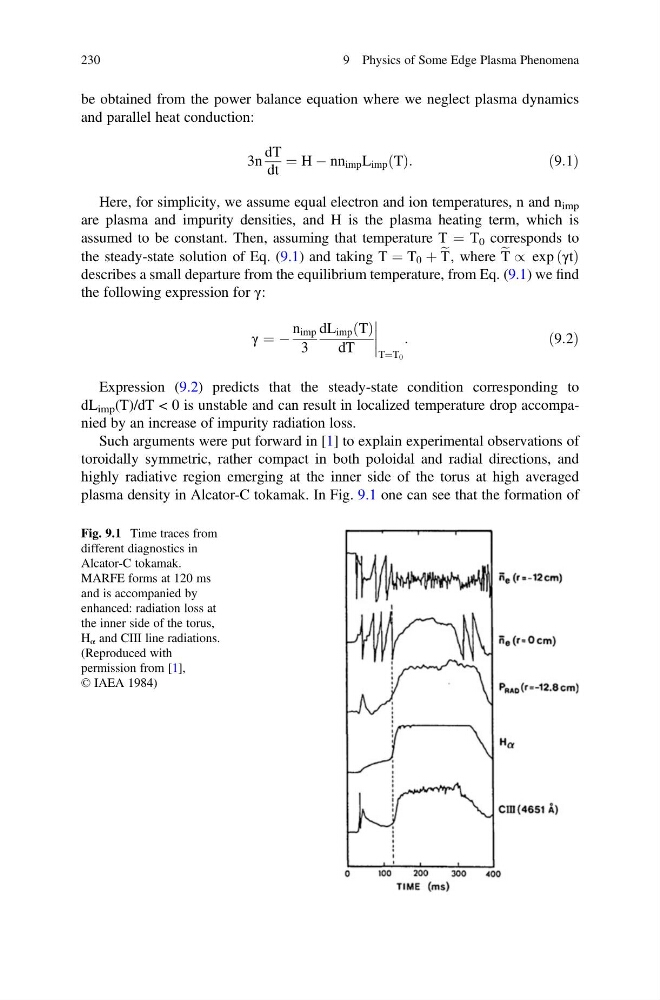
plasma density in Alcator-C tokamak. In Fig. 9.1 one can see that the formation of
Fig. 9.1 Time traces from
different diagnostics in
Alcator-C tokamak.
MARFE forms at 120 ms
and is accompanied by
enhanced: radiation loss at
the inner side of the torus,
H α and CIII line radiations.
(Reproduced with
permission from [1],
© IAEA 1984)
230
9 Physics of Some Edge Plasma Phenomena
and parallel heat conduction:
3n
dT
dt
¼ H À nn imp L imp T
ð Þ:
ð9:1Þ
Here, for simplicity, we assume equal electron and ion temperatures, n and n imp
are plasma and impurity densities, and H is the plasma heating term, which is
assumed to be constant. Then, assuming that temperature T ¼ T 0 corresponds to
the steady-state solution of Eq. (9.1) and taking T ¼ T 0 þ e
T, where e
T / exp γt
ð Þ
describes a small departure from the equilibrium temperature, from Eq. (9.1) we find
the following expression for γ:
γ ¼ À
n imp
3
dL imp T
ð Þ
dT
T¼T 0
:
ð9:2Þ
Expression (9.2) predicts that the steady-state condition corresponding to
dL imp (T)/dT < 0 is unstable and can result in localized temperature drop accompanied by an increase of impurity radiation loss.
Such arguments were put forward in [1] to explain experimental observations of
toroidally symmetric, rather compact in both poloidal and radial directions, and
highly radiative region emerging at the inner side of the torus at high averaged
plasma density in Alcator-C tokamak. In Fig. 9.1 one can see that the formation of
Fig. 9.1 Time traces from
different diagnostics in
Alcator-C tokamak.
MARFE forms at 120 ms
and is accompanied by
enhanced: radiation loss at
the inner side of the torus,
H α and CIII line radiations.
(Reproduced with
permission from [1],
© IAEA 1984)
230
9 Physics of Some Edge Plasma Phenomena