

important roles [16, 17]. Moreover, C-Mod data show that plasma temperature in the
MARFE region falls below 1 eV whereas plasma density reaches ~2Â10
15 cm
À3 ,
which stimulates very strong plasma recombination sink, which is close to plasma
ionization source in the rest of the tokamak main chamber volume. As a result, the
density of neutral Hydrogen in MARFE becomes so high that it traps about 95% of
Ly α and more than 50% of Ly β radiation.
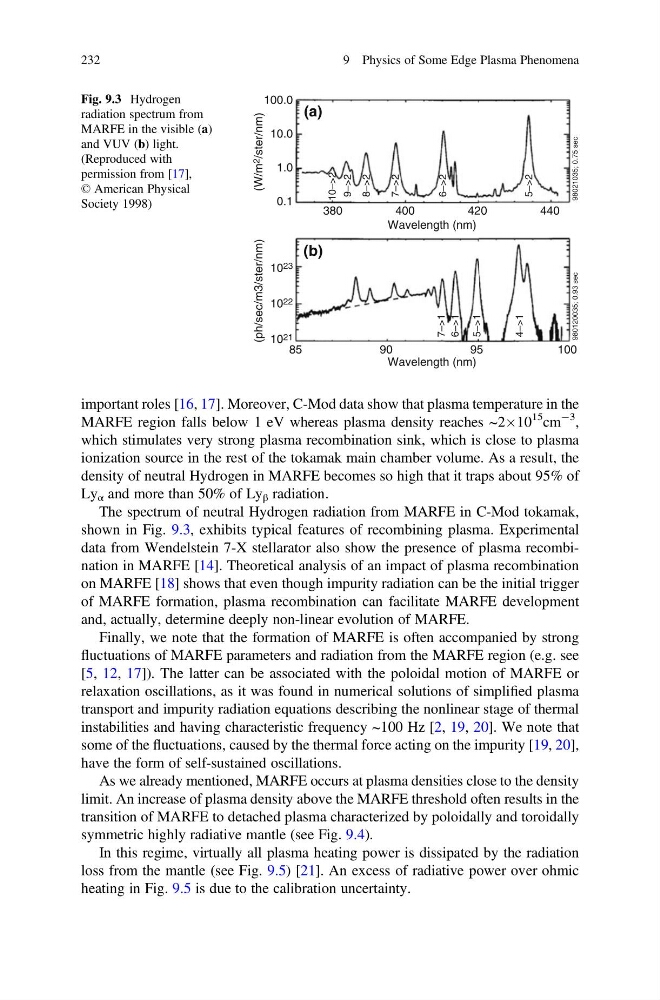
The spectrum of neutral Hydrogen radiation from MARFE in C-Mod tokamak,
shown in Fig. 9.3, exhibits typical features of recombining plasma. Experimental
data from Wendelstein 7-X stellarator also show the presence of plasma recombination in MARFE [14]. Theoretical analysis of an impact of plasma recombination
on MARFE [18] shows that even though impurity radiation can be the initial trigger
of MARFE formation, plasma recombination can facilitate MARFE development
and, actually, determine deeply non-linear evolution of MARFE.
Finally, we note that the formation of MARFE is often accompanied by strong
fluctuations of MARFE parameters and radiation from the MARFE region (e.g. see
[5, 12, 17]). The latter can be associated with the poloidal motion of MARFE or
relaxation oscillations, as it was found in numerical solutions of simplified plasma
transport and impurity radiation equations describing the nonlinear stage of thermal
instabilities and having characteristic frequency ~100 Hz [2, 19, 20]. We note that
some of the fluctuations, caused by the thermal force acting on the impurity [19, 20],
have the form of self-sustained oscillations.
As we already mentioned, MARFE occurs at plasma densities close to the density
limit. An increase of plasma density above the MARFE threshold often results in the
transition of MARFE to detached plasma characterized by poloidally and toroidally
symmetric highly radiative mantle (see Fig. 9.4).
In this regime, virtually all plasma heating power is dissipated by the radiation
loss from the mantle (see Fig. 9.5) [21]. An excess of radiative power over ohmic
heating in Fig. 9.5 is due to the calibration uncertainty.
85
90
95
100
980120035; 0.93 sec
98021035; 0.75 sec
10 21
10 22
(ph/sec/m3/ster/nm)
(W/m 2
/ster/nm)
10 23
0.1
1.0
10.0
100.0
Wavelength (nm)
380
(a)
(b)
400
420
440
Wavelength (nm)
7–>1
6–>1
5–>1
4–>1
5–>2
6–>2
7–>2
8–>2
9–>2
10–>2
Fig. 9.3 Hydrogen
radiation spectrum from
MARFE in the visible (a)
and VUV (b) light.
(Reproduced with
permission from [17],
© American Physical
Society 1998)
232
9 Physics of Some Edge Plasma Phenomena
MARFE region falls below 1 eV whereas plasma density reaches ~2Â10
15 cm
À3 ,
which stimulates very strong plasma recombination sink, which is close to plasma
ionization source in the rest of the tokamak main chamber volume. As a result, the
density of neutral Hydrogen in MARFE becomes so high that it traps about 95% of
Ly α and more than 50% of Ly β radiation.
The spectrum of neutral Hydrogen radiation from MARFE in C-Mod tokamak,
shown in Fig. 9.3, exhibits typical features of recombining plasma. Experimental
data from Wendelstein 7-X stellarator also show the presence of plasma recombination in MARFE [14]. Theoretical analysis of an impact of plasma recombination
on MARFE [18] shows that even though impurity radiation can be the initial trigger
of MARFE formation, plasma recombination can facilitate MARFE development
and, actually, determine deeply non-linear evolution of MARFE.
Finally, we note that the formation of MARFE is often accompanied by strong
fluctuations of MARFE parameters and radiation from the MARFE region (e.g. see
[5, 12, 17]). The latter can be associated with the poloidal motion of MARFE or
relaxation oscillations, as it was found in numerical solutions of simplified plasma
transport and impurity radiation equations describing the nonlinear stage of thermal
instabilities and having characteristic frequency ~100 Hz [2, 19, 20]. We note that
some of the fluctuations, caused by the thermal force acting on the impurity [19, 20],
have the form of self-sustained oscillations.
As we already mentioned, MARFE occurs at plasma densities close to the density
limit. An increase of plasma density above the MARFE threshold often results in the
transition of MARFE to detached plasma characterized by poloidally and toroidally
symmetric highly radiative mantle (see Fig. 9.4).
In this regime, virtually all plasma heating power is dissipated by the radiation
loss from the mantle (see Fig. 9.5) [21]. An excess of radiative power over ohmic
heating in Fig. 9.5 is due to the calibration uncertainty.
85
90
95
100
980120035; 0.93 sec
98021035; 0.75 sec
10 21
10 22
(ph/sec/m3/ster/nm)
(W/m 2
/ster/nm)
10 23
0.1
1.0
10.0
100.0
Wavelength (nm)
380
(a)
(b)
400
420
440
Wavelength (nm)
7–>1
6–>1
5–>1
4–>1
5–>2
6–>2
7–>2
8–>2
9–>2
10–>2
Fig. 9.3 Hydrogen
radiation spectrum from
MARFE in the visible (a)
and VUV (b) light.
(Reproduced with
permission from [17],
© American Physical
Society 1998)
232
9 Physics of Some Edge Plasma Phenomena