

currents in order to disturb the magnetic surfaces at the plasma edge. A number of
experiments performed on DIII-D [82], ASDEX Upgrade [83], JET [84], NSTX
[85], MAST [86] tokamaks have shown that this scheme allows working in H-mode
without Type I ELMs.
Effective stochastization of the flux surfaces around the separatrix results in a
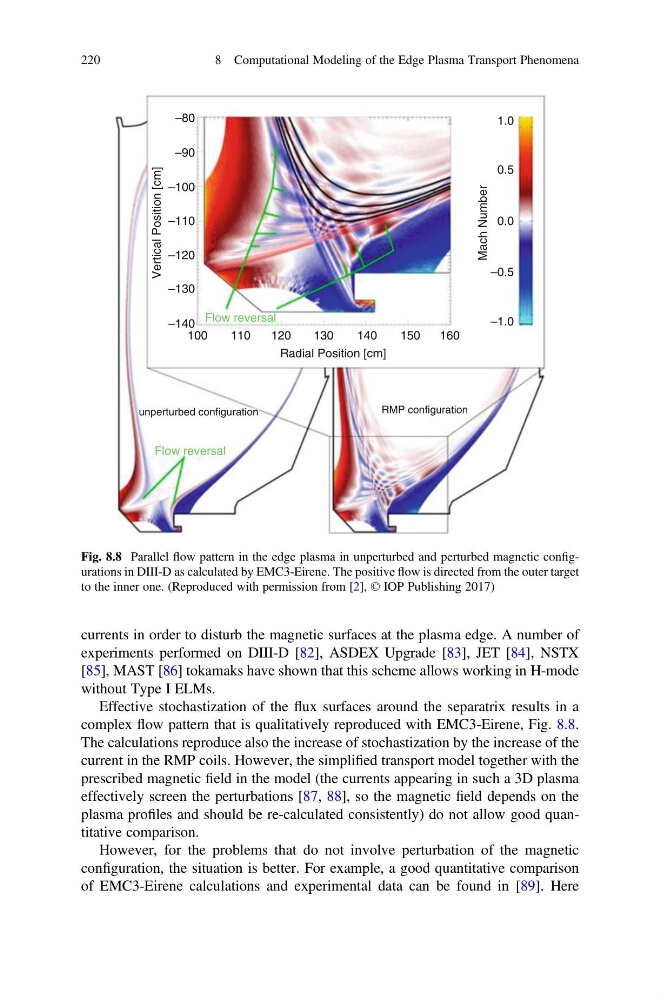
complex flow pattern that is qualitatively reproduced with EMC3-Eirene, Fig. 8.8.
The calculations reproduce also the increase of stochastization by the increase of the
current in the RMP coils. However, the simplified transport model together with the
prescribed magnetic field in the model (the currents appearing in such a 3D plasma
effectively screen the perturbations [87, 88], so the magnetic field depends on the
plasma profiles and should be re-calculated consistently) do not allow good quantitative comparison.
However, for the problems that do not involve perturbation of the magnetic
configuration, the situation is better. For example, a good quantitative comparison
of EMC3-Eirene calculations and experimental data can be found in [89]. Here
–80
1.0
0.5
–0.5
–1.0
0.0
–90
–100
–110
–120
–130
–140
100
110
120
130
140
150
160
Radial Position [cm]
Vertical Position [cm]
Mach Number
unperturbed configuration
Flow reversal
Flow reversal
RMP configuration
Fig. 8.8 Parallel flow pattern in the edge plasma in unperturbed and perturbed magnetic configurations in DIII-D as calculated by EMC3-Eirene. The positive flow is directed from the outer target
to the inner one. (Reproduced with permission from [2], © IOP Publishing 2017)
220
8 Computational Modeling of the Edge Plasma Transport Phenomena
experiments performed on DIII-D [82], ASDEX Upgrade [83], JET [84], NSTX
[85], MAST [86] tokamaks have shown that this scheme allows working in H-mode
without Type I ELMs.
Effective stochastization of the flux surfaces around the separatrix results in a
complex flow pattern that is qualitatively reproduced with EMC3-Eirene, Fig. 8.8.
The calculations reproduce also the increase of stochastization by the increase of the
current in the RMP coils. However, the simplified transport model together with the
prescribed magnetic field in the model (the currents appearing in such a 3D plasma
effectively screen the perturbations [87, 88], so the magnetic field depends on the
plasma profiles and should be re-calculated consistently) do not allow good quantitative comparison.
However, for the problems that do not involve perturbation of the magnetic
configuration, the situation is better. For example, a good quantitative comparison
of EMC3-Eirene calculations and experimental data can be found in [89]. Here
–80
1.0
0.5
–0.5
–1.0
0.0
–90
–100
–110
–120
–130
–140
100
110
120
130
140
150
160
Radial Position [cm]
Vertical Position [cm]
Mach Number
unperturbed configuration
Flow reversal
Flow reversal
RMP configuration
Fig. 8.8 Parallel flow pattern in the edge plasma in unperturbed and perturbed magnetic configurations in DIII-D as calculated by EMC3-Eirene. The positive flow is directed from the outer target
to the inner one. (Reproduced with permission from [2], © IOP Publishing 2017)
220
8 Computational Modeling of the Edge Plasma Transport Phenomena