

8.4.2 Modeling the 3D Effects
The 2D models considered above assume the toroidal symmetry of the problem. In a
real tokamak experiment, this symmetry is not maintained. The vacuum chamber has
discreet ports (NBI, pumping, diagnostics, etc.) and protruding structures, such as
limiters or ICRF antennas. The particle source from the gas puff or NBI is toroidally
asymmetric. The external magnetic fields applied to the plasma are asymmetric and
the plasma itself develops perturbations that are not toroidally symmetric (e.g.,
ELMs). Therefore, the results of the 2D modeling can only be considered as
toroidally average and 3D models are needed to study these 3D effects in more
detail.
The most published 3D transport codes for the edge plasma modeling are
presently EMC3-Eirene [2] and JOREK [79]. EMC3-Eirene is a 3D Monte-Carlo
code based on the stationary Braginskii equations for the plasma ions and electrons,
coupled to the Monte-Carlo code Eirene that calculates the neutral-related sources in
the plasma equations. It is a transport code that runs on a prescribed background
magnetic field of nearly arbitrary complexity. JOREK is a finite-element, non-ideal
MHD code that solves time-dependent, non-linear MHD and transport equations and
calculates the perturbations of the magnetic field self-consistently. Naturally, the
increase of the geometrical complexity requires some simplification of the transport
models used in these codes. Given the limited amount of the computational
resources available, this is unavoidable.
The EMC3-Eirene code was originally developed aiming at stellarator applications [52]. The growing interest to its application to tokamak modeling in last
decades is related to the perspective of using the resonance magnetic perturbation
(RMP) techniques to reduce the size of the ELMs that are seen as one of the key
issues for the divertor lifetime in a fusion reactor-tokamak such as ITER [81]. The
idea of this method is in introducing toroidally asymmetric, external coils carrying
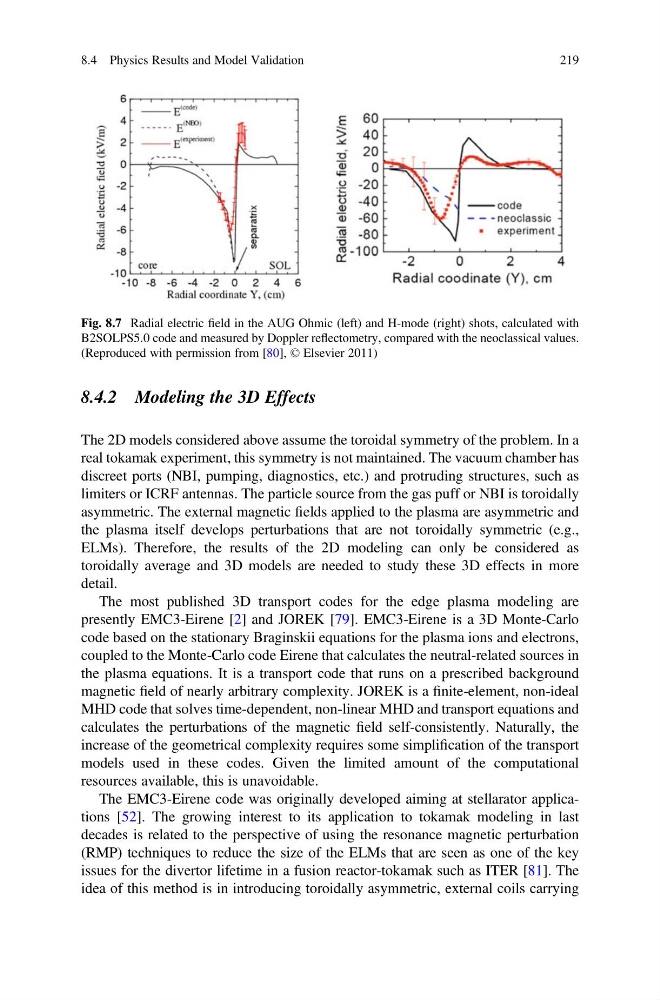
Fig. 8.7 Radial electric field in the AUG Ohmic (left) and H-mode (right) shots, calculated with
B2SOLPS5.0 code and measured by Doppler reflectometry, compared with the neoclassical values.
(Reproduced with permission from [80], © Elsevier 2011)
8.4 Physics Results and Model Validation
219
The 2D models considered above assume the toroidal symmetry of the problem. In a
real tokamak experiment, this symmetry is not maintained. The vacuum chamber has
discreet ports (NBI, pumping, diagnostics, etc.) and protruding structures, such as
limiters or ICRF antennas. The particle source from the gas puff or NBI is toroidally
asymmetric. The external magnetic fields applied to the plasma are asymmetric and
the plasma itself develops perturbations that are not toroidally symmetric (e.g.,
ELMs). Therefore, the results of the 2D modeling can only be considered as
toroidally average and 3D models are needed to study these 3D effects in more
detail.
The most published 3D transport codes for the edge plasma modeling are
presently EMC3-Eirene [2] and JOREK [79]. EMC3-Eirene is a 3D Monte-Carlo
code based on the stationary Braginskii equations for the plasma ions and electrons,
coupled to the Monte-Carlo code Eirene that calculates the neutral-related sources in
the plasma equations. It is a transport code that runs on a prescribed background
magnetic field of nearly arbitrary complexity. JOREK is a finite-element, non-ideal
MHD code that solves time-dependent, non-linear MHD and transport equations and
calculates the perturbations of the magnetic field self-consistently. Naturally, the
increase of the geometrical complexity requires some simplification of the transport
models used in these codes. Given the limited amount of the computational
resources available, this is unavoidable.
The EMC3-Eirene code was originally developed aiming at stellarator applications [52]. The growing interest to its application to tokamak modeling in last
decades is related to the perspective of using the resonance magnetic perturbation
(RMP) techniques to reduce the size of the ELMs that are seen as one of the key
issues for the divertor lifetime in a fusion reactor-tokamak such as ITER [81]. The
idea of this method is in introducing toroidally asymmetric, external coils carrying
Fig. 8.7 Radial electric field in the AUG Ohmic (left) and H-mode (right) shots, calculated with
B2SOLPS5.0 code and measured by Doppler reflectometry, compared with the neoclassical values.
(Reproduced with permission from [80], © Elsevier 2011)
8.4 Physics Results and Model Validation
219