

occupy large volume inside the toroidal magnetic field that is expensive to generate.
Therefore, the usage of such divertors in future fusion reactors requires high
confidence in assessments of both divertor and core plasma performance.
The high recycling and, in particular, detached divertor regimes are characterized
by strongly coupled plasma-neutral interactions providing, for example, an efficient
cooling channel for the plasma within ~eV temperature range where the radiation
energy losses become virtually negligible. But, whereas due to fast plasma transport
along the magnetic field lines, the plasma parameters can be explicitly affected by
the magnetic configuration, neutral transport is not affected directly by the magnetic
field (although an indirect effect, caused by the plasma parameter variation, is
present). However, neutral transport can be directly impacted by the special shaping
of the divertor PFCs (the so-called “closed” divertors), which can better confine
the neutrals in the divertor region. Therefore, in an attempt to facilitate divertor
detachment, both the magnetic configuration and the geometry of the divertor
material structures should be taken into account.
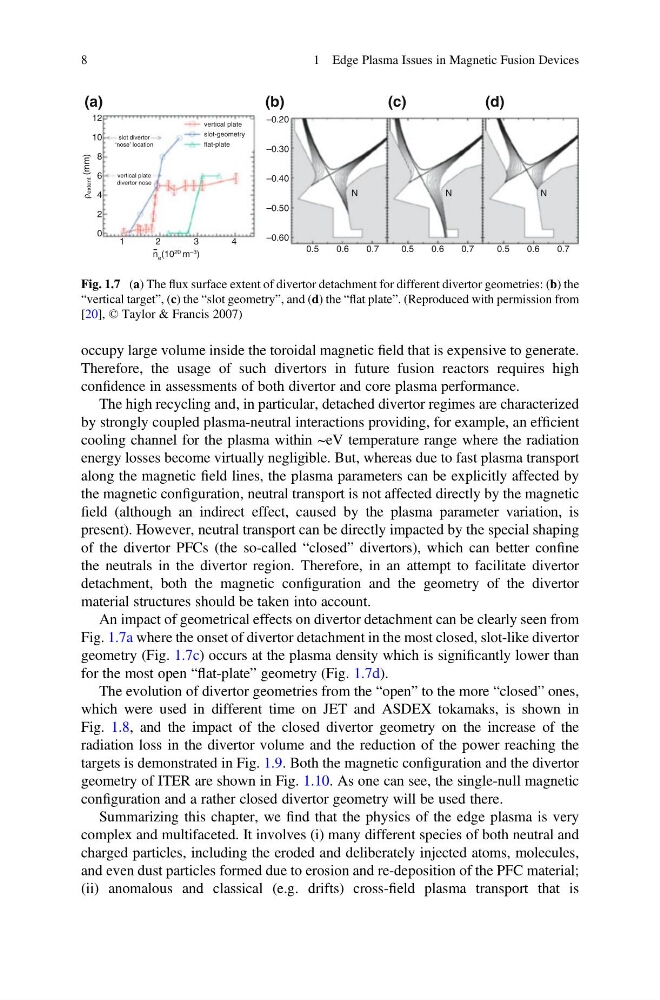
An impact of geometrical effects on divertor detachment can be clearly seen from
Fig. 1.7a where the onset of divertor detachment in the most closed, slot-like divertor
geometry (Fig. 1.7c) occurs at the plasma density which is significantly lower than
for the most open “flat-plate” geometry (Fig. 1.7d).
The evolution of divertor geometries from the “open” to the more “closed” ones,
which were used in different time on JET and ASDEX tokamaks, is shown in
Fig. 1.8, and the impact of the closed divertor geometry on the increase of the
radiation loss in the divertor volume and the reduction of the power reaching the
targets is demonstrated in Fig. 1.9. Both the magnetic configuration and the divertor
geometry of ITER are shown in Fig. 1.10. As one can see, the single-null magnetic
configuration and a rather closed divertor geometry will be used there.
Summarizing this chapter, we find that the physics of the edge plasma is very
complex and multifaceted. It involves (i) many different species of both neutral and
charged particles, including the eroded and deliberately injected atoms, molecules,
and even dust particles formed due to erosion and re-deposition of the PFC material;
(ii) anomalous and classical (e.g. drifts) cross-field plasma transport that is
0
1
2
n e (10 20 m –3 )
3
(a)
(b)
(c)
(d)
4
0.5
–0.60
–0.50
–0.40
–0.30
–0.20
N
N
N
0.6
0.7
0.5
0.6
0.7
0.5
0.6
0.7
2
4
ρextent (mm)
6
8
10
12
vertical plate
divertor nose
slot divertor
‘nose’ location
vertical plate
slot-geometry
flat-plate
Fig. 1.7 (a) The flux surface extent of divertor detachment for different divertor geometries: (b) the
“vertical target”, (c) the “slot geometry”, and (d) the “flat plate”. (Reproduced with permission from
[20], © Taylor & Francis 2007)
8
1 Edge Plasma Issues in Magnetic Fusion Devices
Therefore, the usage of such divertors in future fusion reactors requires high
confidence in assessments of both divertor and core plasma performance.
The high recycling and, in particular, detached divertor regimes are characterized
by strongly coupled plasma-neutral interactions providing, for example, an efficient
cooling channel for the plasma within ~eV temperature range where the radiation
energy losses become virtually negligible. But, whereas due to fast plasma transport
along the magnetic field lines, the plasma parameters can be explicitly affected by
the magnetic configuration, neutral transport is not affected directly by the magnetic
field (although an indirect effect, caused by the plasma parameter variation, is
present). However, neutral transport can be directly impacted by the special shaping
of the divertor PFCs (the so-called “closed” divertors), which can better confine
the neutrals in the divertor region. Therefore, in an attempt to facilitate divertor
detachment, both the magnetic configuration and the geometry of the divertor
material structures should be taken into account.
An impact of geometrical effects on divertor detachment can be clearly seen from
Fig. 1.7a where the onset of divertor detachment in the most closed, slot-like divertor
geometry (Fig. 1.7c) occurs at the plasma density which is significantly lower than
for the most open “flat-plate” geometry (Fig. 1.7d).
The evolution of divertor geometries from the “open” to the more “closed” ones,
which were used in different time on JET and ASDEX tokamaks, is shown in
Fig. 1.8, and the impact of the closed divertor geometry on the increase of the
radiation loss in the divertor volume and the reduction of the power reaching the
targets is demonstrated in Fig. 1.9. Both the magnetic configuration and the divertor
geometry of ITER are shown in Fig. 1.10. As one can see, the single-null magnetic
configuration and a rather closed divertor geometry will be used there.
Summarizing this chapter, we find that the physics of the edge plasma is very
complex and multifaceted. It involves (i) many different species of both neutral and
charged particles, including the eroded and deliberately injected atoms, molecules,
and even dust particles formed due to erosion and re-deposition of the PFC material;
(ii) anomalous and classical (e.g. drifts) cross-field plasma transport that is
0
1
2
n e (10 20 m –3 )
3
(a)
(b)
(c)
(d)
4
0.5
–0.60
–0.50
–0.40
–0.30
–0.20
N
N
N
0.6
0.7
0.5
0.6
0.7
0.5
0.6
0.7
2
4
ρextent (mm)
6
8
10
12
vertical plate
divertor nose
slot divertor
‘nose’ location
vertical plate
slot-geometry
flat-plate
Fig. 1.7 (a) The flux surface extent of divertor detachment for different divertor geometries: (b) the
“vertical target”, (c) the “slot geometry”, and (d) the “flat plate”. (Reproduced with permission from
[20], © Taylor & Francis 2007)
8
1 Edge Plasma Issues in Magnetic Fusion Devices