

complicated by X-point effects; (iii) plasma transport along the magnetic field lines,
which is often altered by kinetic effects (e.g. kinetic effects in plasma heat conduction along the magnetic field lines); (iv) atomic physics processes playing the crucial
role in the radiation losses due to impurity and hydrogenic species, plasma-neutral
interactions, plasma recycling, and in establishing both the high recycling and
detached divertor regimes; (v) plasma interactions with the material surfaces of the
PFCs, including the formation of the so-called sheath region in a close proximity to
Mark I
Mark IIAP
Mark IIGB (Gasbox)
Div I
Div II, “Lyra”
divertor
closure
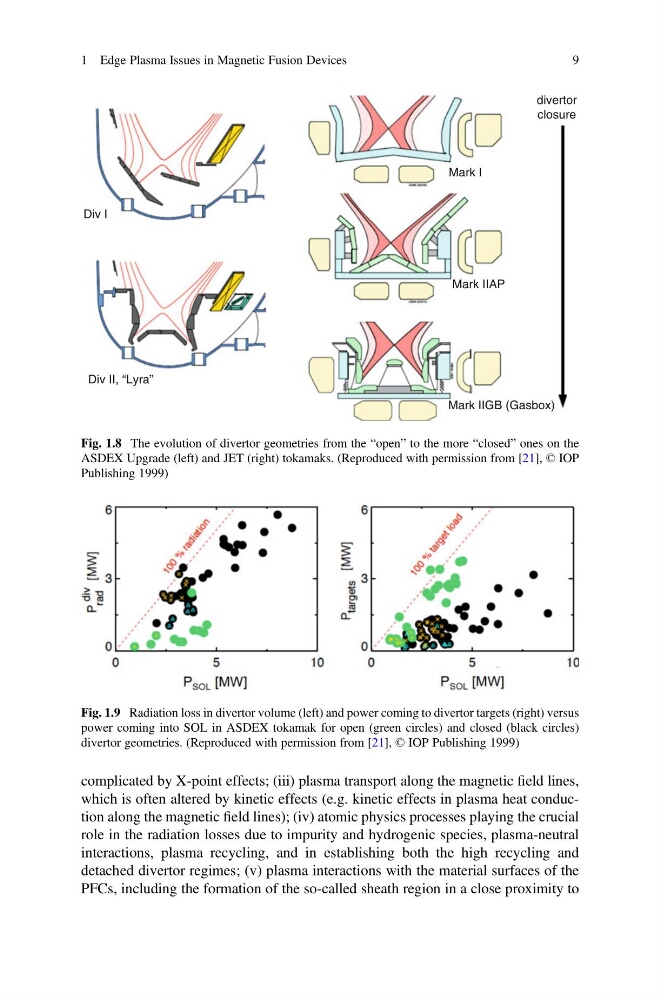
Fig. 1.8 The evolution of divertor geometries from the “open” to the more “closed” ones on the
ASDEX Upgrade (left) and JET (right) tokamaks. (Reproduced with permission from [21], © IOP
Publishing 1999)
Fig. 1.9 Radiation loss in divertor volume (left) and power coming to divertor targets (right) versus
power coming into SOL in ASDEX tokamak for open (green circles) and closed (black circles)
divertor geometries. (Reproduced with permission from [21], © IOP Publishing 1999)
1 Edge Plasma Issues in Magnetic Fusion Devices
9
which is often altered by kinetic effects (e.g. kinetic effects in plasma heat conduction along the magnetic field lines); (iv) atomic physics processes playing the crucial
role in the radiation losses due to impurity and hydrogenic species, plasma-neutral
interactions, plasma recycling, and in establishing both the high recycling and
detached divertor regimes; (v) plasma interactions with the material surfaces of the
PFCs, including the formation of the so-called sheath region in a close proximity to
Mark I
Mark IIAP
Mark IIGB (Gasbox)
Div I
Div II, “Lyra”
divertor
closure
Fig. 1.8 The evolution of divertor geometries from the “open” to the more “closed” ones on the
ASDEX Upgrade (left) and JET (right) tokamaks. (Reproduced with permission from [21], © IOP
Publishing 1999)
Fig. 1.9 Radiation loss in divertor volume (left) and power coming to divertor targets (right) versus
power coming into SOL in ASDEX tokamak for open (green circles) and closed (black circles)
divertor geometries. (Reproduced with permission from [21], © IOP Publishing 1999)
1 Edge Plasma Issues in Magnetic Fusion Devices
9