

divertor target. Recently established experimental scaling predicts that in H-mode in
between ELMs, λ q / I
À1
p / B
À1
pol , where I p is the tokamak plasma current and B pol is
the strength of the poloidal magnetic field [144].
In [145] this scaling was attributed to ion drifts in the tokamak magnetic field
(with no turbulent impact on the ion dynamics) so that λ q becomes of the order of the
poloidal gyroradius of ions. Recently, this scaling was reproduced for current
tokamaks by the fluid BOUT++ and gyrokinetic XGC1 plasma turbulence codes
(see Fig. 7.37).
Interestingly, both codes predict a large departure of λ q from the experimental
scaling for ITER (see Fig. 7.37). However, the physics of this is not clear yet and
further studies are needed to confirm these results. In [147] it was speculated that the
transition from drift- to turbulence-dominated processes that set λ q occurs in next
step tokamaks due to the larger size and stronger magnetic field.
7.4 Conclusions
In this chapter, we reviewed the basic theory of plasma waves responsible for
anomalous plasma transport, considered their main destabilizing mechanisms and
presented some experimental data confirming the theoretical and simulation results.
The situation with theoretical analysis and predictions of anomalous cross-field
transport is more complex and as of today, we only have a basic theoretical
understanding of the processes governing anomalous plasma transport, although
there is a large amount of experimental data and simulation results supporting these
ideas. Nonetheless, at present, practically all results of edge plasma transport simulation performed with 2D codes such as SOLPS or UEDGE, are based either on the
usage of the anomalous transport coefficients fitting the edge plasma parameter
profiles observed in experiments or on the scoping studies of an impact of the
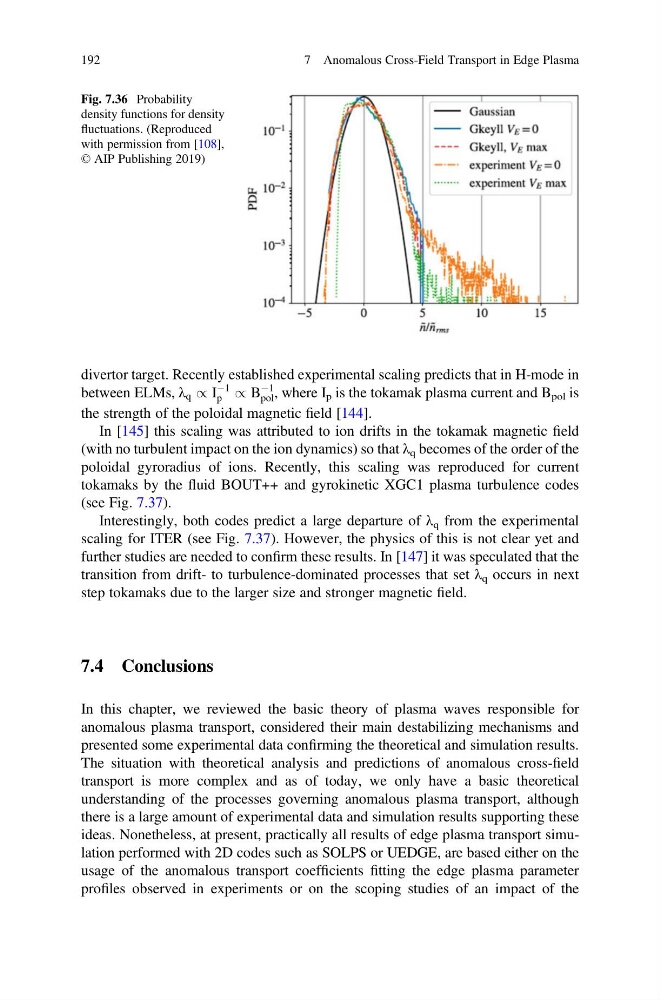
Fig. 7.36 Probability
density functions for density
fluctuations. (Reproduced
with permission from [108],
© AIP Publishing 2019)
192
7 Anomalous Cross-Field Transport in Edge Plasma
between ELMs, λ q / I
À1
p / B
À1
pol , where I p is the tokamak plasma current and B pol is
the strength of the poloidal magnetic field [144].
In [145] this scaling was attributed to ion drifts in the tokamak magnetic field
(with no turbulent impact on the ion dynamics) so that λ q becomes of the order of the
poloidal gyroradius of ions. Recently, this scaling was reproduced for current
tokamaks by the fluid BOUT++ and gyrokinetic XGC1 plasma turbulence codes
(see Fig. 7.37).
Interestingly, both codes predict a large departure of λ q from the experimental
scaling for ITER (see Fig. 7.37). However, the physics of this is not clear yet and
further studies are needed to confirm these results. In [147] it was speculated that the
transition from drift- to turbulence-dominated processes that set λ q occurs in next
step tokamaks due to the larger size and stronger magnetic field.
7.4 Conclusions
In this chapter, we reviewed the basic theory of plasma waves responsible for
anomalous plasma transport, considered their main destabilizing mechanisms and
presented some experimental data confirming the theoretical and simulation results.
The situation with theoretical analysis and predictions of anomalous cross-field
transport is more complex and as of today, we only have a basic theoretical
understanding of the processes governing anomalous plasma transport, although
there is a large amount of experimental data and simulation results supporting these
ideas. Nonetheless, at present, practically all results of edge plasma transport simulation performed with 2D codes such as SOLPS or UEDGE, are based either on the
usage of the anomalous transport coefficients fitting the edge plasma parameter
profiles observed in experiments or on the scoping studies of an impact of the
Fig. 7.36 Probability
density functions for density
fluctuations. (Reproduced
with permission from [108],
© AIP Publishing 2019)
192
7 Anomalous Cross-Field Transport in Edge Plasma