

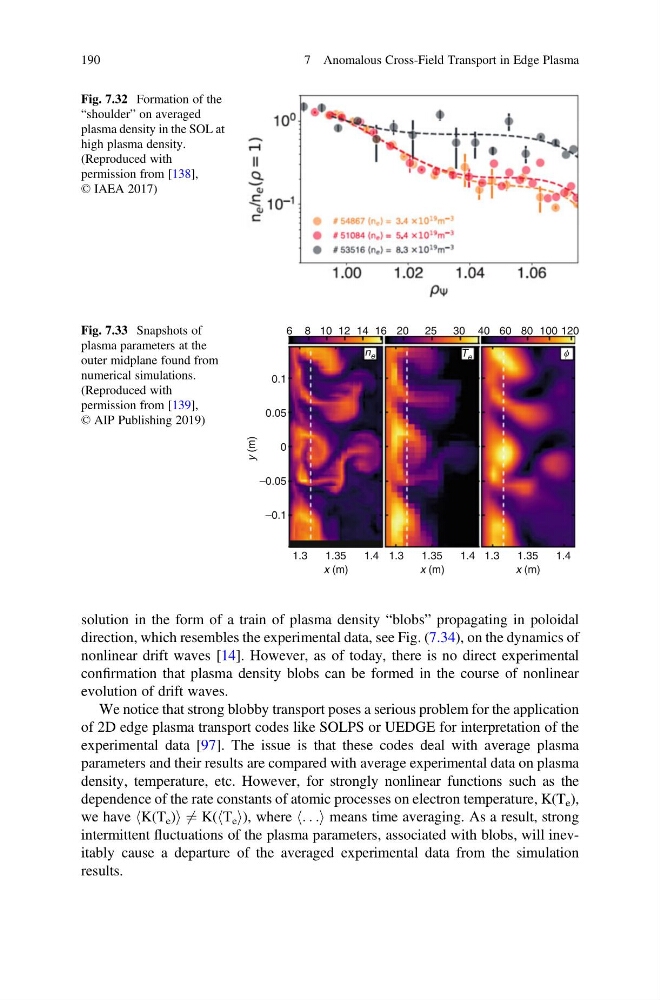
solution in the form of a train of plasma density “blobs” propagating in poloidal
direction, which resembles the experimental data, see Fig. (7.34), on the dynamics of
nonlinear drift waves [14]. However, as of today, there is no direct experimental
confirmation that plasma density blobs can be formed in the course of nonlinear
evolution of drift waves.
We notice that strong blobby transport poses a serious problem for the application
of 2D edge plasma transport codes like SOLPS or UEDGE for interpretation of the
experimental data [97]. The issue is that these codes deal with average plasma
parameters and their results are compared with average experimental data on plasma
density, temperature, etc. However, for strongly nonlinear functions such as the
dependence of the rate constants of atomic processes on electron temperature, K(T e ),
we have hK(T e )i 6 ¼ K(hT e i), where h. . .i means time averaging. As a result, strong
intermittent fluctuations of the plasma parameters, associated with blobs, will inevitably cause a departure of the averaged experimental data from the simulation
results.
Fig. 7.32 Formation of the
“shoulder” on averaged
plasma density in the SOL at
high plasma density.
(Reproduced with
permission from [138],
© IAEA 2017)
1.3
6 8 10 12 14 16 20
n e
T e
f
25
30 40 60 80 100 120
1.35
x (m)
1.4 1.3
1.35
x (m)
y (m)
1.4 1.3
1.35
x (m)
1.4
–0.1
–0.05
0
0.05
0.1
Fig. 7.33 Snapshots of
plasma parameters at the
outer midplane found from
numerical simulations.
(Reproduced with
permission from [139],
© AIP Publishing 2019)
190
7 Anomalous Cross-Field Transport in Edge Plasma
direction, which resembles the experimental data, see Fig. (7.34), on the dynamics of
nonlinear drift waves [14]. However, as of today, there is no direct experimental
confirmation that plasma density blobs can be formed in the course of nonlinear
evolution of drift waves.
We notice that strong blobby transport poses a serious problem for the application
of 2D edge plasma transport codes like SOLPS or UEDGE for interpretation of the
experimental data [97]. The issue is that these codes deal with average plasma
parameters and their results are compared with average experimental data on plasma
density, temperature, etc. However, for strongly nonlinear functions such as the
dependence of the rate constants of atomic processes on electron temperature, K(T e ),
we have hK(T e )i 6 ¼ K(hT e i), where h. . .i means time averaging. As a result, strong
intermittent fluctuations of the plasma parameters, associated with blobs, will inevitably cause a departure of the averaged experimental data from the simulation
results.
Fig. 7.32 Formation of the
“shoulder” on averaged
plasma density in the SOL at
high plasma density.
(Reproduced with
permission from [138],
© IAEA 2017)
1.3
6 8 10 12 14 16 20
n e
T e
f
25
30 40 60 80 100 120
1.35
x (m)
1.4 1.3
1.35
x (m)
y (m)
1.4 1.3
1.35
x (m)
1.4
–0.1
–0.05
0
0.05
0.1
Fig. 7.33 Snapshots of
plasma parameters at the
outer midplane found from
numerical simulations.
(Reproduced with
permission from [139],
© AIP Publishing 2019)
190
7 Anomalous Cross-Field Transport in Edge Plasma