

which, in particular, shows that for the case of k
2
1 ρ
2
s ( 1, the drift wave is always
unstable and generates a zonal flow. Analysis of the dynamics of uncorrelated drift
wave packets performed in [92] also demonstrates the possibility of the generation of
zonal flows. In [118] it was shown that in addition to the exact integrals of the CHM
equation (the energy and the enstrophy) there is also a third “approximate”
integral, I, which, however, becomes exact for the case of the resonant triad
interactions (see also [119] and the references therein). This integral can only be
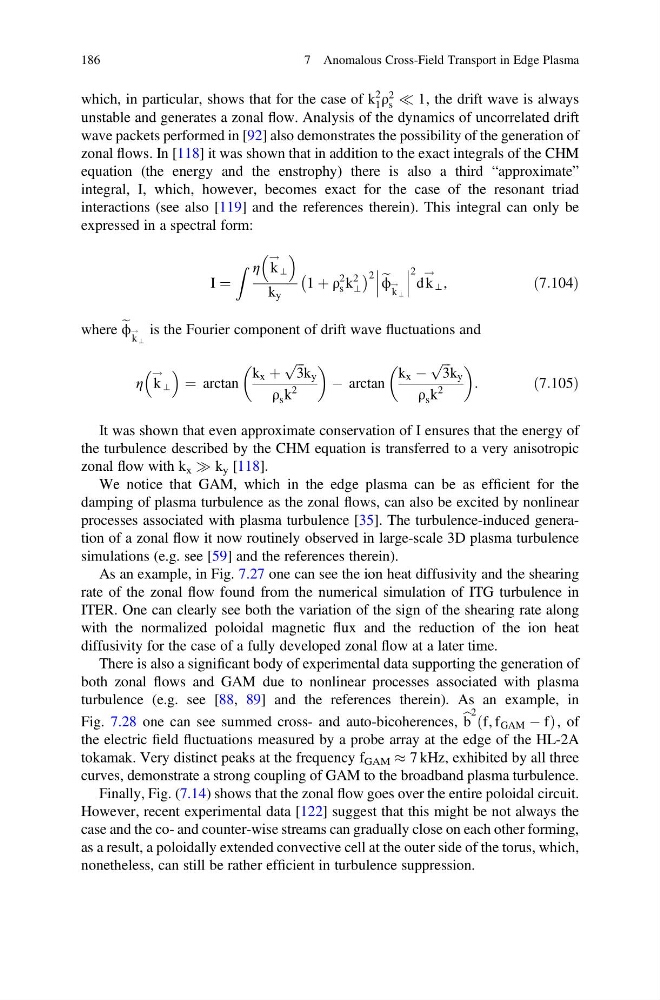
expressed in a spectral form:
I ¼
Z η k
!
⊥
k y
1 þ ρ
2
s k
2
⊥
À
Á 2 e
ϕ
k
!
⊥
2
dk
!
⊥ ,
ð7:104Þ
where e
ϕ
k
!
⊥
is the Fourier component of drift wave fluctuations and
η k
!
⊥
¼ arctan
k x þ
ffiffi ffi
3
p
k y
ρ s k
2
À arctan
k x À
ffiffi ffi
3
p
k y
ρ s k
2
:
ð7:105Þ
It was shown that even approximate conservation of I ensures that the energy of
the turbulence described by the CHM equation is transferred to a very anisotropic
zonal flow with k x ) k y [118].
We notice that GAM, which in the edge plasma can be as efficient for the
damping of plasma turbulence as the zonal flows, can also be excited by nonlinear
processes associated with plasma turbulence [35]. The turbulence-induced generation of a zonal flow it now routinely observed in large-scale 3D plasma turbulence
simulations (e.g. see [59] and the references therein).
As an example, in Fig. 7.27 one can see the ion heat diffusivity and the shearing
rate of the zonal flow found from the numerical simulation of ITG turbulence in
ITER. One can clearly see both the variation of the sign of the shearing rate along
with the normalized poloidal magnetic flux and the reduction of the ion heat
diffusivity for the case of a fully developed zonal flow at a later time.
There is also a significant body of experimental data supporting the generation of
both zonal flows and GAM due to nonlinear processes associated with plasma
turbulence (e.g. see [88, 89] and the references therein). As an example, in
Fig. 7.28 one can see summed cross- and auto-bicoherences, b b
2
f, f GAM À f
ð
Þ , of
the electric field fluctuations measured by a probe array at the edge of the HL-2A
tokamak. Very distinct peaks at the frequency f GAM % 7 kHz, exhibited by all three
curves, demonstrate a strong coupling of GAM to the broadband plasma turbulence.
Finally, Fig. (7.14) shows that the zonal flow goes over the entire poloidal circuit.
However, recent experimental data [122] suggest that this might be not always the
case and the co- and counter-wise streams can gradually close on each other forming,
as a result, a poloidally extended convective cell at the outer side of the torus, which,
nonetheless, can still be rather efficient in turbulence suppression.
186
7 Anomalous Cross-Field Transport in Edge Plasma
2
1 ρ
2
s ( 1, the drift wave is always
unstable and generates a zonal flow. Analysis of the dynamics of uncorrelated drift
wave packets performed in [92] also demonstrates the possibility of the generation of
zonal flows. In [118] it was shown that in addition to the exact integrals of the CHM
equation (the energy and the enstrophy) there is also a third “approximate”
integral, I, which, however, becomes exact for the case of the resonant triad
interactions (see also [119] and the references therein). This integral can only be
expressed in a spectral form:
I ¼
Z η k
!
⊥
k y
1 þ ρ
2
s k
2
⊥
À
Á 2 e
ϕ
k
!
⊥
2
dk
!
⊥ ,
ð7:104Þ
where e
ϕ
k
!
⊥
is the Fourier component of drift wave fluctuations and
η k
!
⊥
¼ arctan
k x þ
ffiffi ffi
3
p
k y
ρ s k
2
À arctan
k x À
ffiffi ffi
3
p
k y
ρ s k
2
:
ð7:105Þ
It was shown that even approximate conservation of I ensures that the energy of
the turbulence described by the CHM equation is transferred to a very anisotropic
zonal flow with k x ) k y [118].
We notice that GAM, which in the edge plasma can be as efficient for the
damping of plasma turbulence as the zonal flows, can also be excited by nonlinear
processes associated with plasma turbulence [35]. The turbulence-induced generation of a zonal flow it now routinely observed in large-scale 3D plasma turbulence
simulations (e.g. see [59] and the references therein).
As an example, in Fig. 7.27 one can see the ion heat diffusivity and the shearing
rate of the zonal flow found from the numerical simulation of ITG turbulence in
ITER. One can clearly see both the variation of the sign of the shearing rate along
with the normalized poloidal magnetic flux and the reduction of the ion heat
diffusivity for the case of a fully developed zonal flow at a later time.
There is also a significant body of experimental data supporting the generation of
both zonal flows and GAM due to nonlinear processes associated with plasma
turbulence (e.g. see [88, 89] and the references therein). As an example, in
Fig. 7.28 one can see summed cross- and auto-bicoherences, b b
2
f, f GAM À f
ð
Þ , of
the electric field fluctuations measured by a probe array at the edge of the HL-2A
tokamak. Very distinct peaks at the frequency f GAM % 7 kHz, exhibited by all three
curves, demonstrate a strong coupling of GAM to the broadband plasma turbulence.
Finally, Fig. (7.14) shows that the zonal flow goes over the entire poloidal circuit.
However, recent experimental data [122] suggest that this might be not always the
case and the co- and counter-wise streams can gradually close on each other forming,
as a result, a poloidally extended convective cell at the outer side of the torus, which,
nonetheless, can still be rather efficient in turbulence suppression.
186
7 Anomalous Cross-Field Transport in Edge Plasma