

cascaded to large spatial scales (small j k
!
⊥ j) whereas the enstrophy to the small ones
(large j k
!
⊥ j). Thus, we see that the generation of large-scale structures from smallscale fluctuations is inherent for 2D turbulence. However, these conservation laws
tell us nothing about the generation of the zonal flows, which can suppress the
plasma instabilities. Generally speaking, these large-scale structures can be largescale convective cells facilitating anomalous cross-field plasma transport [115]. For
this reason, the topic of zonal flow generation from drift wave turbulence have
received so much attention from both theory (e.g. see [59, 92, 116, 117] and the
references therein) and experiment (e.g. see reviews [88, 89]).
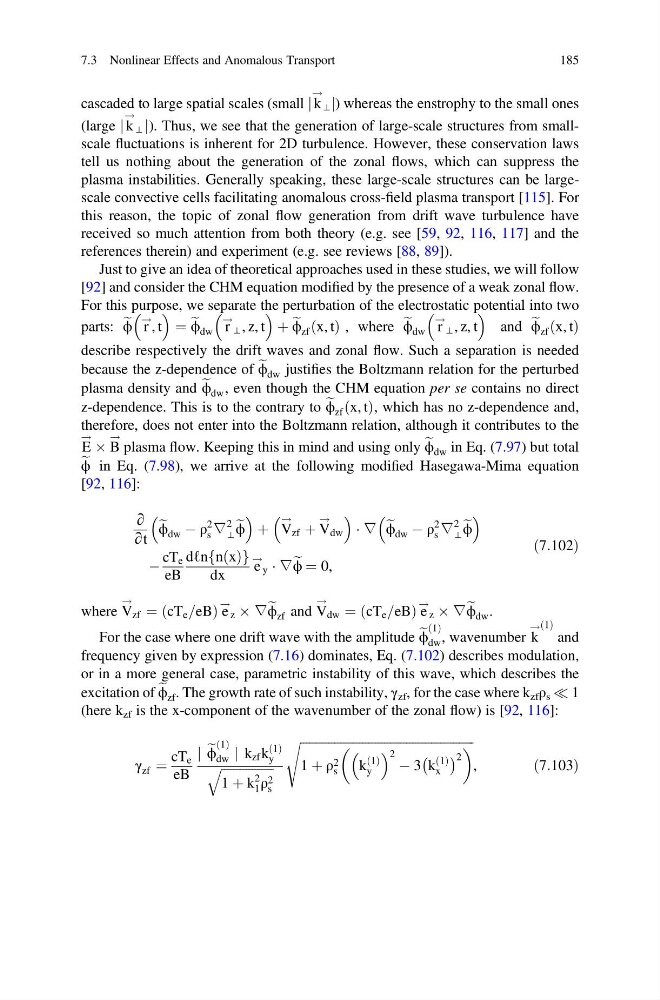
Just to give an idea of theoretical approaches used in these studies, we will follow
[92] and consider the CHM equation modified by the presence of a weak zonal flow.
For this purpose, we separate the perturbation of the electrostatic potential into two
parts: e
ϕ r
!
, t
¼ e
ϕ dw r
!
⊥ , z, t
þ e
ϕ zf x, t
ð Þ , where e
ϕ dw r
!
⊥ , z, t
and e
ϕ zf x, t
ð Þ
describe respectively the drift waves and zonal flow. Such a separation is needed
because the z-dependence of e
ϕ dw justifies the Boltzmann relation for the perturbed
plasma density and e
ϕ dw , even though the CHM equation per se contains no direct
z-dependence. This is to the contrary to e
ϕ zf x, t
ð Þ, which has no z-dependence and,
therefore, does not enter into the Boltzmann relation, although it contributes to the
E
! Â B
!
plasma flow. Keeping this in mind and using only e
ϕ dw in Eq. (7.97) but total
e
ϕ in Eq. (7.98), we arrive at the following modified Hasegawa-Mima equation
[92, 116]:
∂
∂t
e
ϕ dw À ρ
2
s ∇
2
⊥
e
ϕ
þ V
!
zf þ V
!
dw
Á ∇ e
ϕ dw À ρ
2
s ∇
2
⊥
e
ϕ
À
cT e
eB
dℓn n x
ð Þ
f
g
dx
e
!
y Á ∇ e
ϕ ¼ 0,
ð7:102Þ
where V
!
zf ¼ cT e =eB
ð
Þe
!
z  ∇ e
ϕ zf and V
!
dw ¼ cT e =eB
ð
Þe
!
z  ∇ e
ϕ dw .
For the case where one drift wave with the amplitude e
ϕ
1
ð Þ
dw , wavenumber k
! 1
ð Þ
and
frequency given by expression (7.16) dominates, Eq. (7.102) describes modulation,
or in a more general case, parametric instability of this wave, which describes the
excitation of e
ϕ zf . The growth rate of such instability, γ zf , for the case where k zf ρ s ( 1
(here k zf is the x-component of the wavenumber of the zonal flow) is [92, 116]:
γ zf ¼
cT e
eB
j e
ϕ
1
ð Þ
dw j k zf k
1
ð Þ
y
ffiffiffiffiffiffiffiffiffiffiffiffiffiffiffiffiffi
1 þ k
2
1 ρ 2
s
q
ffiffiffiffiffiffiffiffiffiffiffiffiffiffiffiffiffiffiffiffiffiffiffiffiffiffiffiffiffiffiffiffiffiffiffiffiffiffiffiffiffiffiffiffiffiffiffiffiffiffiffiffiffiffiffi ffi
1 þ ρ 2
s
k
1
ð Þ
y
2 À 3 k
1
ð Þ
x
À Á 2
s
,
ð7:103Þ
7.3 Nonlinear Effects and Anomalous Transport
185
!
⊥ j) whereas the enstrophy to the small ones
(large j k
!
⊥ j). Thus, we see that the generation of large-scale structures from smallscale fluctuations is inherent for 2D turbulence. However, these conservation laws
tell us nothing about the generation of the zonal flows, which can suppress the
plasma instabilities. Generally speaking, these large-scale structures can be largescale convective cells facilitating anomalous cross-field plasma transport [115]. For
this reason, the topic of zonal flow generation from drift wave turbulence have
received so much attention from both theory (e.g. see [59, 92, 116, 117] and the
references therein) and experiment (e.g. see reviews [88, 89]).
Just to give an idea of theoretical approaches used in these studies, we will follow
[92] and consider the CHM equation modified by the presence of a weak zonal flow.
For this purpose, we separate the perturbation of the electrostatic potential into two
parts: e
ϕ r
!
, t
¼ e
ϕ dw r
!
⊥ , z, t
þ e
ϕ zf x, t
ð Þ , where e
ϕ dw r
!
⊥ , z, t
and e
ϕ zf x, t
ð Þ
describe respectively the drift waves and zonal flow. Such a separation is needed
because the z-dependence of e
ϕ dw justifies the Boltzmann relation for the perturbed
plasma density and e
ϕ dw , even though the CHM equation per se contains no direct
z-dependence. This is to the contrary to e
ϕ zf x, t
ð Þ, which has no z-dependence and,
therefore, does not enter into the Boltzmann relation, although it contributes to the
E
! Â B
!
plasma flow. Keeping this in mind and using only e
ϕ dw in Eq. (7.97) but total
e
ϕ in Eq. (7.98), we arrive at the following modified Hasegawa-Mima equation
[92, 116]:
∂
∂t
e
ϕ dw À ρ
2
s ∇
2
⊥
e
ϕ
þ V
!
zf þ V
!
dw
Á ∇ e
ϕ dw À ρ
2
s ∇
2
⊥
e
ϕ
À
cT e
eB
dℓn n x
ð Þ
f
g
dx
e
!
y Á ∇ e
ϕ ¼ 0,
ð7:102Þ
where V
!
zf ¼ cT e =eB
ð
Þe
!
z  ∇ e
ϕ zf and V
!
dw ¼ cT e =eB
ð
Þe
!
z  ∇ e
ϕ dw .
For the case where one drift wave with the amplitude e
ϕ
1
ð Þ
dw , wavenumber k
! 1
ð Þ
and
frequency given by expression (7.16) dominates, Eq. (7.102) describes modulation,
or in a more general case, parametric instability of this wave, which describes the
excitation of e
ϕ zf . The growth rate of such instability, γ zf , for the case where k zf ρ s ( 1
(here k zf is the x-component of the wavenumber of the zonal flow) is [92, 116]:
γ zf ¼
cT e
eB
j e
ϕ
1
ð Þ
dw j k zf k
1
ð Þ
y
ffiffiffiffiffiffiffiffiffiffiffiffiffiffiffiffiffi
1 þ k
2
1 ρ 2
s
q
ffiffiffiffiffiffiffiffiffiffiffiffiffiffiffiffiffiffiffiffiffiffiffiffiffiffiffiffiffiffiffiffiffiffiffiffiffiffiffiffiffiffiffiffiffiffiffiffiffiffiffiffiffiffiffi ffi
1 þ ρ 2
s
k
1
ð Þ
y
2 À 3 k
1
ð Þ
x
À Á 2
s
,
ð7:103Þ
7.3 Nonlinear Effects and Anomalous Transport
185