

reason for this is that in addition to the energy, in 2D fluids, there is an extra
invariant, enstrophy (e.g. see [111–113]), which prevents the energy cascade to
and the energy dissipation at small scales, which happens in the Kolmogorov 3D
turbulence model.
As an illustration, we consider the so-called Charney-Hasegawa-Mima (CHM)
model [113, 114], which is the simplest nonlinear model describing both the
atmospheric Rossby and the magnetized plasma drift wave dynamics. We consider
plasma embedded into a straight constant magnetic field (in the z-direction) and
having constant electron temperature and cold ions. We will assume that the
perturbation of the electron density, e n e , obey the Boltzmann relation which we
will approximate as follows
e n e ¼ n x
ð Þ exp e
ϕ
À 1
n
o
% n x
ð Þ e
ϕ,
ð7:97Þ
where n(x) is the unperturbed plasma density depending on the “radial” coordinate
x. The ion velocity can be found from Eqs. (7.8) and (7.9). Keeping nonlinear terms,
we find
V
!
i ¼ V
!
E
! ÂB
! À
∂
∂t
þ V
!
E
! ÂB
! Á ∇
cT e ∇ ⊥ e
ϕ
BΩ Bi
,
ð7:98Þ
where V
!
E
! ÂB
! ¼ cT e =eB
ð
Þe
!
z  ∇ e
ϕ. Substituting the expression (7.98) into ion the
continuity equation and assuming quasi-neutrality, we arrive at the CHM equation
∂
∂t
þ V
!
E
! ÂB
! Á ∇
e
ϕ À ρ
2
s ∇
2
⊥
e
ϕ
À
cT e
eB
dℓn n x
ð Þ
f
g
dx
e
!
y Á ∇ e
ϕ ¼ 0,
ð7:99Þ
which in the linear case gives the drift wave frequency (7.16).
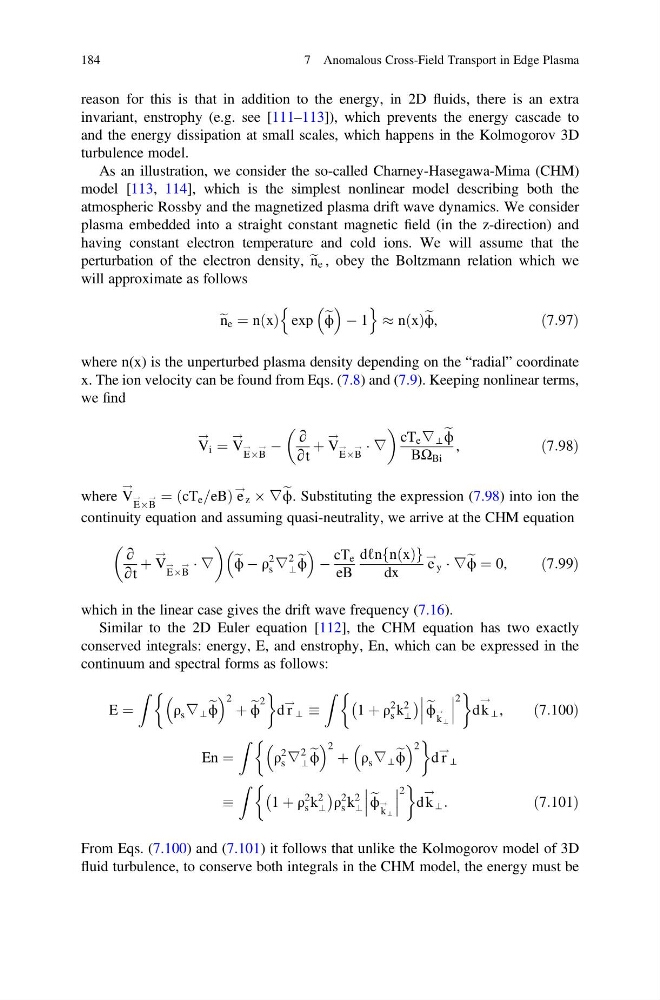
Similar to the 2D Euler equation [112], the CHM equation has two exactly
conserved integrals: energy, E, and enstrophy, En, which can be expressed in the
continuum and spectral forms as follows:
E ¼
Z
ρ s ∇ ⊥ e
ϕ
2 þ e
ϕ
2
&
'
d r
!
⊥
Z
1 þ ρ
2
s k
2
⊥
À
Á e
ϕ
k
!
⊥
2
&
'
dk
!
⊥ ,
ð7:100Þ
En ¼
Z
ρ
2
s ∇
2
⊥
e
ϕ
2 þ ρ s ∇ ⊥ e
ϕ
2
&
'
d r
!
⊥
Z
1 þ ρ
2
s k
2
⊥
À
Á ρ
2
s k
2
⊥
e
ϕ
k
!
⊥
2
&
'
dk
!
⊥ :
ð7:101Þ
From Eqs. (7.100) and (7.101) it follows that unlike the Kolmogorov model of 3D
fluid turbulence, to conserve both integrals in the CHM model, the energy must be
184
7 Anomalous Cross-Field Transport in Edge Plasma
invariant, enstrophy (e.g. see [111–113]), which prevents the energy cascade to
and the energy dissipation at small scales, which happens in the Kolmogorov 3D
turbulence model.
As an illustration, we consider the so-called Charney-Hasegawa-Mima (CHM)
model [113, 114], which is the simplest nonlinear model describing both the
atmospheric Rossby and the magnetized plasma drift wave dynamics. We consider
plasma embedded into a straight constant magnetic field (in the z-direction) and
having constant electron temperature and cold ions. We will assume that the
perturbation of the electron density, e n e , obey the Boltzmann relation which we
will approximate as follows
e n e ¼ n x
ð Þ exp e
ϕ
À 1
n
o
% n x
ð Þ e
ϕ,
ð7:97Þ
where n(x) is the unperturbed plasma density depending on the “radial” coordinate
x. The ion velocity can be found from Eqs. (7.8) and (7.9). Keeping nonlinear terms,
we find
V
!
i ¼ V
!
E
! ÂB
! À
∂
∂t
þ V
!
E
! ÂB
! Á ∇
cT e ∇ ⊥ e
ϕ
BΩ Bi
,
ð7:98Þ
where V
!
E
! ÂB
! ¼ cT e =eB
ð
Þe
!
z  ∇ e
ϕ. Substituting the expression (7.98) into ion the
continuity equation and assuming quasi-neutrality, we arrive at the CHM equation
∂
∂t
þ V
!
E
! ÂB
! Á ∇
e
ϕ À ρ
2
s ∇
2
⊥
e
ϕ
À
cT e
eB
dℓn n x
ð Þ
f
g
dx
e
!
y Á ∇ e
ϕ ¼ 0,
ð7:99Þ
which in the linear case gives the drift wave frequency (7.16).
Similar to the 2D Euler equation [112], the CHM equation has two exactly
conserved integrals: energy, E, and enstrophy, En, which can be expressed in the
continuum and spectral forms as follows:
E ¼
Z
ρ s ∇ ⊥ e
ϕ
2 þ e
ϕ
2
&
'
d r
!
⊥
Z
1 þ ρ
2
s k
2
⊥
À
Á e
ϕ
k
!
⊥
2
&
'
dk
!
⊥ ,
ð7:100Þ
En ¼
Z
ρ
2
s ∇
2
⊥
e
ϕ
2 þ ρ s ∇ ⊥ e
ϕ
2
&
'
d r
!
⊥
Z
1 þ ρ
2
s k
2
⊥
À
Á ρ
2
s k
2
⊥
e
ϕ
k
!
⊥
2
&
'
dk
!
⊥ :
ð7:101Þ
From Eqs. (7.100) and (7.101) it follows that unlike the Kolmogorov model of 3D
fluid turbulence, to conserve both integrals in the CHM model, the energy must be
184
7 Anomalous Cross-Field Transport in Edge Plasma